
for about 37 years now that’s me when
about three decades ago I was lucky that
I was born in a family that both stories
master storytellers my father was a
documentary filmmaker my mother was one
of the first women news producers in the
country with the Russian Consul in Pondy
so this meant that as a young child I
got to travel and see the country and I
fell in love with India the amazing
diversity that we had every single place
every few kilometers you go it changed
but that is another story the day my
life changed 11th March 2010 my wife
Ambika and I were blessed with our
daughter
Gayatri as I held her in my hands I felt
an emotion I’d never felt before
tears of joy well I had this perfect
human being in my arms and the world
around her was not so perfect and I knew
then that I had to do whatever I could
to make it slightly better but what
could I do all I do is tell stories so I
decided then then let me spend half my
time telling stories that are meaningful
stories that add value give people a
voice that don’t have a voice people
that inspire stories that inspire people
and but these don’t get funded so how do
you take care of that so what I did was
I spent half my time doing commercially
successful projects with television
documentary films or corporate films and
I cross subsidized all the money I got
from that the profit back into
meaningful content and stories as a
child I love TV and stories and
television were very interesting for me
but as a child growing up we only had
one format in the late seventies and
early eighties those are black and white
and the problem with this was that
we got to see what the state wanted us
to see entertainment those few hours a
day but that was soon to change and soon
in the 90s we got cable and satellite
television it blew up every few years
every few months you will have newer and
newer channels you had programming from
across the world stories coming to our
shores
from the west from America and one of
those was Baywatch and as a young
teenager growing up in that time it was
aspirational for me
hey this spoke of a lifestyle are waking
up to a hangover of disposable morality
of living every day as it came not
worried about the consequences of my
actions but this wasn’t me and this
wasn’t who we are and in fact it wasn’t
what the Western American freely society
was either I think Americans are some of
the most hard-working god-fearing family
centered people just like any of us that
wasn’t the case and it was interesting
while me and my generation we were
waking up through hangovers friends in
the West were waking up to yoga
meditation switching back to
vegetarianism veganism the agricultural
practices was going back to organic it’s
ironic that a few decades ago we will
solve a story in there how are we going
to feed this growing population of
hundreds of millions of people
now billion plus the only way was
through petrochemical based fertilizers
pesticides and genetically modified
seeds but when you go down that path and
five six decades later what happens
there’s a crisis in agriculture today
farm suicides are not unheard of across
the country but are these stories that
can give answer to these guys so we
actually found something in Andhra
Pradesh where a million farmers worked
and went back to traditional farming
Narayan and his wife narsimha on a
hundred square meters of land plant
seven varieties of crop traditional
Indian fun fact
not monoculture one crop and they’re
able to pull out enough money from this
to sustain their own livelihoods they’re
able to pull out in the vegetable sweet
and sell about four thousand rupees a
month in the market now contextually you
could rent a house in their village for
two hundred rupees so four thousand
rupees goes a long way
if stories like that are able to give
answers to farmers across the country
the crisis of Agriculture of cutting
down 50% of the costs that is linked
with these chemical based pesticides and
fertilizers to healthier alternatives in
traditional farming practices if they
reach out the farmers across the country
what the crisis continue would follow
suicides continue so stories can give
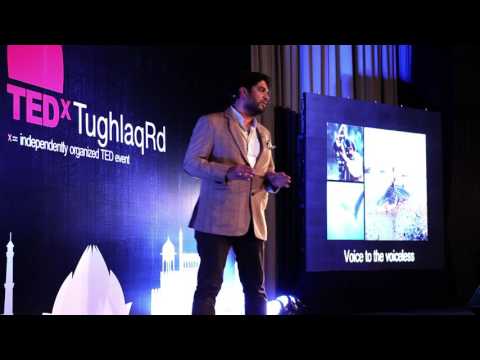
answers stories also gives voice to the
voiceless I was fortunate to understudy
with my uncle Mike and work with my
cousin got them both master storytellers
now Mike’s project and film on the
shores of Silence documented the
slaughter of 1,200 whale sharks every
year on the cost of good job now it’s an
interesting turning point this was the
first film that was actually able to
bring about a law protecting a species
not only named there globally the whale
shark is protected because of this one
film or story under sight is but more
interestingly as Mike made this film he
reached out to the fishermen the
community is that we’re going out and
killing these whale sharks so while one
year 1,200 where shots were killed the
very next year zero were killed so a
story made a deep impact so stories also
give a voice to the voiceless of whale
sharks in this case stories also inspire
so this is Lakshman Rao he’s a chai
wallah in ideal but he had a dream of
being an author so he wrote a book and
he went to a publisher and area range
and the guys is like something amazing
chai wallah what do you know what you
contribute to literature and he had a
book inside and thankfully for all of us
he didn’t sell short so he went ahead
and published his book Amazon publishing
today Lakshman Rao has 24 books 13 have
been published six have been reprinted
hell he sells on Amazon as I was leaving
I asked him I said mr. Dow why do you
Sylvie you are an author so it’s larger
in India storytellers and authors don’t
get paid enough now the problem is this
good stories that bad stories there’s
lots of stories and over a short span of
just bit more than two decades India now
has 857 television channels 460 of these
are news channels and sadly negative
news self so we’ve been bombarded
constantly again anything with a
negative news negative stories that fill
the mindset what happens when we do that
we’ve all start coming up with a one-man
society starts getting divided are we
switching off from content but not all
of that is bad
we just heard mr. Gupta talk about how
you know society joined in with that
story of never stood with her the same
happen with Jessica Lange this was a
turning point
NDTV as a leading channel took this up
my brother works there and you know some
of the content they’ve done the stories
they have done have got illegal mining
stopped or have fought against human
trafficking but in this case it gave
voice to someone who could not have a
voice anymore
someone who’s gone her life taken away
but she got justice because a story
worked I think India where they’re born
and I feel really fortunate to be born
here
I think we have so much going on India
for me is a living tapestry of colors of
different faiths coming together living
in harmony every few kilometers you go
languages change dialects change food
amazing foods and colors traditions arts
culture we have it all and I think this
needs to be preserved otherwise
we all lose out so coming back the
future of technology
my daughter geyser is now seven and my
son in village is 20 months old
interestingly they learned how to swipe
devices before they could walk and they
choose the content they want to watch
they’re not interested in watching
television because they can choose what
they want when they want and where they
want they don’t want to listen to what
large media groups want to tell them
what the government wants to tell them
or what industrial hobbies and interests
tell them they are the youtubers and
it’s interesting with YouTube there’s
300 hours of content that goes onto
YouTube every minute of every day it’s
massive so what’s happened is you’ve got
a brilliant platform Digital has
provided us with a democracy freedom of
speech and expression and as long as we
can preserve that those that don’t have
a voice will have a voice for billion
videos are viewed every day on YouTube
and this is just the beginning my
challenge to you all is this I spent
half my time telling meaningful stories
you all have these devices the cliched
cell phone is actually better in terms
of quality than cameras and professional
equipment were a few years ago which
costs hundreds of thousands of dollars
but that’s gone so you have the ability
to tell stories why not mean your voice
for the voiceless like it’s brilliant
inspirational story that preserve
culture and traditions and inspire
others I think we have a lot going on in
India stories at every corner
stories of communities coming together
in times of crisis an adversity
different fates living in harmony
it’s not about divisive stuff but we get
that in television and main media so I
think that’s the challenge I leave you
all with until the next story thank you [Applause]