
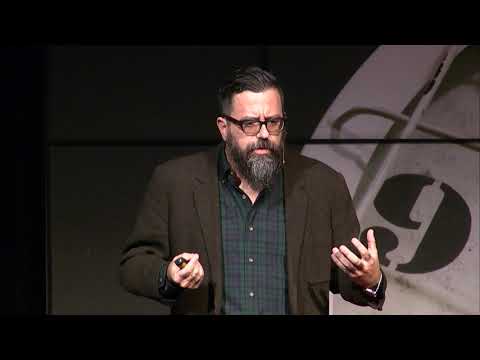
so I’m standing here before you today to
make the case that one of the most
fundamental characteristics that defines
us as human beings is our impulse to
tell stories to one another
and this is something we know even as
small children we know it intuitively
it’s encoded in our shared cultural DNA
and we know these beats even today we
delight in the grammar and the syntax
and the musicality of a well-told tale
once upon a time happily ever after
too hot too cold just right I’ll huff
I’ll puff I’ll blow your house down I
think I can I think I can I think I can
I could go on I’m not going to but
hopefully you get the point even when
we’re very young we eagerly anticipate
these elements showing up in the stories
that are told to us and we even go on to
insert them into our own stories later
on when we go to tell them it’s because
of this shared cultural DNA of stories
that it makes them engaging creative and
efficient ways of conveying complex
information to one another whether
that’s bare bones facts or or whether
that’s social customs or moral codes or
information about our historical roots
who we are where we came from story is
how we mark time is how we imbue time
with significance and meaning because
otherwise we’re just all alone on this
little blue marble hurtling through
space making our way towards the
eventual heat death of the universe and
that is way too depressing a thought to
think about I don’t even know why I
brought it up why did I bring it up so
we tell stories to pass the time and
when we tell tales about how our
grandfather once was swimming off the
coast of Tybee Island and this bull
shark was approaching and he punch them
in the nose and it swam away or how a
couple weeks ago during Sunday service
our toddler dropped an f-bomb right in
the middle of it in front of God and
everybody
stories are doing important work
maintaining social cohesion by
entertaining and by educating and by
inspiring and so it’s this interest in
storytelling that drew me to the project
I’m here to talk about with you today
it’s called the digital archive of
literacy narratives or if you’re in the
house we call it the da Ln and if you’re
familiar with initiatives like
StoryCorps or NPR’s this I believe or
Ira Glass is Chicago project or any of a
number of other national oral history
collection projects then you probably
have a good general idea of what the DLN
is but more specifically it’s an online
publicly accessible collection of at
this moment around 7,500 individual
submissions all of them are stories
stories about how people learn to read
or write or otherwise figure out the
complex codes and rules that structure
our lives as students as musicians as
gamers as specialized laborers as people
of color or particular sexual identities
each one of those stories represents a
person who is sharing potentially with
the entire world an important moment
about their learning experiences so a
little background a bit about the DLN
it’s around ten years old and it started
even a little before that when we had
conversations and development and
planning primarily on the OSU campus and
the English department and this was led
by professors Cynthia selfe and Louie
Ullman and once we started talking and
we’re serious about getting this project
started we reached out to our colleagues
at other institutions across the nation
including Georgia State University of
Illinois Purdue and Michigan I assure
you that the people these institutions
are fine upstanding people and from that
we started off with a very specific and
and I think a modest goal we want to
just collect stories from the people
the general public and and and figure
out what their attitudes and beliefs
were concerning literacy and then go on
and use that to refine our teaching and
and whatnot but it’s grown considerably
since then the da L n is what I like to
call a beautiful wonderful mess of
stories and those stories come in all
sorts of shapes and sizes they come in
different formats one on one interviews
or people that just sit down in front of
webcam and just extemporaneously go or
things that are more rehearsed and
polished we take a variety of file
format so they’re they’re written
narratives in a variety of text formats
they’re document scans video files audio
files they take the form of different
genres storytellers position themselves
as heroes overcoming seemingly
insurmountable odds or their victims
whose attitudes have been shaped by the
traumas they’ve experienced or they’re
rebels who just flout the rules and do
whatever the heck they want it has
global reach people who have submitted
to the site come from six of seven
continents we’re still trying to get one
from Antarctica and I’m not joking
that’s that’s I’ve got somebody on that
she knows a guy who knows a guy who I
guess lives in Antarctica each of these
each of these submissions is accompanied
by a bunch of metadata information like
relevant keywords or the time and during
which these stories occurred or relevant
state or geographical region or a
country or any additional languages and
that metadata is really valuable for us
when we kind of do some data analytics
these stories represent a cross-section
of the population young and old blue
collar professional regular people just
like us and then people that breed that
rarefied air like like Olympic athletes
and novelist and even one former
president but like I said the DLN is a
so when we started this we knew how
people would use it and primarily it
gets used in the classroom teachers in
high school and college level classes
mostly they use it by having their
students model the contents they find on
the dalm so they’re probably directed to
go look for narratives about particular
topics and then study them and then
create their own narratives and consider
uploading those to the side as well and
then in addition to that growing body of
scholarship has emerged around this
project so this takes the form of things
like articles in academic journals or
edited collections and an ever-growing
number of conference presentations so
all that activity basically reflects
what we anticipated from the outset but
if you ask me what’s really interesting
are the emergent uses to which people
have put the dalm
and primarily this takes the form of
community outreach and engagement
initiatives projects where we reach out
with community partners and we go out
into communities and do collection
events and hopefully run away with from
that experience when narratives that are
mutually beneficial for all the parties
so just to give you some examples close
to home here in Columbus we go into
neighborhoods like Linden or the hilltop
communities that are economically
disadvantaged but absolutely rich in
terms of history and culture people tell
us stories about how the local barber
shop or the church functions as informal
sites of literacy instruction and
community activism so that’s pretty
awesome an ongoing project we have is
called the literacy narratives of black
Columbus and designated OSU English
classes partner up with community
leaders and we go and we collect
narratives from people like black
business owners or black artists and
another example we have is we we collect
a growing number of narratives from deaf
and hard-of-hearing persons who talk
about navigating the tricky line between
mainstream culture and deaf culture
but in each of these cases the same
thing is going on these are communities
that typically have been
underrepresented their voices and and
and and their images have not circulated
in mainstream culture as as widely as
they might have and so what the DLN has
done in this case it’s kind of given
them a platform where they can preserve
an alternative history and so it gives
that community a voice and hopefully
helps them galvanize a little more
strongly in the process here’s what I’ve
come to know by working with the dalm
I’ve been with it since the beginning
set aside whatever we’re learning about
literacy which is important but let’s
just set it aside we also learn a lot
about the human condition in general
think about that shared cultural DNA and
the stories that connect us in in these
cases we have common experiences common
languages common expressions common
values and beliefs that tie us together
and in particular when it comes to
literacy these constitute some of the
most enduring and precious and
persistent memories that we all have and
hold near and dear to our hearts and I’m
looking across the crowd and I’m
guaranteeing you that you’re all
thinking of one or maybe more than one
because we all know these stories write
stories about the first time we wrote
our name in cursive I think I was in
second grade stories about having our
chill or parents read bedtime stories to
us when we were children stories about
how when we got a little older the first
time we read a story back to them how
proud we were stories about hopping on
pop or the moral dilemma of whether or
not you should eat green eggs and ham or
or that that story about learning that
brick makes a far more durable
construction material than straw or
sticks and I spoiled that for you
sorry it’s still worth reading stories
about the first time you cracked open
dat Nintendo Entertainment System and
you spent hours learning to play
patterns and the cheat codes and and you
stories about spending evenings with
your friends at the Somali community
center learning English stories about
teaching Bible study class in the local
prison this is why we’re involved with
this project these stories give us so
much information about what motivates us
what gives us hope what gives us Drive
also it gives us information about what
causes us dread and anxiety frustration
who helps us who hinders us along the
way the coping strategies we develop
that’ll let us overcome obstacles and
ultimately recognize some measure of
success like take all that together and
it’s a fundamental simple but really
powerful idea is that all these stories
tell us ultimately that in this journey
through life hurtling on that blue
marble we are not alone and this is a
story that I can personally attest to
seeing it myself last year I taught a
class that used the DLN I had a student
enrolled in it who had been diagnosed
with autism and when she started her
final research project I remember her
coming up to me and she was excited
about seeing that there were several
narratives on the site that dealt with
learning disabilities where the people
talked about the the challenges they
faced working with their disability in
the context of a regimented and
standardized educational system and that
same term I had another student she was
bilingual she still lived with her
parents who did not speak English so she
served as kind of their conduit or their
translator to the outside world she paid
the bill she answered the door answered
a phone
and she likewise came up to me and was
excited to find that there were other
narratives on that site other people
talking about many of the same issues
that she’s been facing in both of these
cases these were students who felt kind
of isolated or
marginalized because they didn’t feel
like they fit in properly and
experiencing these other accounts people
dealing with the same issues
commiserating offering solutions it
energized them it encouraged them and
empowered them it alternately led them
to know that they too were not alone and
so I thought I’d end this talk by
recounting my own personal story about
why this projects important to me and it
was a couple of years ago and Cindy and
Louie were getting ready to retire and
well-deserved retirement I guess they
pulled me into a meeting and we’re
saying well somebody’s got to take this
thing over
are you interested and to be honest I
was apprehensive at first it might be
more accurate to say I was freaking out
because this is a big project and it’s
bigger than anything I’ve ever taken on
and involves so many moving parts
technical logistic dealing with people
grad students and faculty spread all
over different institutions it even
involves money and most of you don’t
know me but I should never be allowed to
handle money especially other people’s
money especially to States money edit
that out
but they said been settled down we trust
you and you should know that when you
take over a project like this you grow
into it it has a way of changing you and
that’s something that absolutely turned
out to be true when I decided to take on
the co-director ship along with my
colleague much more capable and
confident than I am Michael Harker down
at Georgia State we discovered that it
changes us
in much the same way that people that
contribute each individual story changes
the project we became more mindful more
aware of how this project touches people
the value they see in it and how that
value changes depending on how they’re
using it Michael and I like to talk and
joke and use that National Park Service
line about if you go camping you should
leave the place better than when you
found it and that’s our goal in life we
want to leave this thing better than we
found it because ultimately this will
grow beyond us even and it will take on
new value and so I’d like to close this
talk by inviting you all of you to
consider submitting your own narrative
to the DLN there’s the URL there I like
to say that each story we get as a gift
of your time and your experience and
your humanity and if we’re lucky enough
to get those gifts we will do our best
to preserve and share them with the rest
of the world so thank you for listening
and I look forward to hearing your stories
Please follow and like us: