
the past they’re things that have
already happened and we like to tell
them to one another because we enjoy
them and they stay with us over time
they help to define our sense of place
in the world and the very best stories
shed meaning on our very existence
that’s what’s thinking a lot about that
as I started to consider the idea that
was going to write my first children’s
story but I realized when I thought
about my own children’s relationship to
fiction that maybe things had changed a
little bit and it wasn’t so much a
concern about whether the stories would
survive but would we and it made me
think that perhaps I was very motivated
to write about them about the future to
write sci-fi because it enables you to
ask those very tough questions those big
what-if questions those big unknowns
what if for example the whole world all
of our environments all of our
communities all of our climate all of
our fears spiral out of control where
does that leave us and what kind of
potential is that for writing stories
when I first started writing sea bean I
was working in an office in Greenwich
pretty much straddling the Greenwich
meridian so I think that’s why I was
thinking quite a lot about time at the
time and I came across something called
a sea bean and if you never heard of a
sea bean before it’s something quite
special I’ve got one here rather similar
to the one in the slide it’s one of
nature’s brilliant inventions it’s a
robust little vessel waterproof it can
travel thousands of miles it’s actually
a seed or more specifically a drift seed
and they grow on trees in the rain
forest
and when the pod on the tree ripens and
splits open the seeds the sea beans fall
into a water course and they flow out to
sea and they can travel thousands of
miles and many people hope to find one
on a beach and they do often rush up on
British beaches because of the Gulf
Stream washing them across the Atlantic
Ocean so this was something for me that
got me got me thinking and in my case it
germinated into something that was an
idea for a story and I started to think
about other things that maybe would wash
up in our lives
from even further away than a see beam
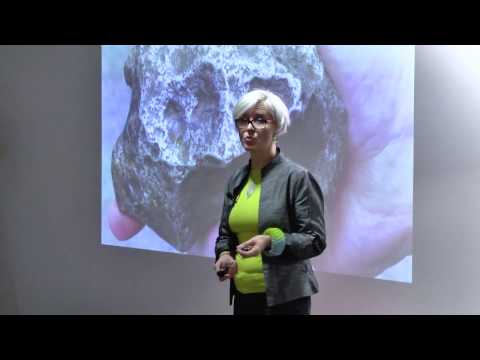
something like this meteorite for
instance which has a potential to tell
us things not just about our own planet
the future of our own planet but tell us
stories about the future of our universe
so I was thinking ok these are kind of
key ingredients maybe that I was working
with at the time to build up a sense of
what my story was going to be what if he
takes something that’s kind of a cross
between a sea bean and a meteorite a
sort of time travel device maybe and let
them come barging into somebody’s life
for somebody’s otherwise everyday
existence
what sort of impetus would that be for a
story and you can tell already that this
sea bean device in my story was pretty
much the main character and what if that
device that sea bean device had strange
kind of chimerical qualities
color-changing abilities it had encoded
within it some secret information that
could only be activated by a highly
eventful process of trial and error and
that would be the key driver for my
story and then of course I had to think
about well where on earth was this sea
beam gonna wash up in my story
what kind of Beach was it going to
arrive on somewhere preferably very
remote very desolate very wild somewhere
perhaps like st. kilda which is an
archipelago it’s actually the remotest
part of the UK we have ever wanted a
little factoid like that it’s a remotest
part of the UK it’s a world heritage
site twice over so it’s quite a special
place which is what I was after is a
real place which was also something that
I was wanting to write about and it’s an
island and we all love stories that are
set on Islands and then because I was
writing a children’s adventure story I
needed one smart eleven-year-old who was
going to discover my sea bean when it
arrived on the beach one day on her
Island on st. kilda the thing I need to
tell you perhaps about st. kilda is that
it’s so wild and so remote and so
desolate that the last people who
actually lived there begged to leave in
1930
so Alice and the small community that
have gone to live there in the very near
future my story sets very near now it’s
set in 2018 so in two years time I’m
gonna have trouble explaining things but
I needed somebody like Alice who had a
warm hat warm hands a warm heart and was
capable of handling a little bit of
weirdness was curious enough to figure
out why the sea bean changes color when
she touches it and how to get inside it
because of course there’s no obvious
ways in when it first arrives and she
would then obviously leave my story into
the full sequence of C B so I was
immersing myself in lots of information
about st. kilda I had accumulated quite
a library by then I was working with a
map not unlike this one above my desk
where I was where I was writing and the
whole story got told at that point
nobody knew I was writing fiction I was
doing it almost for my own amusement but
the book got finished in February 2009
and like most debut authors I had
absolutely no idea what to do next so I
stuck it in Bulldog clips in a drawer
and it stayed there for three years
until 2012 when I pulled it out again
for some reason and reread it and I
realized then that the reason I hadn’t
known what to do with it was because the
story was only 1/3 told and that there
were these two other amazing segments of
the story that would make it into a
trilogy so I got quite excited at that
point and I thought right I need to quit
my job so I stopped working in Greenwich
and I started working in Surbiton from
Mike from my desk at home and I started
to think quite a lot about the next
story the second installment because my
story had barely gotten out of second
gear I needed to think about what the
middle story was going to be and of
course the sink Hilda has a very rich
history it goes back to Stone Age times
it’s been lived on continuously until
1930 and there are a lot of rich things
in the past that I thought would be
fantastic in a time travel story to have
my characters travel back in time and
not realize at first that that’s what
had happened because at the end of C
beam the device is broken and they have
to do a factory reset and what they
don’t realize is it’s it’s kind of reset
the clock a little bit too much so Alice
gets to meet all these characters from a
hundred years ago and I got to imagine
what would have happened for example if
they turned up in a strange time-travel
device in 1918 in May 1918 when actually
st. kilda came under attack by a real
German submarine or what if Alice went
even further back in time to the 1700s
when a certain lady Grange was
imprisoned on st. kilda against her will
in a stone client rather like this one
and what happens if Alice rescued her
and brought her back to the present time
so at that point I was fortunate enough
to have been approached by a publisher
who offered me a three-book deal she
hadn’t even seen sight or sound of the
third one yet but I’d signed the
contract and I thought it was maybe
about time I actually went to st. kilda
myself because there’s only so much that
you can find out on the internet and so
I went off one epic day to see the
magical place itself it was a 12 hour
journey and it looks like quite a choppy
sea apparently this was quite a calm day
Takota st. Kilda and it was every bit as
magical as I was hoping for but also
quite strange because I think I’d gone
there thinking I was doing a
fact-checking mission maybe take some
promotional photographs and adjust a few
things in my story if I hadn’t got the
distances quite right or whatever but
what I wasn’t expecting was it would
feel like I was arriving into a very
elaborate full-sized film set that
somebody had built for me from my
imagination it was quite extraordinary
so happy that seat sits and killed her
and see being all kind of stacked up we
we went to press with the book we had a
fantastic book launch at foils in China
crossroad and my friend made this
fabulous cake that has all the
topography of st. kilda you could ever
wish for and a large sea bean parked on
the top there and my story c.b.c war
then was finished a few months later and
we launched that on a route master bus
going around London and giving out
copies of the book to various children’s
libraries around around London and then
I came to write sea rice and really
that’s what I want to sort of focus on a
little bit more today because writing
sea rise children often ask me when I go
into schools which one’s your favorite
and I think sea rice was the most
unexpected kind of experience for me
because at the end of sea war the
children know far too much about this
sea bean
whoever it is that’s provided it has got
a bit suspicious and has recalled it and
in the process of recalling it the
children somehow get abducted inside the
sea being it keeps them prisoner and
they find that they’ve been taken a
hundred years into the future to 2118 so
what I had to do with my third book was
imagine what sin killed would be like a
hundred years into the future
a rather inundated and ravaged version
of it and we’re seeing a lot of science
even in the news today about what it was
going to be the effects of these
disrupted weather patterns these strange
solar storms that are happening we’re
starting to see the Northern Lights in
much less northerly latitudes and in
Alex’s case she’s struggling to come to
terms with being on this island
wondering how they’re ever going to get
back to their present and how it has
come to be that some rather questionable
characters of driven technology
including the sea beam itself she finds
out beyond its ethical limits and that’s
when I realized that I’d got to the core
of what maybe want to write in the first
place it wasn’t just to tell a really
good story
although obviously that’s a key part of
it it was to travel to a place in your
imagination where you can no longer
avoid the issue where you feel compelled
to do something to to change what’s
happening in the world today and that
was what I hoped would be the take-home
message of my trilogy so when it came to
designing the covers for the books I
realized that I needed to make them a
little bit more arresting a little bit
more special and this is a rather
inadequate way that they are represented
if you go and look on the Internet
but what I wanted was something that had
something of the Equality of the sea
beam that maybe when you interacted with
it it did something a bit different so I
said to my publisher it would be really
great wouldn’t it if when we published
the book it changed color and I thought
she’d just laugh and say get out of here
you know but I done some homework at
that point and I’d found a company in
Cheshire that could print this special
thermochromic ink onto the surface of
the books so they literally would do
that they would literally change color
so here you can see my publishers hand
demonstrating you think we haven’t got
time for the ordinance participation but
you can all have a go later
so she went for it and of course what’s
what’s what’s not to like about that you
go into schools and children just want
to handle your books that you actually
get a collective gasp when you do it
when you do an assembly and you have
somebody with nice hot hands in the
front row come and actually make the
covers of the book but what I haven’t
realized at that time was I had this
brilliant brilliant set of books with
these brilliant sort of marketing
gimmick to them was that actually my
books fell into this entirely new
literary genre that I’d never heard
about it was a bit embarrassing because
obviously I only found out about it
couple of weeks after the book came out
and I was in a bookshop in London and I
felt drawn to this table which had this
sort of sign on it saying this word
Clive by that I’d never heard of before
but notice that went over and had a look
and I thought all these books all have
to do with climate change and I realised
that I hadn’t written a piece of sci-fi
at all I i’d written clive i my books
belonged here on this table with these
other ones so i was a little bit sort of
taken aback about this and i thought
well okay it’s just part and parcel of
the whole process of writing stories
from the future you know i’m gonna have
to roll with it so i went home and i did
some research and i found out that the
guy who coined the term is this guy here
dan bloom is American living in Taiwan
and he’s very passionate and evangelical
about it and over the next few months I
came across a whole bunch of other
authors who were writing both for
children and adults in the genre of of
life I in fact if you go on Goodreads
now today there’s a whole page dedicated
to clarify titles and it was a weird
sort of zeitgeist kind of a moment
really
journalists were keen to interviewers
Hollywood were trying to jump on the the
Clyde bandwagon people were even going
on climate change marches carrying Clyde
banners and somewhere in the middle of
all of that the editor of the children’s
book cent section of The Guardian
newspaper asked me if I’d write a piece
about why I write Clive by now I’ve
written a lot of things over the last 20
odd years both fiction and nonfiction
and I have to say this was one of the
hardest assignments I’ve every wonder
taken and there were lots of tunes and
frames you know lots of draw
handed back and forth between myself and
the editor and she’d say things like oh
well you know I want to know more about
your motivation as a writer I want to
know more about you or I want to know
what you think about other children’s
literature and although it was quite a
frustrating process I realized that it
was also the most illuminating one I got
a lot of insights into what it meant to
be a Clio author I had to really think
long and hard about it and I realized
that in going out and and reading my
books in libraries and book shops and
whatnot I didn’t just want to do that to
sell more books which is what a lot of
authors seem to want to do they want to
reach their audience don’t they I
realized I needed to do some something
more than that and at that point I’d
maybe gone and spoken in about 50
different schools around Kingston and
across sorry
I’ve been on the radio a few times and I
don’t even done a couple of literary
festivals but I realized I haven’t
developed a sort of real sense of
purpose about what I was doing
and going out there and talking about my
books so I realized that the first thing
I needed to do was to get the children
out of the classroom that would that
would be a good start I was like I
wanted them to feel a little bit like
Alice does when they’re transported to
the Amazon rainforest and they find a
golden nugget in CB and there’s this
moment where they find this amazing
object and it’s something that’s going
to solve a lot of problems for them in
the future so they take it home with
them and it becomes a sort of talisman
and it enables them to unlock their
story from the future so I started to
make these boxes there were like baby
sea beans and you take them into
classrooms they’d have a few clues in
them a bit of treasure and the children
would use them as inspiration it didn’t
really matter what was in the box in the
end because it was about getting them to
focus with a sense of urgency and awe on
a future moment here’s a child writing a
story set in 2114 it made this the
teachers quite nervous when I push away
the desks and let them write on the
floor and talk passionately and loudly
about what would happen if their
community was substituted by water or
suddenly had a power-down moment or was
invaded by displaced people from
somewhere else but it was that thinking
outside of the box even though I was
giving them a box that really mattered
to me it was taking climate change out
the science curriculum and into a sort
of openly creative participatory
environment that collide fight afforded
me and then I realized that it wasn’t
enough to give them the treasure and the
clues I needed to let them out to find
their own clues and look for their own
evidence so we ran workshops on beaches
weed buckets and in fields with
magnifying glasses and it wasn’t so much
about them capturing samples from nature
specimens from nature is about capturing
their imagination I was trying to get
them to look at those beaches and those
fields in an entirely different way and
they bring the findings back to the
classroom and they start talking about
it if I’m honest not everybody got out
the starting blocks some children found
it just too daunting to be asked to
write a story from the future
others went off and quietly in 20
minutes came up with an absolutely
heart-stopping story the best workshops
were where I realized that I’d even
captured the teachers imagination enough
for them to want to let the children
carry on after I’d gone and do something
that they could all be really proud of
like these children who won a regional
Clio writing competition that I went
that I ran or the children at Hinch Lee
woods school where I ran at a writers
club over the course of the whole year
and they built up a collection of Clyde
by stories that we published in an
anthology all these children from ride
school in the Isle of Wight who created
sort of nonlinear stories on these big
black boxes that look a little bit like
sea beans as well he wanted he was so
proud of them they wanted to display
them in the school entrance way
afterwards or one child who even went
home after my workshop and built the
whole of st. kilda and sea bean in in
Minecraft because they wanted to go on
their own time travel adventures but at
the end it doesn’t really matter what
the output is what the physical output
is what really mattered to me was that
in getting children to engage with
stories from the future their story from
the future to dream up their story from
the future that even if their own
parents and the adults around them were
still in some sort of weird denial about
whether it was even happening in the
first place that when the time comes
when they are faced with climate change
in their own lives and it’s starting to
really affect their own existence it
will be in their power to do something
about it thank you very much
you [Applause]