
[Music]
[Applause]
[Music]
that simpler improvised musical phrase
there it’s quite easy for me to do
because I’ve been playing for a long
time but how do I go about teaching that
to these young musicians in the band
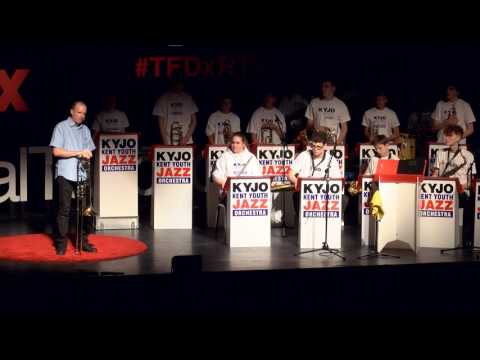
there you can sit down guys well a lot
of people have said to me before
isn’t jazz all just made up as you go
along and after I help them back up off
the floor I’ll say Oh unknown not quite
jazz like all forms of music has its own
distinctive sound its own language and
when we speak we all use words and
phrases we know already don’t we to
convey but we want to stay we can give a
speech we’ve already prepared or we can
speak off the cuff deciding what we want
to say as we go along in jazz and other
forms of music that future improvisation
are no different from that we can play
the bit we’ve prepared the main melody
the bit you might recognize but we can
also make some stuff up play around with
that melody introduce their own ideas
playing off-the-cuff therefore
improvising I’d just like to show you
one approach I take to teaching young
musicians the very beginnings of
improvising and when you’re playing in a
band like this it can be quite daunting
to get up and play in front of everyone
placed solo in front of everyone so
let’s start from a really simple point
now this is going to require a bit of
audience participation so that simple
point we’re gonna start from it’s just
one single sound just a single note I’d
like you to sing it back to me
that’s excellent you can’t go home early
fantastic okay let’s play around on that
note for a little bit
[Music]
okay let’s add another note to that
[Music]
okay now with just three notes there we
already have infinite possibilities for
improvisation we can play the notes in a
different order we can repeat the same
note several times we can leave gaps
play long notes and short notes so we’ve
gone from that single sound which we can
think of as the equivalent of a one word
or one syllable to building up words and
building up phrases and by copying what
I’m playing there you’re really doing
what a young child does when she first
learns to speak starting with a syllable
and building up into words let’s try
some phrases on those three notes
[Music]
[Music]
some of us tried that I love that now
with the exception of that last example
there you found that really easy just to
copy what I played you can hear it and
sing it straight back we’re very good at
that as human beings now unfortunately
for our young musicians in band here
they’re not human beings no I’m joking
they’re definitely human but they do
have the obstacle of a musical
instrument so we can hear the note but
we have to get it back out onto the
instrument and it’s a bit like having to
translate so you’ll hear that when I
play them the first note that first
syllable we talked about you might find
there’s a bit of trial and error trying
to get the note and that trial and error
is really in point it’s important give
them give them the space to to have that
room for error
because that’s how we overcome problems
it’s even more important they give
themselves room to make mistakes to get
over the psychological problem of the
idea that I must get it right no you
must get it wrong that’s how you learn
stuff so let’s just try a single note
band
[Music]
okay so we found it eventually you might
notice the trombones got that note
before everyone else and that’s because
trombonist are better than everyone else
or maybe because my slide was in in an
obvious position and they could they
could copy they could use a visual aid
of whether a slide was there okay so
let’s try a second note okay now like
you they could clearly hear that the
second note was higher than the first
note but the question is how much higher
we have to know the interval between the
notes the music leans well that’s the
distance between the two notes and so we
need to use listening skill – do I need
to employ listening skills and develop
them to be able to do that but we also
need to listen on a much more general
level we need to listen to lots of music
if you want to play a jazz solo it’s not
much used if you haven’t heard much jazz
music before so we might listen to Miles
Davis John Coltrane Louie Armstrong
person sitting next to us and think wow
that sounds really good I’d love to
sound like that and so you imitate what
they’re playing or try to at least and
you’re never going to sound like like
those people never gonna send anyone
because everyone’s got their own
individual sound but by trying we find
our own sound and this is where making
mistakes really comes in if you’ve
already decided that making mistakes is
a bad idea
then when you play something different
from what you intended you then just
discard it as wrong but if we allow
ourselves to make mistakes we can play
something we never intended to do and
think I didn’t mean to do that but it
sounds pretty good I’m going to do it
again and that’s finding your own sound
finding your own voice in the music so
let’s try some phrases that we can
repeat here Ben so we can sit on that
first night
[Music]
okay now so far we haven’t really done
much improvising I’ve been playing
patterns and everyone’s been copying
what I’ve played so let’s see what it
sounds like if I play a group of notes a
little musical pattern or riff and get
someone in the band to play back to me
the same notes in a different order or
introduce their own ideas as they think
of them so Harry’s really really
trombone here
[Music]
yeah Harry witty on the trombone okay
now I’d love to see is young musicians
that learning musical instruments to
sometimes get rid of this security
blanket of the music in front of them
Chuck that way well put it to one side
if it’s expensive and learn bits of that
music and try and noodle around the net
try some different ideas and you know
just try and improvise either with those
ideas or ideas of your own or if you’ve
got scales to do for an exam we’ve all
heard this before
[Music]
Della’s ditch halter but we can try and
play with those ideas and and we’re kind
of really using those how they would
appear in music you don’t really see us
to go like ascending and descending in
music like that were you hear them more
like this so I’d love to see more people
doing that kind of thing and just
experimenting you know music the
creative subjects they be creative with
it now what I like to do is show you
what we can do with some of those ideas
those riff they’re three and four note
riffs and give them to the band to play
I’m going to give each section of the
band a different thing to play and build
up a whole new piece of music now they
have no idea what I’m gonna in fact I
have no idea what I’m going to do now
we’re just going to try some things and
see where we end up so come on a musical
journey with me
[Music]
[Music]
[Music]
[Music]
[Music]
[Music]
[Music]
[Music]
[Music]
[Music]
[Music]
[Music]
[Music]
yeah thank you very much
okay
you
Please follow and like us: