
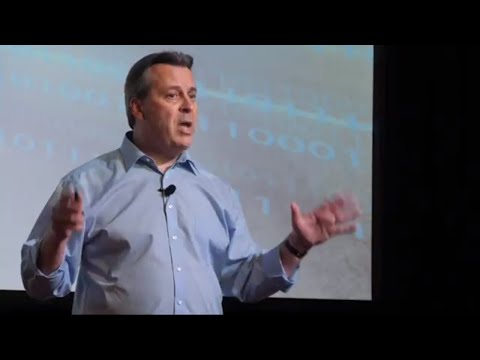
so the world is changing at
remarkable rate of speed and this is a
great thing but it is causing a great
deal of concern for a lot of people
Alvin Toffler said that humans are not
adapted for the rate of change that
we’re experiencing Elon Musk said robots
are going to steal your job Stephen
Hawking said artificial intelligence may
be the end of humanity as we know it
what we’re experiencing is called the
fourth Industrial Revolution and as the
name implies there were other
revolutions that preceded it there was
the first Industrial Revolution the
agricultural revolution and perhaps the
first great human revolution the bipedal
revolution or a lone individual stood on
its hind feet created competitive
advantage for survival
it could see further it could hunt
better and it freed its hands to use
tools the Agricultural Revolution
allowed greater production of food to
create sustenance for larger populations
and had the consequence of tying us to a
geographical location which meant that
nomadic tribes had to now become
villages as the populations got larger
villages grew into towns towns became
cities roads developed to connect the
different cities together trade ensued
which meant currency which meant
government and all of this created
competitive advantage for survival when
the Industrial Revolution first came
along the intent was not to mechanize
the entire planet it was to make more
efficient already existing agricultural
processes in particular taking raw
agricultural materials wool cotton flax
and spinning them into thread which
could be converted into cloth at a
higher rate with fewer people than was
possible by mechanical means so
the natural reaction for a lot of people
at the time was of course concern and
anxiety where the machine’s going to
[Music]
take my jobs were we going to be able to
keep up with the new pace of change was
it going to be the end of humanity as we
knew it so they did the only logical
thing they destroyed the machines and
they chased the inventors out of town
just for reference this is the
technology that we’re talking about so
the good news is the Industrial
Revolution continued the invention of
the steam machine allowed for powered
factories which meant factory towns
which allowed for greater production
specialized functions developed which
led to division of labor which led to
assembly lines and mass production
electricity allowed for the creation of
electronics which led to computers
computer networks smart phones smart
phone apps and the hyper connected
Internet that we’re all experiencing
right now so the natural question that a
lot of people ask at this point is are
these really revolutions or perhaps this
is an evolutionary process and I’d
actually like to suggest that perhaps
it’s really an incubation process and
let me tell you why I say that so if we
look at the development of an embryonic
organism it starts off as a single cell
metaphorically standing on its two hind
feet so it could produce create colonies
create special functions skin cells bone
cells muscle cells organs developed the
heart the lungs liver the nervous system
and the brain an interesting thing
happens when the brain and nervous
system starts to develop all of these
specialized function that
exist now start to interact and
communicate with each other and they
start to function as a single entity so
is it possible that all the connections
that we’re experiencing right now
globally indicates that we are really
like a prenatal organism still in its
embryonic State this is a map of the
internet and all of its connections
circa 2003 the lines represent
connections the dots of color represents
specialized function and the connections
between the two of them this is a map of
the internet around 2015 and as you can
see there’s a great deal more community
connections there’s a lot more clusters
the clusters are more robust and there’s
a great deal more connection between
them so in the year 2000 the human
population was about 6 billion people of
that 6 billion about a half a billion
were connected together electronically
via the Internet in 2010 the human
population had grown to about 7 billion
people but the interconnected population
grew at a faster rate to one and a half
billion people three times the number of
just ten years before it’s estimated
that by the year 2020 the human
population will be about 8 billion
people two-thirds of whom will be
connected electronically to each other
this is a human brain and again the
lines represent connections the colored
areas represent clusters of specialized
function and just as a point of
reference there are roughly 100 billion
neurons in a human brain and the
important thing to keep in mind is with
brains numbers matter connections matter
and special functions really really
matter so this is a human city
and as you can see illustrated in the in
the photograph there are numbers there
are connections although some of those
numbers are left out of the connections
there’s specialized function and again
there are some that are left out of that
specialized function but cities
represent a microcosm of our global
circumstance right now so what’s
happening is much like the transition
from the agricultural age to the
industrial age the connections that
leveraged the new capability were four
already exist in specialized function so
in our current circumstance those would
be things like journalism education
retail and government right now it is
possible for someone to get an education
from any place at any time by anyone as
long as they have connection to the
electronic internet government similarly
is dealing with constituencies who have
access to information in real time as
events happen and they’re having to deal
with citizens who expect a greater role
in how they’re being represented and
greater transparency in how governments
deal with this information as you might
imagine not everybody is as enthusiastic
about this as everyone else there are
three primary challenges that will
address how we move forward at this
point the first is how do we ensure the
accuracy and timeliness of the data
that’s being transferred the second is
we need to get more connections hooked
in to this worldwide infrastructure and
we have to get them to step up and
function at a higher level than they’re
currently functioning without the
interconnectedness the third critical
issue is we’re going to have to create
rules and systems that will prevent
hi social people or organizations from
leveraging opportunities to the
detriment of the Ranger of the system so
the question is will we be able to keep
pace with a change yes the technology
will be a force multiplier which will
allow us and our limited capacity to
function at a higher rate of change will
robots take our jobs they will they’ll
take our lower-level jobs and they will
free us up to perform at a higher level
than we can currently even imagine the
last question was this the end of
humanity as we know it and the answer is
probably but that means that a new
humanity is likely to emerge from our
current circumstance and the question
then is what kind of humanity is likely
to emerge largely the result from that
will be how do we address the three
primary issues we could end up with
utopia or we could end up with a
dystopia and it largely is determined by
whether we listen to the voices of our
baser human instincts or the voices of
our better angels thank you
[Applause]
you
Please follow and like us: