
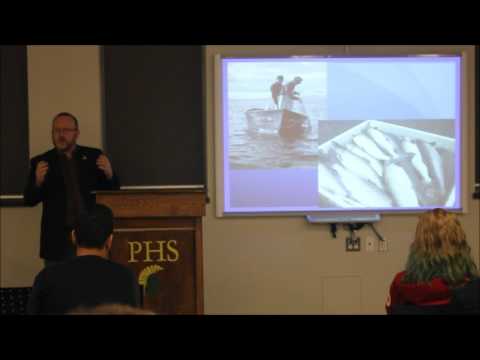
future biologists in the room the
translation of that biography works when
you’re young you’d have to do really
cool stuff in the field maybe you had to
spend one more time in the office but I
am actually pretty blessed working on
this project and I’m really glad to be
here tonight and so I’m red top today
it’s theme by discussing an effort being
made to bring something back into our
future by bringing lankan Sam in fact to
Lake Ontario and its rivers this isn’t
going to be like a movie though or we
can just jump in a time machine and go
back five hundred years or a thousand
years and have a pristine untouched Lake
Ontario it’s that’s gone from forever
but by bringing limpets em back to the
lake and to the rivers and keeping them
here we’re going to be able to help
shape the future with healthy watersheds
that have benefits not just for this one
species of fish as awesome as it is but
for all of us and for our natural
environment now we work to us what’s
really good in two stories tonight of I
do need to tell a story or else
everything awesome no tomboy doesn’t
make any sense so often people are a bit
of a trouble connecting the words
Atlantic salmon with later Ontario and
don’t really understand I want to say
look just in the
ocean or over in Europe or on the east
coast of Canada or for the rapid they
show up in grocery store shelves or on
restaurant menus but in fact once upon a
time here in Ontario we have was
considered to be the greatest freshwater
population of this species in the world
and by here I mean quite literally right
here duffels creatures only about five
hundred yards five hundred meters away
from us right now and it was actually
known as Riviera saman to its original
French pioneers as a few hundred years
ago now if you think the know about
Atlantic salmon were there the Lake
Ontario and the ocean all the stalks on
Lake Ontario because they live in two
different places at different times in
their life then migrate between those
places so they live in open water so
Lake Ontario as big salmon and they swim
around there they feed they grow but
then they move into rivers to lay their
eggs that’s where they reproduce and
there’s this whole series of life stages
that happens in those rivers the fish
hatched they grow and mature and those
rivers don’t they’d have to be big
enough and head up to the lake again to
grow up into adults and it’s this space
that was in the rivers where things went
wrong for londone7 and they didn’t just
disappear the way in early Earhart
disappeared or the Edmund Fitzgerald or
Jimmy Hoffa we actually know pretty well
even though it was a couple of new years
ago what happened to them we can
describe his mountain history to us it
was three main things that went wrong
the cold clean rocky rivers that they
need just like this they disappeared
vagenis normally mystery they not to be
too warm for the fish they got lethally
warm for the young fish and the rocket
was covered up by not as erosion
happening and not only did the roads
would be bad in many cases they
disappear this is a tidal Creek in
Toronto
find this river anymore prawn was
actually missing all of its rivers
between the west side of the Don River
told what Etobicoke
they’re all gone they went under the
city now so the rivers themselves
disappeared and then like the salmon are
pretty much the best jumpers in the fish
world you can jump three meters 10 feet
out of the basketball net to get over
waterfalls but dams were built in these
rivers and the lab said when we jumped
that high but they can’t get over 8
metre tall dam with 5 meter tall day and
we built hundreds of these dams on each
River not just across the rivers however
ever had before and their dams on it
Credit River and Mississauga had been
over 1,500 dams built on it and so the
fish trying to get to where they needed
to go to reproduce anymore and finally
they were being fished for for food
wasn’t a recreational fishery this
people using Spears and pitchforks and
nets it was largely unregulated fishery
as well really rules in place when there
were rules in place there’s no real
evidence they were ever enforced and so
I need to nineties we have I know
Atlantic salmon left both in our side of
the lake end on New York’s I don’t like
hundreds of thousands of a trench
millions of small fish all gone done
150 years people had always wanted to
bring it laughs at 7:00 back in when
there actually we’re being wiped out
there were efforts to try and install
this is the first government-sponsored
hatchery in North America was built to
try to save them demo for near Newcastle
and people wanted to bring them back or
save them for a number of reasons it was
the moral perspective that we broke tit
so we bought it and environmental rod
that we need to write also the rhetoric
return of Atlantis and signal a healthy
ecosystem for storing ecosystems and
healthy watersheds they also give us an
incentive to make those watersheds a
healthy again rather than just having an
abstract idea just sort of Martha
Stewart thing of it being a good thing
there’s a real practical reason to save
these things protect these rivers and
find the Atlantic salmon themselves have
their own they’re very legendary fish
they have their own social and economic
value by in and of themselves but all
this interest and enthusiasm for
bringing light to salmon back are saving
them was frustrated because long after
we lost in the leaf Ontario and the
other Great Lakes kept getting worse up
through the 1960s we had a whole strain
of invasive species come in the worst of
them was the sea lamprey the basically
vampires on fish their fish themself but
they’re vampires another fish we lost
lake trout from Lake Ontario they were
another native species they had elected
salmon or the two top predators and with
that whole layer who went chopped off
now without any predators in the lake
we simply broke the whole ecosystem and
lately die-offs both crayfish it wash up
on shore then we add pollution going
straight into the lake and into the
rivers as well and that was everything
from dangerous chemicals to sea weeds
even tons
sawdust before in the river and so that
the rivers and the latent in you to
degrade after we lost a lot of salmon
but eventually things got turned around
and restoration efforts began on the
watersheds and after a long period of
work with 30 years or so Atlantic salmon
came back on the table again and in 2006
a large scale multi-partner restoration
effort began to bring them back and to
do that we’re doing sort of four things
and probably all in detail but we’re
basically raising and releasing fish
into the river system sort of the
obvious manner in things box we’ve gone
to a vast ocean we back in Maine the get
fish better live their whole lives and
have trees they produce the eggs that we
raise them the fish that we release in
the rivers we’re continuing to make
their habitats fender and protect the
good habitat that has already been
restored this is a pretty significant
component of the restoration effort
we’re having a large research and
assessment program underway so we’re
finding out how the fish are doing in
the modern Lake Ontario and we’re
learning from them and we’re just in how
we do things to make our restoration
efforts more success and then finally we
also need to go out and talk about
salmon
we not only literally need to
reintroduce the fish into the river but
we also need to reintroduce them to
people people forgotten used to be here
or come to Canada since they were gone
and don’t know how important that fish
was to Ontario’s natural history and so
that’s what we’re doing and and this is
an again it’s a large partnership record
for 40 organizations but I despite there
being three levels of government and
stakeholders and corporations involved
in this we’re not enough we’re going to
bring them back and we’re going to keep
the New York needs to be more than us
and so too if it we can make this up
more than us we can achieve this future
of having sustainable healthy watersheds
with multiple benefits that are also
buffered against future effects from
things like climate change and invasive
species that we’re going to face so from
the very beginning we’ve sort of built
this program to be a gateway to make
communities care but the watersheds and
move from caring to being engaged and
restoring and protecting the watersheds
then becoming future stewards are
willing to invest in these watersheds
and to achieve that we’ve to create
these community of stewards we’ve always
looked to meet the Atlantic salmon
program of public effort community
effort the main content of salmon a
personal for people so when we release
these fish we make them public events
people to promote and get into the water
and release fish if they want they don’t
want to do that you can stand on the
shore and see the fish meet the fish see
what good habitat looks like we get our
students out to help clean the rivers of
garbage out from in or beside the rivers
we have a lot of volunteers from over
the plant trees and we do that to shade
the rivers again stabilize the stream
banks there’s a lot of habitat work we
did our volunteers to help us with and
then our most popular project as in the
program now in our communities is for
more than 100 classroom hatcheries
there’s actually one in this school here
mr. Simmons and so here we have students
raising fish for us they picked it will
release the fish into our rivers alone
here at defin Street more than just the
fish the students add are also learning
with the salmon they’re becoming
ambassadors for us spreading the word
their families and fears become future
Stewart Stewart
we often have find that our students who
have been in the file symmetric program
we’re doing their own environmental
programs on clean episodes in the the
neighborhood and neighboring parks and
down back at the river and so with that
with that support where we’re heading
wards and leading to is digit our
stockfish to come back into the rivers
get them here get them building nestling
aids and so we can see more and more of
these so this is a while active salmon
this is the one we put in the river was
born and the records parents were
officially put in we need to see more of
these we need to see them growing up in
the river of the lake coming back
producing future generations while
Atlanta salmon that are adapted to this
on water Lake Ontario and with that
encouraging the continuing and I’m so
touched and also the care about the
environment and so that can wrap up thank you