
[Music]
I see turtles have been on the planet
for over 70 million years they swim in
the ocean while the dinosaurs were going
extinct they’ve seen climate change
natural disasters various predators
major shifts in the sing Beach habitat
this ancient reptile has adapted to an
evolving planet for millennia yet in
recent decades they struggle to coexist
with a superior predator us this is our
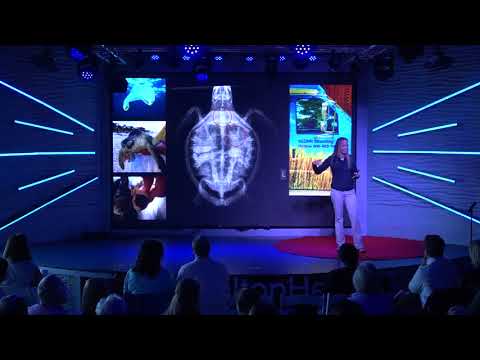
colon a fossil that was discovered in
South Dakota in 1895 shallow seas
covered the central North American
continent it most closely resembles the
sea turtles that we have today in
particular the leatherback sea turtle
the leatherback is the largest of the
seven species and it’s the only one with
a leathery shell and we presumed that
Archelon also had a leathery shell it
weighed in at over 3,000 pounds it’s 16
feet wide and 13 feet long everything
was bigger back then but leatherback is
no small turtle it weighs in on average
of a thousand pounds for the largest one
we’ve ever discovered in 1988 in Wales
was over 2,000 pounds its shell was nine
feet long so it was 11 feet overall that
turtle I’m assuming is over a hundred
years old
because reptiles have indeterminate
growth which means they grow as long as
they live I’m also going to assume that
an animal that has been on the planet
for millions of years has become such a
fixture that was out its support the
framework of the ocean environment would
suffer a significant blow we don’t know
exactly what that is but it cannot be
good man has the ability to create
unnatural things we have spinning blades
through the water to push our boats we
have major concrete structures on the
beach encroaching on nesting Beach
habitats we have plastics that resemble
food sources on the ocean floor
artificial lights that confuse
hatchlings when they come out of their
nests we have fishing line hooks and net
that entangle sea turtles and they drown
our theme is resilience sea turtles have
accomplished and conquered extreme odds
until now but the pace with which we
create change is too fast for them to
keep up we started paying attention in
the early 60s when tea turtles are
washing up dead on South Carolina
beaches with no apparent injuries having
drown in shrimp Nets the sea turtle soup
industry was having trouble keeping out
the demand and this is Key West in 1961
they are processing green sea turtles
here in the late 60s we had some laws in
place that would protect sea turtles to
certain extent but in December of 1973
the Endangered Species Act was passed
all six that are in our waters have been
on that list for my entire existence I
was born seven months after that so from
my entire existence six out of the seven
species have been on the list the
seventh species is not on the list
because it’s the Australian flatback and
it only lives in Australia it’s out of
our jurisdiction forty-four years later
we have made some improvements most
beaches have nests monitoring programs
in place we have beach front lighting
ordinances in effect May through October
10:00 p.m. to 6:00 a.m. exterior lights
off this is your flood light it doesn’t
mean you have to go to bed at 10:00 p.m.
just means you have to bring the shades
close so that no light is visible from
the beach when a hatchling comes out of
its nest it looks for the brightest
light and the brightest light is always
going to be a flood light over the glow
of the moon so they end up in your
swimming pools under your decks behind
the dune and they perish
we lost 32 nests on Hilton Head to
beachfront lighting this season the sea
turtle excluder device is required in
all shrimp net in the United States it
was enforced in the early 90s in South
Carolina it’s a big metal contraption
that’s sewn into the net with bars
vertically down the center the fish in
the crab and the shrimp go through the
bars and they end up in the sock of the
net
the sea turtle hits the bars and is
forced down with the current of the boat
pulling the net and it’s ejected out of
the hole on the bottom to breathe
another day major major improvement in
the fishing industry here
we encourage beach goers to use a red
flashlight on their beach walks that red
wavelength is not as distracting to a
sea turtle as white light is if you have
to have a light on the beach color it
with a Sharpie if it’s not red red it’s
all we need
whole Patrol if you haven’t heard of
pole patrols on the front page of the
island packet at some point this past
season it’s a group that gets together
in the evenings residents and high
school students fulfilling service hours
they fill in holes at the end of the day
and every year the holes get deeper I’m
not sure why you need a 4-foot hole at
the beach but when a hatchling comes out
of the sand and walks down to the water
and then dark it falls into the hole it
does not get out beaver county is being
encouraged to put a ban on the
single-use plastic bag the problem with
this particular item of plastic is that
it’s Airy
it flies just like a balloon so when it
is caught in the wind and flies over the
ocean it lands on the water and
submerges it looks just like a jellyfish
moving through the water that’s a main
food source for the leatherback sea
turtle and once it’s ingested it clogs
the intestines and it is fatal so in my
world that plastic bag ban would be an
excellent contribution to the
conservation of sea turtles off the
beach and on the water we have fishermen
reeling in that big fish and at the end
of their line it’s not a fish didn’t
expect that it’s a sea turtle
they usually swallow the hook and the
good old days we just cut the line say
oh it’ll rust out not so much it causes
a lot of damage in the meantime so if
you know the hotline to call South
Carolina’s Department of Natural
Resources we’ll call a volunteer
probably me and I’ll meet you at the
boat landing and transport that turtle
to the South Carolina Aquarium in
Charleston where they were surgically
removed that hook rehabilitate the
turtle and release it we had three hooks
wallowers this seat
voters neglect to slow down during the
nesting season sea turtles are
congregating near shore they’re waiting
for their opportunity to approach the
beach in the dark to deposit their eggs
so May through October we’re gonna have
that concentration my job my stranding
position I go to these turtles that have
been struck I measured them I take
pictures I take a genetic sample a pit
tag scan them specie ate them sex them
and supply all that information for the
Department of Natural Resources and they
will collect that and be able to keep
track of our population maybe
individuals will take out of their
catalogue and we will know how these sea
turtles are dying I dig the hole also
and barium that’s the hard part
sometimes they wash up debilitated and
when they do we need to pay attention
this is a message from the ocean they
are a keystone species which means they
are near the top of the food chain and
when they are sick we can assume there’s
something going on down here
it could be obvious like plastics lodged
in their intestines or it could be more
vague like fertilizers bio accumulating
and sea grasses which is a main food
source for the green sea turtle we
believe that that contamination of their
food source is causing a disease called
fiber papilloma ptosis as a herpes virus
rampant in the green sea turtle
population it manifests itself as wart
on the outside of their soft tissue
covers their eyes makes it hard for them
to swim it’s also internal and disrupts
their organ function this guy was the
30th stranding on Hilton Head in 2017 he
washed up in the harbor town yacht basin
just two weeks ago unfortunately his
disease was too far advanced for her
rehabilitation he did make it to the
hospital but that was as far as he got
have you ever had that moment in your
life when you know that you look back on
it you know if you hadn’t had that
experience that you wouldn’t be the same
person that you are today I feel
fortunate that I have had that
experience
when I was in my early 20s I worked on a
dive boat that ran out of Hilton Head
Harbor and our destination was 16 miles
offshore the Eagles Nest wreckage my job
as the dive master was to help the
divers into the water get him back out
of the water and then dive back down to
the wreck to remove the anchor from the
wreckage and set it in the sand so the
crew could easily pull it up it was also
my five minutes of diving all I could
afford
so on this particular day I was just
looking around and out of the depths a
large shadow is approaching and being
the age that I was I was lack of fear
lack of experience stood there to wait
and see what it was fortunately it was a
sea turtle I’d never seen one in the
water
but I could tell what it was if you’ve
ever seen it looks like a bird flying in
slow motion it is graceful in its
element just beautiful so I stood very
still waiting to see if it would just
get close enough for me to get a good
look at it not only did it get close
enough it would have head-butted me if I
had not rolled back on my heels and lay
on the ocean floor while it hovers over
me like a spacecraft talk about
impressed that turtle was 10 feet long
in all directions as water magnifies
so when I made my way up that rope that
line snot tears filling my mask I get
back on the bed the boys notice of
course and make fun of me and normally I
would have let him have it but on this
particular day I was speechless they
knew I was serious
I was changed forever I knew what I was
gonna do for the rest of my life
19 years later a master’s degree in
marine biology with a focus on sea
turtle biology by the way the most non
lucrative field you can possibly imagine
and I managed the sea turtle protection
project for Hilton Head Island thousands
of volunteer hours spent on nesting
beaches for sea turtle conservation I am
still inspired by sea turtles I’ve had
the privilege of being in their presence
while they’re swimming while they’re
laying their eggs in the sand while
they’re hatching and while they’re
taking their last breaths and when I see
them I see that turtle that I chose me
that changed my life forever so I hope
that you will consider your impact on
the ocean environment here is your list
again
lights out beach runner if you’re
staying there just turn those
non-essential exterior lights off red
lights on your beach walk fill your
holes how simple is that
responsible boating and know that
hotline to call if you find an injured
turtle are you reel it in at the end of
your line keep those plastics off the
beach and if you can use your canvas
bags at the grocery store I know it’s
hard to remember I’ve had to go back to
the car and get them or just forget the
bag and carry each thing out
individually I have done that before
sea turtles have been on the planet for
over 70 million years but in a matter of
decades we have totally diminished their
population to a point where they could
go extinct we need to pay attention will
we continue to act irresponsibly for the
sake of convenience or will you help me
consider these suggestions that I’m
giving be proactive in
implement them for the health of our sea
turtle population to promote their
existence for the next generation to be
inspired on behalf of all sea turtles
nesting on Hilton Head thank you
[Applause]
[Laughter]
[Applause]
Please follow and like us: