
[Music]
hi thanks so much Wow so first off how
many people here have ever been been to
or seen a TED talk show of hands whoa
that’s like the best response I’ve ever
gotten to this question I see some
people didn’t didn’t raise their hands
and us if you haven’t ever been to a TED
talk I highly recommend it it’s really a
really stimulating but the fact that
most of you have been tells me something
it tells me that you’re intrinsically
motivated to learn ok it’s like that
means you do it for the joy of learning
it really feels good you don’t have
extrinsic rewards that make you do it no
one’s paying you and I know it’s
threatening to punish you if you don’t
do it and you’re not doing it for
hedonic rewards right it’s not that the
TED talk tastes good or it um it
stimulates you sexually I mean I’m
assuming right and so so that’s really
interesting it’s really interesting to
me because I work in trying to motivate
people and get them excited to learn
about science and that entire idea and
that that phrase intrinsic learning was
coined by Harry Harlow at the I
University of wisconsin-madison when he
saw rhesus monkeys playing this
mechanical puzzle and he was like well
that’s really interesting because
they’re really into it and they’re not
getting any rewards to do that and at
the time you know it was a psychology
was dominated by behaviorism and the
idea that you know we only do things if
we’re rewarded for doing them or if
we’re going to be punished for not doing
them and so the behaviorist saw this and
they’re like well this is this is crazy
why are they playing with this puzzle
and so we said well let’s reward them
let’s give them a treat the longer they
play with that puzzle and a weird thing
happened the rhesus monkeys that got
rewarded didn’t play it longer in fact
they were less interested they were
somehow when it was their idea when it
was autonomous it was really engaging
for them but as soon as there were
extrinsic rewards for it it actually
became less interesting to them so it
wasn’t know until you know decades later
that the brain has its own reward system
or systems many of them and you might
have seen these you know the films of
the the rats that press the lever and
they have an electrode going into their
brain that it rewards them and they will
keep pressing that lever and ignore food
or anything sex or anything they are
just going to keep pressing that lever
and getting that direct stimulation to
the brain until they drop and you know
what we usually hear is that oh it’s
like they’re getting morphine or
something they’re getting this you know
euphoria from you know that part of the
brain but if you watch them they don’t
you know they don’t like press the lever
and go ah oh yeah then they press the
lever and they go they do that they have
this expectance this anticipation this
feeling that there’s something more see
I worked in the theme of this TEDx
cleverly and seamlessly into my talk I
notice that and and I so then some
scientists began to think well they’re
not stimulating the part you know
something similar to the morphine reward
system or something like that they’re
triggering the same rewards that we get
from intrinsically motivated behavior so
it’s a feeling of there’s something
there I’m going to learn something new
I’m going to find something valuable and
that’s really feels good so what they’re
really doing is they’re administrating a
concentrated TED talk right into their
brain and that feeling I’m going to
learn something new this is really so
that’s really interesting to me because
I am I work at the education Directorate
for the American Association for the
Advancement of science and or triple is
as the cool kids call it and I am not
interested in teaching science I’m
interested in seeing how people get
motivated especially kids to be
enthusiastic learners and doers and
people who are really jazzed up by that
and so this idea of intrinsic motivation
was really interesting to me and it’s a
hard thing to do in school because we
saw from the rhesus monkey is that it
has to be autonomous it has to be
something you do because you want to do
it has to be self-motivated and
exploratory and if you add rewards and
punishments it kills it and schools by
their nature aren’t crazy about
unleashing autonomous behavior and there
are a lot of rewards and punishments so
I work in out of school after school
environments and particularly I’m just
starting a project on national parks to
see how we can get kids and grownups
sort of motivated to explore and get
excited about science in that
environment now the other thing I do at
triple is is a daily radio program
called science update it’s a new short
little story every single day about
exciting work in science and so I’ve
been doing this for thirty years now and
so I’ve talked to thousands and
thousands of scientists and I thought
wow I think that maybe if I talked to
some of them they can give me feedback
on what got them so jazzed up about
science so for this talk I reached out
to a couple of my favorites and so one
of my favorites
oh yeah that’s that’s not the actual
scientist that’s uh who knows what that
is
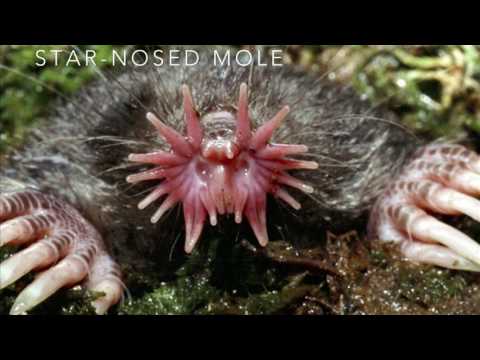
star-nosed mole first time I saw
star-nosed mole when I was a kid in a in
a book I was like I must have one it’s
it was talked about you know just that
it was and you couldn’t tell in the book
how big they were so I was assuming they
were like maybe I don’t know like the
size of a seal and I pictured myself
taking it for a walk and taking it to
school and what a sensation it would be
um but it turns out they’re just like
the size of a hamster and the little
star nose is just like the size of your
fingertip but it has these 22 appendages
and it doesn’t use them to smell it uses
them to feel and it burrows underground
it can’t see underground and it does
this thing with them it’s like and that
that was in slow motion
so I can’t move at mole speeds it’s in
crud in fact the the start of those mole
is the world’s fastest either and it’s
in the Guinness Book of World Records
and seriously and and and and it is it
can do this because of these appendages
and how they can feel so quickly now
this fellow who studies them and he’s
been on my show a couple times is Ken
Catania at Vanderbilt and he’s a
neuroscientist and you know he had
scientists for parents and used to go
exploring when he was a kid and when he
was young he came upon a star nose mole
it was dead and he didn’t know what it
was but it stuck in his mind and again
he so looked at that and said there is
something more to that than you know
than just a pretty face
and sure enough he has studied these for
decades now and he’s found that each of
those little appendages has its own area
of the brain that it sends signals to
and when it does that all those areas of
the brain talk to each other and create
this coherent picture that allows it to
decide whether that’s food or soup or
not food in an instant and now you’re
saying wait a minute our tax dollars are
going to pay because some guy is a kid
saw this creature and decided he wanted
to say star-nosed mole x’ this is this
is what’s wrong with America today what
possible use could this be well it turns
out it’s very very very useful because
one of the most profound and important
puzzles in neuroscience is how do we
make sense of the world we get all this
data from our eyes and our ears and our
nose it’s the only way we see the world
but it comes to us as little bits just
like the star-nosed mole x’ different
things when it does that and somehow our
brain puts that all together into this
coherent experience that we that allows
us to to to function and there are you
know very disabling mental conditions
where that part of the brain doesn’t
function very well and you can’t study
this in people but star-nosed mole x’
are perfect for this and easily mapped
and easily state and so Ken’s work is
unlocking some of the most profound
mysteries in neuroscience and for that
he won the MacArthur award in the you
know the genius award and so really
important work that you would never
suspect but you know he had scientists
parents and he had experiences when he
was young and some thinking okay early
motivation autonomous exploration could
be really useful the next person that I
turned to was not a scientist it
art teacher that my sister had 50 years
ago in high school and the thing about
mr. Carrol was he was obsessed with
turtles to the point where the kids
would like I think mr. Carroll is a
turtle I think he becomes a turtle at
night and swims in the pond with the
other turtles because kids are cruel but
they look but they loved him and he was
a great teacher and so I’m working on
this this this this talk and I’m
thinking I wonder whatever happened to
mr. Carroll and if he’s alive and if
he’s still obsessed with turtles so I go
it and you should I’m athd right and so
I I will chase anything down I will I’m
like all over the place and I don’t even
know where this talk is going to end up
you know just hang with me here but so I
looked and sure enough he is alive and
there are a million David Carol turtle
responses on the on Google when you
search for him it turns out that he has
become famous for being the turtle guy
he’s written books about turtles he has
a book called self-portrait with turtle
he has a here’s a National Book Award
finalist for his work and not only that
but unexpectedly he is contributing to
science because all of his when he does
his paintings and turtles and he goes
out and studies them he takes notes and
one of the ways we learn about
ecosystems and how they change over time
is years and years of detailed notes and
he has them so he’s become a really
useful to the science community and he
won a MacArthur Genius award and so
amazing and so the first I didn’t know
either of these for the first two people
I picked her dr. V MacArthur geniuses
and so I said well how did you get
excited by turtles because I emailed him
and here’s what he said
Smith interval world that was just
incredible and I was already spellbound
just seeing the stream dragonfly’s for
arts and this back one of March reads
and it was just selling transit and then
I saw something moving in the reeds
watch to see what am I going to see next
you know and this is this as a pattern
for life now what is next out here and
this tremendously beautiful I didn’t
know what the species are kind of was of
course but this black showed yellow
spotted to appear that was it alright
and so what was really important to me
about mr. Carroll is he did not have a
encouraging environment for exploration
when he was a kid he was in a city until
he moved to a country into the country
when he was 8 but his parents weren’t
scientists like ken’s they didn’t
encourage autonomous exploration they
kind of forbid it but he saw this bit of
woods near a new home they had moved to
and he was drawn to it and as soon as he
went in that was it in fact I have here
a do to a great technology called
retrospective positron emission
tomography a image of his brain at the
age of 8 so in case you’re not a
neuroscientist let me I can interpret
this after that experience turtles were
his life I mean he had other other
things but he would he would feel this
excited anticipation about exploring
every day and he would slip back there
even though you know he didn’t have any
outside encouragement to do so now for
comparison purposes here’s the same skin
of my brain at the age of 8
previous brain brain of MacArthur Genius
award winner this brain this is the
brain of someone who does a one-minute
radio show on a different topic every
day
now our next scientist studies bees now
you hear a lot about honeybees and that
sort of thing but honeybees are domestic
animals you know those were brought here
from Europe to take care of our crops
and pollinate and they are very
important but we have native bees that
live here in all sorts of shapes and
sizes and variety and they’re not social
in most parts so they don’t sting
they’re not they don’t um they don’t
harm people they’re beautiful and this
is the fellow
Sam Draghi who studies them and he had
similar stories about autonomous
exploration when he was a kid and going
out and he fell in love with these at a
certain point and he never looked back
and he has not yet won the MacArthur
Genius award but they should he should
now I asked him doesn’t this sort of
love a kind of bordering on obsession I
mean you guys have all devoted literally
decades of your life to studying this
one thing and um he said it can it
actually can and you have to sort of get
this balance between this you know
object of your study and real life and
but you know he’s managed to do that he
knows others that actually have
difficulty you know managing
relationships with humans after they’ve
become so involved with with their
object of their study and this last one
I don’t have the picture of the person
but this is a ghost orchid and I put
this up here because there was this book
by Susan Orleans the orchid thief about
a person whose
cest with orchids to the point of
self-destruction so he basically you
know was so obsessed with these that he
would try to get endangered orchids out
of the Everglades and he got arrested so
you can take it too far
so just to wrap up because I have gone
no longer than I expected here here’s
what I’ve learned from these guys first
early exposure very useful that gets
that intrinsic that feeds that intrinsic
motivation having a support from family
isn’t critical and having a lot of
opportunity you can still do it which is
really important for me cuz I work with
a lot of kids who don’t have a lot of
support who don’t have scientists for
parents and and the other thing they all
have in common is just this real love of
their subject it comes through they take
pictures of their subjects they they
it’s more than just a professional
interest but I’ve run out of time I just
want to leave you with the the main
thing that separates the really
successful folks that that win genius
awards and achieve great things and that
is executive function the ability to get
out of that there’s something more
feeling that feels really good just like
those rats hitting the bar but doesn’t
lead to anything of substance one way to
get over that the L this is a tip that I
can share with you it works every time
terror when you’re terrified when you’re
seeking something like you have a
deadline and you have to do a TED talk
all of a sudden the amygdala comes in
this fear center that makes the hair on
the back of your well if you have hair
on the back stand up and all of a sudden
that seeking behaviors replaced by I’m
focused I have to get this done I have
to take action now
and now I said I had it answer I didn’t
say it was a useful answer unless you
like pay someone to come and beat you up
if you don’t move into action when you
have something to do but one thing that
you can do and one thing that I’ll be
exploring and some of the research that
I’m just embarking on in national parks
is taking you know once you’re in this
exploratory mode and you can use this
well you know throughout this day when
your TED Talks try to do something that
will sort of obligate you to go further
before beyond there’s something more
style anticipation try to write
something down make a promise to
somebody that you’re going to take
action on something that really got you
jazzed up if it’s this talk it might be
citizen science you think this is really
cool there are citizen science projects
you can sign up for where you actually
contribute to science and once you do
that then you have this sort of
obligation to not only seek endlessly
you’re out in a national park or
whatever but to then deliver your data
to those people and so it’s that sort of
ability to sort of take charge of your
explorations that takes this excited
anticipatory there’s something more
ellipses feeling and then replace it
with the satisfaction and the
exclamation point to actually achieving
something more thank you
[Applause]
Please follow and like us: