
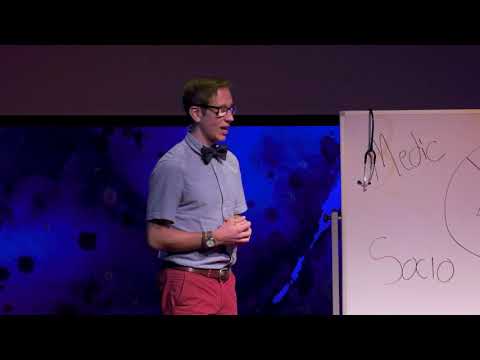
hello everybody so I’m a medical doctor
in my last year of residency training
I’m currently working at the family
medicine residency of Idaho down in
Boise and I have been in training now
for the last seven years learning how to
save lives in the next ten minutes or so
I’m going to tell you how to do that
so to start off with like you to picture
yourself in your favorite restaurant or
or perhaps any any public place really
out of the corner of your eye you
noticed an elderly person clasping at
their chest and they keel over on the
floor is anybody anxious I’m anxious and
I do this all the time
now something obviously needs to be done
in this sort of scenario and fortunately
for us there’s been people thinking
about this long before this scenario
actually really ever happened you want
to do things like dial nine-one-one
everybody knows 9-1-1 right that’s a
good number and do things like like
check for a pulse and see if that person
lying unresponsive is breathing and if
they don’t have a pulse not breathing
start thinking about doing CPR helping
them breathe so this scenario that I’ve
shared with you actually is something
very similar to something that happened
to a gentleman that I take care of in
the clinic last year I’ll call him Gus
for the purposes of this conversation
although that’s not his real name
spoiler alert
to give you a mental image of Gus he’s a
very slender fella has a beard about two
feet wide and three feet tall and when
he stands up it’s like he unfolds to six
foot five so Gus has been a smoker for
four decades and that gave him severe
lung disease and one day last year that
lung disease was acting up in a bad way
so bad in fact that it caused his heart
to stop beating
Gus died fortunately for him before that
happened he had called the paramedics to
his house and when they found out that
his heart stopped beating they
immediately started doing chest
compressions they rammed a tube into his
throat to help him breathe he was
brought agent Lee to the hospital where
he was given doses of adrenaline and
shocks to his heart and after a long and
harrowing resuscitation attempt a
heartbeat returns
we brought Gus back to life people in
residency have been asking me a lot of
questions are you really old enough to
have you done that before
my favorite response to that questions
now is my first one but one of the other
things that people asked me my friends
and family for the most part they say
Scott how is saving lives going lately
and I think that this image this story
that I’ve just shared with you about Gus
is the the type of image that they and
that we all have when we think about
what our healthcare system is up to this
business of saving lives but if you’ve
been paying attention at all in the last
10 or 15 years you’ve also heard that
our health system and our health is
failing us we spend a lot of money on
health it more money in fact than any
other country per person in the world
health care expenses are the leading
cause of individual bankruptcy in our
country as well but despite all of this
spending were we’re not doing very well
with respect to our health the World
Health Organization report released in
2016
ranks the United States as 37th amongst
all countries over the globe in terms of
overall health it seems that we have
become adept at resurrecting the dead
but do not know hardly anything about
helping the living to stay healthy while
they are still alive and this tells me
that we need a paradigm shift in how we
think about saving lives I’m going to
talk to you about the research that
leads me to this conclusion like many
so these researchers for the past
decades have been trying to figure out
in investigating which factors impact
our health as individuals and by
extrapolation our health as a population
they call these factors the determinants
of population health and they break
these determinants of health into
various categories excuse me while I
write four words up on the whiteboard
and for those of you way back there I’ll
be talking through the myths as well you
can cue the the background music now I’m
okay so the first category that they
talk about I’ve written jeans up here by
that I mean the factors that are woven
into our DNA the bodies that we are born
to the health that we can really not do
anything to change those sorts of
genetic factors I’ve also written
behavior up here so our personal
behaviors that have have relation to our
health your diet your level of exercise
maybe alcohol consumption or smoking in
the case of our friend Gus one couldn’t
help but think if he was able to stop
smoking at all in the last 40 years
maybe his lungs would not have gotten so
bad maybe we would have never been
talking about this whole episode in the
first place another category of the
determinants of health would be those
social economic and environmental
factors that impact our health where one
lives level of income and the household
level of education air quality in the
environment that you live all of these
factors play into our health as well and
then I’ve wrote or abbreviated medical
care up here you’ve probably wondering
what this guy’s the doctors he gonna
talk about medical care so so the last
category the medical care and that’s
kind of a two-part two-part ordeal one
being whether or not one has access to
care having health insurance being able
to access care is actually associated
with a decreased mortality risk before
anything else and then once you’re in
care when you’re in the clinic or the
hospital the quality of that care as
well so I’ve I’ve left the pie unsliced
because I wanted you to consider for
just a moment if you were if you were
the one slicing it up how do you think
that each of these relates to each other
which category do you think is the most
important as far as the determinants of
our health I hear a lot of different
answers out there that’s perfect so to
start off with I’ll tell you that genes
our genetics make up a relatively small
amount of the overall health as a
population and realizing that for an
individual that might be a different
story but
as a population a relatively small
amount somewhere in the order of 10% and
when you look at behaviors actually a
relatively larger amount in the realm of
25% leaving us with the socio-economic
factors and the medical care and this is
humbling for me to admit as a doctor but
the medical care actually pales in
comparison to those socio-economic and
environmental factors so if you were
designing a society that encouraged its
members to lead healthy lives how would
you be organizing your priorities if I
just gave you that information if you
are the one spending the three trillion
dollars that we spend on our health
every year what would be the first item
on your budget list I know that for me
actually my first dollar wouldn’t be on
this stethoscope and the medical care
that it represents I mentioned that we
need a paradigm shift in how we think
about saving lives here and I propose
that we call that paradigm shift saving
lives in slow motion
saving lives in slow motion what I mean
by that is addressing these sorts of
factors and keeping people healthy
before they ever have to start taking a
bite out of that pie sorry that slice of
the pie saving lives in slow motion
actually means a lot of different things
and I can give you a couple examples it
might mean decreasing our obesity and
our smoking and our addiction rates here
in this country it might mean a wellness
initiative in the workplace or paid
maternity and paternity leave it might
be building a new city park or
organizing your community or your city
in in such a fashion that was safe and
encouraged people to get outside and be
physically active it might be walking to
the bus for work instead of driving your
car
in the medical field specifically it
might be focusing more on primary care
rather than on expensive procedures it
is these things and many other things I
would be here for a long time talking
about them but in short saving lives and
still emotions is a long list of things
that we probably should have been doing
for a long time now I’ll also tell you
that there are barriers to saving lives
in slow motion for one it can be hard to
pay for or hard to convince people to
pay for when you’re not going to be
seeing results an initiative in this
sort of vein for years or even decades
to come
saving a life in slow motion is not
glamorous it’s it’s not that sexy it’s
not gonna get you on Grey’s Anatomy or
the next episode of house and saving a
life in slow motion doesn’t really make
doctors or hospitals millions of dollars
either but I am convinced that saving a
life in slow motion is our way forward
if we’re going to improve our health and
fix our broken health care system it
would seem that those behaviors that I
just mentioned in this day are actually
the thing that is overcoming us we are
doing open-heart surgery for $50,000
rather than helping one to control their
weight or to stop smoking long before
the heart attack long before the surgery
ever needed to happen this might be
motivating to you you might be asking
yourself what does this have to do with
with me maybe I don’t fit very
convenient to this pie with some numbers
scribbled up there and if you’re asking
yourself how do I fit into this this
whole discussion I think actually that
you would be the best person to tell me
how you fit in we all as individuals
need to take a role in terms of our
health as individuals but as a society
as well and so I’d like you to think for
a moment about your sphere or
years of influence where you sit right
now maybe keep them to yourself just a
little bit there’s a lot of people here
in a closed space you might be an
elected official in which case saving
lives in slow motion for you might be
being cognizant of how your decisions
impact the health of your community you
could be a business leader and maybe
that means enacting wellness in the
workplace initiatives improving your
employees productivity and health at the
same time you might be an educator in
which case your role in this discussion
might be introducing concepts of health
into whatever subject matter you find
yourself teaching you might be an
influencer in your household in which
case setting an example of what it means
to live a healthy life might be the
perfect and the right thing to be doing
because how often does they do as I say
and not as I do sort of strategy really
work out that often you might be a
karate master in charge of a dojo in
which case I think you’re doing great
keep doing what you’re doing but we all
individually have roles that we play in
this discussion of our health as a
society I for one am optimistic that if
we all get on board with this idea that
there is a healthier tomorrow and that
we we can make a way forward for
ourselves I look at things like our
efforts to decrease smoking over the
last decades so decades ago the rate of
of adult smoking in this country was
more than 40 percent that number is now
down to less than 18 percent clearly
that needs to continue to go down but
millions of lives and billions of
dollars have been saved because of that
initiative our children today do not
have to fear infection with things like
smallpox and polio because we have
treatment for preventing those
infections from happening before they
happen we have improved the safety of
our automobiles and
our workplaces and our food supply chain
so I look at these types of things and
cannot help but think if this is what we
have been able to do that that we really
do have what it takes to move forward
and I spend a lot of time interacting
face to face with with people in clinic
as well and and on a personal level I am
also convinced that I’ve seen people
have what it takes to to improve improve
health the people who with the new
diagnosis of diabetes are able to change
their diet maybe make a few tweaks in
their lifestyle and then they watch the
the diabetes melt away controlled
without any need of medications or to
bring up Gus for one more time that he
he spent a month in the hospital after
his heart stopped I don’t blame him
that’s that’s a pretty monumental event
but after being out of the hospital I’ve
been seeing him every six weeks and he’s
got a good regimen of hay of inhalers
for his lung disease and he is actually
doing relatively well the young people
who I take care of who are addicted to
opiates who through our medical
treatments and counseling are able to
regain productive places in society and
so I see these people these individuals
on a face-to-face basis and also see
what we have been capable of and and I’m
convinced that if we are all on board
that we do have what it takes to to to
to help our society become healthier
overall and fix this healthcare crisis
that we’re all hearing about I hope that
this discussion has convinced you of two
things the first thing is that I hope
that you see yourself as intimately
related not just with your own health
but with the health of those around you
and the overall health of our society we
truly are all in this together and
secondly and more importantly I hope
that you feel empowered from this
discussion empowered to know that you
have what it takes to save a life
that you have what it takes to prevent
problems before they happen and to again
improve the health of you yourself your
neighbors and everyone in our community
there will still be times even when we
do everything perfectly there still will
be times when things need to happen in
fast motion and when that does happen we
will still be here please pick up the
phone and give us a call we’ll be there right away thank you very much
Please follow and like us: