
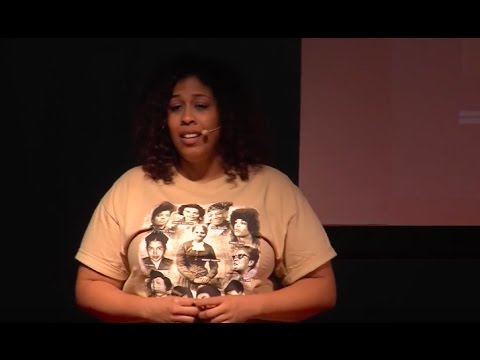
Mexico was a tri cultural state while I
like many of you did but today I’m gonna
challenge you all to think about this
try cultural concept a little
differently now earlier this year Time
magazine interviewed governor susana
Martinez about comments made by none
other than mr. Donald Trump her response
to those comments I listen to the people
of New Mexico
I represent New Mexico first and
foremost I listen to the Hispanics the
Native Americans and the Anglos now I am
a black woman born and raised right here
in New Mexico and this oblivious
attitude by many can make black people
like myself feel left out and invisible
I think it’s about time we change this
because I believe that New Mexico has an
obligation to honor and respect all of
now growing up in New Mexico there were
some things that I learned to do in love
I quickly learned to pick out red green
or Christmas for almost all my meals let
me be clear it’s always green for me and
fall in New Mexico means walking around
town and smelling that roast and chili
and those sunsets that are filled with
the most beautiful Reds pinks and
purples you have ever seen and the
Balloon Fiesta now I am a black woman
and I am a Mexican woman with a black
father and a Mexican mother I quickly
learned that New Mexico carries with her
like many places a history of prejudice
and racism see it was impressed upon my
brothers and I early that this blackness
this is something that you should love
you should be proud of and what we were
taught to honor and respect both of our
culture’s the reality is this is America
and woven within the fabric of this
nation is racism see black people in
this country have been legally
discriminated against for longer than
America has been an actual country now
it didn’t take long for me to realize
that there were some from this other
oppressed group that would take and
internalize these behaviors because of
physical features that my brothers and I
carry lean closer to our black side
that’s exactly how the world will come
to see us and I recall that my being
half wasn’t going to stop Mexican people
from showcasing their racism towards us
I vividly remember a time my mother
father and I we pulled into a gas
station my father stepped inside and a
man jumped out and started banging the
hood of our car with a crowbar you
nigger lover you betrayed us these were
some of the things that he said to my
mother I recall another time my mother
and I we went shopping
we headed into the mall department store
and I headed straight for the shiny
jewelry section I saw a piece I liked
and I asked to see it the lady at the
counter told me ma’am this is out of
your price range now I was young and so
an argument ensued and about that time
and she called over her supervisor and
it was about that time my mom walked up
and asked what was going on and the lady
said ma’am don’t worry we have this
situation under control
well it was also about that time that
they were informed that this situation
was in fact her daughter now I’ve had
many many experiences similar to these
growing up here in New Mexico in
elementary school I vividly recall black
history being given to me in the most
basic and shallow format see I remember
Harriet Tubman she freed the slaves and
Rosa Parks refused to sit at the back of
the bus and dr. Martin Luther King jr.
he had a dream now while all of these
contributions are vitally important I
just knew that there was more out there
now New Mexico it’s where I grew it’s
where I learned it’s where I made
mistakes but it is here that I learned
to love my blackness so I attended the
University of New Mexico I studied
history psychology and Africana Studies
and it was here that I gained a cultural
context of my blackness
let me ask has anybody here heard of
George McJunkin well he was a black man
and in 1922 he led scientists to the
discovery of bison bones right here in
New Mexico and these bones turned out to
be over 10,000 years old and it proved
that people had been on this side of the
country for much longer than originally
expected and what about William caffee
anybody know that name
well her birth name is actually Kathy
Williams and she was the first woman to
enlist in the US Army and this black
woman before she was discovered
but most of her service time here in New
Mexico and speaking of service I know
many of us have heard about the
wonderful amazing history of the Buffalo
Soldiers but did you know that some of
the oldest black settlements in the
country were actually towns right here
in New Mexico that’s right
we have Dora which was established in
the 1870s blackton which was established
in 1903 I mean look where we are at the
African American Performing Arts Center
that’s history but black people are
rarely if ever mentioned in these
historical conversations about New
Mexico now I have since unapologetically
shaped my life around activism and
advocacy for the black community
throughout the Diaspora and in my
learning one thing has become very clear
to me and it’s actually rooted in an old
but necessary counseling cliche it says
you cannot learn to love anyone else
until you learn to love yourself now
when I say that on an individual level
it resonates with people but if I speak
that same concept on a communal scale
people don’t seem to get it see black
people have been oppressed through
colonization racism sexism and
capitalism but the reality is that many
times cultural pride is mistaken for
hate when in fact cultural pride has
been the antithesis to hate here in
America now nowhere is this more
important than in education now I know
you’re probably asking yourself in
telling yourself not Christina black
people aren’t the only people to
experience racism or pain no we aren’t
but now isn’t the time to play
see see this is about representation in
2012 the University of Pittsburgh and
Harvard University did a study and they
combined found that when
african-american parents instill an
informed and sober perspective of race
in their sons and daughters these same
children grow up to experience increased
academic success this is because
representation not only provides a
historical content and an understanding
and a space for healing for these
children it also prepares children for
the very real monster that is racism I’m
gonna tell you all a real quick story
when my son was five years old in
kindergarten I picked him up from school
tears filled his eyes and he looked at
me and said mama I hate my skin I want
to take it off the white kids at school
told me that my skin was dirty and I
want to look like them now me being his
mama what I really wanted to do was go
find their parents and those kids and we
were gonna have maybe some type of
conversation but what I realized I had
to do was I had to step it up I had to
make sure that every time he looked in
the mirror pain was not what he saw I
had to make it my full-time job on top
of raising him to assure that the images
that he receives about himself and
therefore his people were positive in
2015 the black population in New Mexico
was 2.6 percent however the dropout rate
for black students was recorded at sixty
four point three percent that is the
second highest in the state now knowing
that adding a little bit of history is
not a cure for a long-standing battle
with systemic racism what this does is
tell us that it is about time that
those of us who are in these communities
take the lead and take charge and find
ways to begin this healing process now
personally you you can’t change the way
people are viewed in New Mexico and you
really can’t even change an entire
school system by yourself
but this cry for representation by black
people is not new and it is about time
that all of us stop and recognize our
own individual roles within these
problems so by recognizing that New
Mexico is not simply a tri cultural
state but is in fact a multicultural
state full of a vivacious history that
very much includes black people is a
necessary step in the process and some
of you all have the privilege to enact
now I wanna star just stop for a moment
considering everything we’ve talked
about today I want you to imagine what
other amazing black contributions lay
unearthed out there that you don’t know
about far beyond the Sandia’s thank you [Applause]