
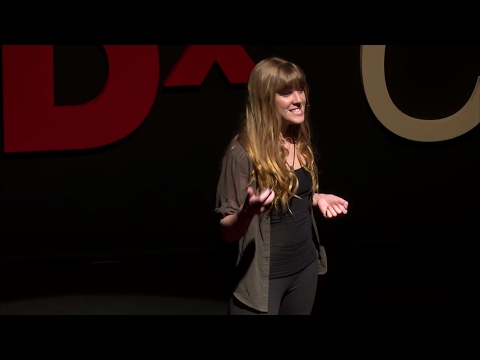
so hello my name is dr. Alison Vaughn
and here today I’m going to talk to you
about technology about animal learning
and about animal welfare but more
specifically I’m here to talk to you
about potty training cows now when
people hear about my research they
normally have a few questions questions
like why and how and are you crazy but
this idea is not as crazy as it first
sounds in fact I hope to prove to you
today the potty training cows has the
power to revolutionize the way we have
dairy cattle and serve as a template for
how we can use technology to meet other
challenges to production animal welfare
now some of you in the audience may have
picked up that by my accent I’m not from
Canada I was born on a small island just
off the northwest coast of Scotland and
it’s a very rugged it’s a very rural
environment and if you’d asked me to
picture a cow well this is what pops
into my head I had a very romantic year
of farming and machinery did not feature
heavily in that in fact I confess I was
pretty suspicious of technology when it
came to farm animals so six years ago
when I moved to Canada to study dairy
cattle welfare and I was faced with this
it was jarring
I’ve been studying animal welfare and
behavior for about 12 years now and this
contrast and my reaction to it got me
thinking about animal welfare how we
define it and what it means the animals
themselves now for most people when we
think of animal welfare I should say
what is good welfare in the first place
so what is good welfare well the short
answer is it means different things to
different people for most of us
intuitively we think of naturalness we
want an animal to have as natural a life
as possible now what does this mean well
there’s one study on Danish pig
production and public’s perceptions and
in that participants from the public
we’re asked to sort pictures of pigs
into those with good welfare and
with poor welfare now to quote one
participant being dirty is critical Pig
should be dirty the reason I put all the
other pigs in that other pile were that
they were just too clean that means it’s
pure industrialized production they were
clean and I don’t like it and that goes
for the one with the curly tail – it was
nice and curly but too clean should have
been dirty now it’s funny because if I
talk to my vet friends and I ask them
what is good welfare they’re likely to
talk about the health of the animal we
want to see an animal that’s free of
injury free of disease and probably
clean in the field of animal behavior in
welfare we often focus on the animals
subjective experience what does that
animal feel what does it want I’m
driving around on a sunny day and I see
cows in a field it looks nice but if we
ask the cow herself what she wants
actually unbalanced they’ve often prefer
to be inside out of the hot Sun in a
cool barn with food and water and when
we want to tuck our animals in at night
while they’d often rather be outside
laying in that cool grass in reality
good welfare needs to balance all of
these approaches we need to have happy
healthy animals that are free to perform
natural behaviors dairy farmers have
embraced technology to meet these needs
if you go to most dairy farms in the
Fraser Valley you’ll often see it looks
like a big mechanical brush like
something you’d find in a car wash if
you hang around for a minute or two
you’re likely to see one of the girls go
up hit it to start it turning and give
herself a good all-over scratch a
massage
now scratching is important behavior for
cows it also helps keep them cleaner and
reduces parasites and if ever you have
seen a cow use one of these you don’t
need me to tell you that they really
love it so we also have automated
milking systems so rather than the
farmer coming taking the cow to be
milked twice a day they have milking
units within the cows pen she can go
whenever she wants to be milked and
that’s how it happened
now this is good because the cow is able
to be milked in a more natural schedule
but what’s really interesting to me is
that it changes a relationship with the
car replacing her in as an active
participant in her own care we wanted to
embrace this approach and apply it to
the challenge of keeping cows clean now
anyone who’s ever been in a cow barn
knows that cows produce a lot of manure
cows produce on average around 15 liters
of urine and 30 kilos of feces that’s
per cow per day so for your average BC
farm of say a hundred cows they’re
having to deal with 1500 liters of urine
3,000 kilos of feces every single day
now that is a lot of mess to clean up
and because of this barns are often
designed to make removing manure easier
we want to keep the cows out of the
manure but some of these designs and
structures to make removing manure
easier can compromise the cows comfort
and may also restrict her behavioral
freedom so what if we could potty train
cows
potty trained cows would mean it has a
Barnsley designed around cows not manure
it would mean reduced ammonia emissions
it would mean less cost and labor for
the farmer I would mean a better
environment for the cows but excitingly
it would also provide cognitive
enrichment for the cow animals love to
learn and I know cows don’t have a
reputation for being very smart but that
could not be more wrong
I’d like to share with you a video from
the UBC’s animal welfare program which I
hope shows you how much they enjoy
learning so this calf has to touch the
starter button on the right this changes
the colour of the screen if it’s a red
screen she touches it when she gets her
milk
if it’s a white screen however she has
to resist that temptation so they’re not
so stupid after all it’s okay she gets
another red school so cool
cows are smart but does that mean that
can be toilet trained well truth be told
there wasn’t a whole lot of research on
this so we set out to see if it could
work we conducted what we call a proof
of principle experiment we wanted just
to see if cows could learn to associate
a specific location with this behavior
in this case we chose urination because
it’s easier to artificially stimulate so
we’d bring our calves individually we
pop them in their potty stop and we’d
give them a diuretic which just meant
they would urinate quicker so they
didn’t have to wait in there too long as
soon as they urinated we released them
they got their milk reward the following
day would be a test day on the test days
we just put the calf in the stall and we
waited to see what would happen if the
urinated fantastic we rang the little
bell we released them they got their
milk if they failed to urinate well too
bad they exited it into a little timeout
pen and the next day they had another
training day so did it work this is one
of our girls you’ll see at the beginning
she’s really trying to pee it’s a bit
like being at the doctor’s when you have
to pee in a cup sometimes you need a
minute or two
this girl’s pedigree name is UBC page
star and boy did she live up to that
name
she needed just one 15 minute training
session she’s about to do her trick here
she urinates and she goes out to get her
award so this calf as I said she just
took one 50-minute training session
every single day after that we popped
her in that stall and she peed and
actually five out of the six calves we
trained urinated more than their
controls and this actually got me to
thinking whether there may be something
to a name because the one animal who did
not learn well her pedigree name was UBC
cage idiot I’m not making this up so
this was all very exciting we proved
that they can do it but realistically we
don’t expect farmers to go around
training every single one of their
calves individually it’s just not
practical so I turned to technology now
as I said I’m not really that into
technology so I teamed up with UBC’s
engineering physics department and an
amazing student called John Harvey and
together we came up with this this is
the interactive camera urination
defecation training program as we like
to call it the ICU pee so this unit is
really for detecting urination
defecation it’s just that piece of the
puzzle it would be mounted above the
calves pen and it consists of two
cameras we have a visible light camera
and a thermal camera I’ll show you a bit
of what the visible light camera allows
us to do so with this program we throw
out anything that isn’t black or white
we clump together the black and white
blobs to make this sort of size of a
calf and it allows us to track
individual animals as they move around
the pen so we know who they are we know
where they are with the thermal cameras
were able to refine that a bit because
the head of a calf is a little warmer
than the rest of their body so we can
sort of see what direction they’re going
in and the cool thing with the thermal
camera is because the inside of a cow is
a lot hotter than the outside when they
urinate or defecate it shows up bright
spot we look at whose bottom is closest
and we assign it to them so we’re just
in the process of validating this now
the next step will be to give feedback
to the calf to let them know hey you got
it right and let them go and claim their
rewards
I really believe it’s just a matter of
time before we have a fully automated
potty training cow system that will
allow us to train and collect
automatically reducing emissions
reducing labor and improving lives for
cars technology doesn’t have to be scary
and I think the way in which we’re using
technology can change it doesn’t just
have to be for automating things that we
already do it can be for approaching a
problem in a whole new way I really
believe that technology and
out-of-the-box thinking hold the key to
restoring the balance in a relationship
with the animals that produce our food
and I think that’s something we all have
a moral responsibility to care about thank you