
least it feels that way to me and and
oftentimes I I just want it to slow down
I just want to take a moment you know so
much change I mean call me nostalgic and
at the risk of dating myself it wasn’t
that long ago that great music is
something that you went to the store to
to buy and you could pick it up and
contemplate that purchase and turn it
over and read it before making the
purchase rather than streaming it online
it wasn’t that long ago that reaching
out to a loved one or a family member
and saying hey or I love you was
something you spoke aloud and you did
suit so with a device plugged into the
wall that my son wouldn’t even recognize
it wasn’t that long ago that coming of
age and the personal freedom of the age
of 16 came with a driver’s license and a
set of car keys not a snapchat account
and on the political front you know it
wasn’t that long ago that England was a
pillar of the EU and and this gentleman
was a purveyor of fine ties and steaks
and the Democrat you know so much change
in fact amidst all of this change you
know isn’t it often that we feel a bit
unstable or a bit unsettled you know in
college I studied physics and electrical
engineering these were two topics that
were rooted in the scientific method and
the scientific methods all about
observations and hypotheses and theorems
and you’d use those things to interpret
the natural world it was tangible
concepts you know theorems like objects
at rest remain at rest unless acted on
by an external force
these were concepts that were tangible
enough that my engineering oriented
brain could use that sort of as a cloak
of comfort that that was how I felt
comfortable in this world of sweeping
change but today and by the way the
scientific method is also a means of
predicting the future but in today’s
world you know the world seems anything
but predictable anything but certain
so the engineering they wanted a theorem
that I could latch on to that would let
me feel that place and grounded in this
world
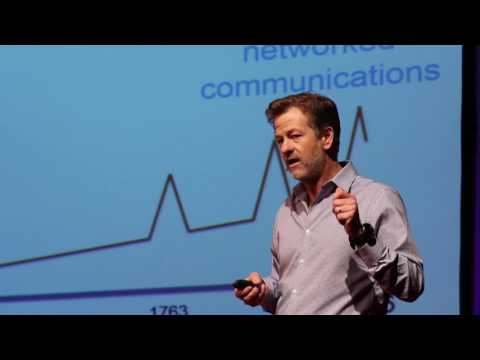
and as I look back across the sweep of
recorded history I saw a pattern now’s
not the only time when everything seemed
to be changing in fact there have been
four periods in history where there was
sweeping change and changed that
happened at an accelerated clip as if as
if the world moved forward at dog years
for some finite amount of time and in
those periods of change everything
changed all of the layers of society
forms of government means of Commerce
modes of transportation the materials of
construction as we heard about earlier
today the distribution and the creation
of wealth and and literally where and
how people worked everything would
change at these compressed moments and
as I looked deeper at it the pattern
that I saw emerge was that at each of
those junctions in history those periods
of radical change seemed to coincide
with Mo’s or times when there was a new
communication paradigm and a new energy
paradigm we walk you through that so
let’s go back to the first instance of
this 10,000 years ago and the energy
paradigm was stored grain and with the
at the ability to store food energy and
nomadic culture shifted to to farmers
and cities and towns emerged and the
energy paradigm coming and that
communication paradigm was written
language and we evolved from spoken word
and you know transmission of ideas
through tribes to scripture and and at
that point in time documents were formed
scripture you know religions were put to
tablets and disseminated and again
everything changed
fast-forward now thousands of years to
the next major revolution point in our
schoolbooks we all know if this says the
Industrial Revolution the new energy
paradigm was the steam engine and for
the first time the ability to harness
power to drive steam engines and steam
ships and factories and the
communication paradigm was the printing
press moving away from monks
transferring tablets one at a time to
the ability to disseminate ideas for
broadly whether it was religious
treatises political ideologies or
advertising how do you influence a far
larger crowd and at this point in
history everything changed
work moved from farm to factory wealth
began to shift from nobility to merchant
class everything changed
step forward again somewhat faster clip
now a hundred years and we’re into the
1870s the new energy paradigm was oil
and its partner the internal combustion
and the communication paradigm with the
telephone Thank You Alexander Graham
Bell internal combustion engine let us
make power portable and with that came
the car in the airplane electronic
communication the telephone meant that
the world that in the past had been
distributed by days or weeks or months
could suddenly be instantaneously
reachable and with that again everything
changed
democracy began to flourish and change
at the government level work began to
move from factory to office sweeping
change destabilizing change so it brings
us to today and I would contend for any
of you who feel a bit unsettled by the
recent turns of events over the last
months or years even I would contend
take comfort with me and the fact that
we are in a period of change like that
again and the two paradigms that are
shaping this age that we’re in now I’ll
contend our sustainability you’ve heard
a lot about that today and networked
communications in all of its forms
Facebook Twitter snapchat but network
communications meaning in my pocket
buzzing periodically I am connected to
literally millions of people around the
world it’s no longer just one two on
phone but literally I am connected
everywhere and these two elements
sustainability and network
communications they weave themselves
into the DNA of every layer of society
that is now being rewritten right so
this is a moment for revolutionaries
this is a moment when the crazy ones as
Steve Jobs has popularized do bold
things when they drive human life
forward you know Steve talked about the
the crazy ones being those people that
are crazy enough to believe that they
can change the world and as such they
are the ones who do right so this is
that do-over moment so while I might
feel at times as though the world is
rushing at me too rapidly I turn that
around rather than being a victim of it
now is the opportunity to be the actor
right to be the change agent so in these
periods of change and judging from the
patterns of the past what can we
anticipate what wicked can we predict
well we know that revolution can be
sudden I’ll give you an illustration
from the transportation revolution at
play now uber invented in 1999 in San
Francisco five years later
yellow cab the industry of for
transportation by taxi that had existed
for 80 years prior was bankrupt we also
know that revolution can be messy 200
years ago in Paris a couple of
revolutions ago they stormed the
steal last summer they were burning cars
and turning them over in response to the
transportation revolution we should
brace ourselves if there’s friction when
change happens like this we also know
that revolution is transformative these
are not periods when incremental change
happens these are periods when we
completely rewrite the plumbing of
society again I’ll touch on uber the
taxi industry in San Francisco before
they existed was 140 million dollars an
enormous industry stable predictable
reliable five years later after uber
uber had not only driven the yellow cab
to bankruptcy but uber in San Francisco
alone was a five hundred million dollar
industry this is an incremental change
this isn’t taking market share for
business people here this was completely
recreating the notion of an industry
three times larger we also know that
today with this guiding hand of
sustainability as the energy paradigm
that this revolution is sustainable that
means at all levels in construction in
governments in commerce in the nature of
work sustainability will leave its
fingerprints and there are countless
examples but here’s one that I find
incredibly evocative this is ollie
say hello to ollie this is a 3d printed
recyclable electric autonomous bus
that’s driving on the streets of
Washington DC today this would not have
been conceived of without that silent
forcing hand of sustainability this
would not exist or operate without the
concept of network communications I hail
it with an app in my pocket today right
this revolution also is personal and
network communications play into that a
whole host of solutions many that are
familiar to you and many perhaps that
are that will be new are now in our
pocket that are making this a uniquely
personal revolution uber we talked about
that my personal driver post mates if
you live in a major city an app in my
pocket that with a tap will bring food
from any restaurant might want to my
doorstep in minutes up work my personal
workforce the ability to reach in my
pocket tap a phone and reach an employee
somewhere on the planet to do a unit of
work an expert that I could hire
economically efficiently Airbnb my
personal castle unlocking three
million-plus and Counting properties
around the world and unique travel
experiences anywhere you might want to
go and I’d say I’ll share with you
liquid space my personal office now this
is where I’ve landed in this age of
revolution this is where my passions
have taken me my personal office now
before I
into the concepts a bit further let me
give you the backstory now a quick quick
primer on on how commercial office works
and how it’s worked for the last hundred
years since the last revolution basic
premise is commercial office buildings
are available for you to put your
company in it right and the business
model is signed a long-term lease
usually no less than five years
oftentimes ten years or Plus that means
companies have to make a big decision
where will I plant my company and where
will I tell all the employees to come
for me my first encounter with this was
when I was a first-time CEO in 1999 in
Silicon Valley I just raised 15 million
dollars I needed space for my firm to
grow and I ran headlong into a lease
requirement of 5 years I had no bloody
idea of what our company would look like
in five years I really couldn’t predict
it for three months but I signed that
lease two floors enough space to grow to
how large I thought we might be we never
even moved into half the space and so
all that extra real estate I was paying
for could have been employees I was
hiring to build the business more
effectively today the reality of what
companies need from an officing
standpoint yes it’s often times
headquarters but they also need to put
satellite offices in multiple regions
they also need for startups a place
where the time commitment for office
could be far shorter to keep pace with
their growing firm and as many of us
probably know work doesn’t just happen
in the office anymore it’s not a place I
go it’s something that I do
regrettably perhaps I can reach for the
phone on the bedside table in the
morning or before I go to bed at night
and check my email we all do right work
is everywhere now internet is everywhere
computer computing is portable but
sometimes places to a company that are
needed
that’s workplace in the unit of hours
okay now it’s so so for companies today
the old real estate model that last
revolution bought us of ten year lease
commitment just doesn’t fit it turns out
that the old model is also quite an
efficient for building owners a quick
lesson on that I’ll use a story that you
maybe heard in grade school teacher
walks into a classroom and puts a glass
jar on the table fills it with rocks and
splashed the classes that is the jar
full the class says yes it’s full
teacher then puts gravel into the jar
and fills the spaces between the rocks
ask again is the glass full glass says
yes it is teacher then puts sand into
the glass you know the class is getting
wise to this teacher then puts water
into the jar and fills it up to the brim
to show the class a lesson hey if your
life feels busy there’s always space to
a little bit more that is the story of
our built landscape today the rocks are
how we try to fill buildings and we
never fill them we’re wrapping up one of
the best years in commercial office
history here today in with the strength
of our current market yet our commercial
office building landscape is over 10%
empty at any given time because you
cannot fill a vessel with rocks alone
need the gravel in the sand in the water
those extra pieces sit there empty yet
the building owner pays for the entire
building but it’s worse than that
in addition to the empty spaces the
building owner hasn’t filled there are
unlucky shots like I was in 1999 that
made long-term lease commitments they’re
only using half of the space that they
leased so from a sustainability
efficiency standpoint or an economic
butyl ization standpoint very very
inefficient moreover on purely
environmental terms the building model
the real estate model that the last
revolution brought us is woefully
inadequate under today’s lens of
sustainability you’ve heard some of
these numbers and a couple presentations
ago 79 percent of US electricity
consumption is powering our buildings 39
percent of our carbon footprint on a
planet that I’ll tell you again is
warming is going into the buildings that
are sending woefully underutilized in
fact and this is the grimmest statistic
of all even a building that may be
leased a hundred percent that companies
are occupying the reality is based upon
survey after survey that the typical
officer desk inside of an office
workplace is only utilize 30 percent of
the workday it’s to say nothing of the
after 9:00 to 5:00 so what is what’s
called for what does the real estate
Revolution need to do I think it’s clear
we have to fill the jar we have to fill
the jar of the existing built landscape
that’s already out there and it’s well
in play the same patterns that have
shown us how to transform things like
transportation with apps in our pocket
are also now transforming real estate
and the two big pieces that were needed
were one let’s use technology let’s use
networked communications to rethink the
way that real estate transactions can
happen let’s put it online the internet
now is where office transactions can
happen the second piece is a bit less
sexy but no less critical and that’s the
legal framework part of what held us
behind and held us so long in the old
revolutions model of long term leases
was that lease document
every commercial office transaction
requires attorneys on both sides brokers
to interpret a custom contract just to
occupy an office that’s being done away
with now as standardized in simplified
models that are akin to the contract you
might sign at a Marriott hotel are
sweeping through real estate online
simple and end-to-end
so what’s it looked like from the front
lines well I’m happy to share that the
owners of buildings and the companies
who have put leases out are embracing
this revolution those those spaces
between the rocks are starting to become
available companies are putting those
empty spaces onto platforms like liquid
space they are finding a way there they
have a motivation to fill those empty
slots and likewise to the professionals
on the go to the CEOs of startup
companies and the real estate heads of
large enterprises they too are embracing
the real estate the the revolution
they’re giving their employees mobility
and choice they’re looking to make more
efficient uses rather than just numb Lee
signing up for long term commitments and
so at these periods of revolution where
new ideas sweep in and where the fabric
of society is rewritten oftentimes
there’s an old guard that swept away and
you can plot that with Peaks economists
today are pointing at peak oil for
example a point when oil production and
demand is actually falling off in fact
they think we may have hit it likewise
with the advent of revolutionaries like
uber and Google and Tesla who are
working on autonomous cars people are
actually talking about peak car and it
may be that we’ve already hit peak car
with my passions applied into office and
many others out there working on similar
things I think we can now look in this
revolution at the phenomena of peak
office and looking backwards for the
last hundred years I’m ready to
characterize that as the rise of the
industrial real estate complex where we
built big things we built dams and
highways and skyscrapers but we did so
without any accountability to
sustainability economic or environmental
but today with the new flexibilities
that are being applied to how the built
landscape can be used with things like
the Airbnb of office happening I think
we’re gonna be able to characterize this
era as the great era of unbuilding let’s
share and utilize and harvest the
buildings that are already constructed
and let’s all delight in that
and so hopefully 10 30 50 years from now
someone on a stage in the future or some
historian will look back on this era and
to some of the crazy ones that were out
there that dared to imagine a new model
for real estate and my hope is that they
will be able to look back and see this
as a period as an outcome we’re more
happy people were working in fewer
buildings and the planet smiled back at
us thank you [Applause]