
lot of doubt it’s full of doubt I don’t
know I don’t know the scissor I have the
answer or anything but it seems to me
that my discipline architecture has a
has a real problem about place and it’s
driven by two aspects of Technology and
it all started on the thirtieth of sep
tember 1968 when this work of genius the
Boeing 747 was unveiled to the world and
it started the process of mass mobility
for the world so that now this is the
data from iata about flights in the
world huge numbers of people flying
equivalent to half of all the world’s
population the equivalent half all the
world’s population will take one flight
in 2016 we are desperate to be somewhere
other than here we are desperate to be
be traveling somewhere else also in the
60s the Space Age began and we started
to be able to float satellites around
the world incredible incredible thing to
be able to do and as a result of that we
have the second big push of technology
as mass mobility and mass connectivity
so there are 10 billion telephone calls
made per day 10 billion telephone calls
we are desperate to be talking to
somebody else somewhere other than where
we are so we want to be somewhere else
and we want to connect to something else
all the time all the damn time this is a
real problem for architects and so we
end up with a complicated diagram and
I’m not going to explain it it has two
axes horizontal is the axis of mobility
more mobility at one end less mobility
over and vertically the axis of con
activity wanted to be connected and we
exist in a confused mess in the middle
maybe you’re not confused but we are he
takes a very very confused let me show
you some of the impacts of this if we
take the traditional city of which you
have thousands in Italy the historic
city was somewhere fixed input in space
and time and we had no choice beautiful
absolutely beautiful and the wonderful
thing about it was architects were in
charge we had complete control whereas
now modernity produces environments of
nowhere like this there’s no season
there’s no day or night you neither here
nor there you do know will know where
you are it’s ambiguous sense of place
and time this is modernity we also have
the algorithmic algorithmic developments
with the same idea reproduced here and
there and everywhere so you travel but
it makes no difference you arrive
someone that was just like where you
left it’s a real problem for architects
this another sense of a sense of
everywhere everywhere being the same the
hotel’s the same the buildings the same
and then we get this wonderful
phenomenon Italy kicks a foot ball into
the net on one side of the world and the
Italians in the pub in London go berserk
simultaneously this is the first time
this is possible that this could happen
in history that emotion can go from one
side of the world to the other side of
the world like this so where is the
football match taking place where is
place is he in the pub or is it at the
game and now you’ll see in the newspaper
it is a picture like this if it was a
big big result it’s the picture in the
pub not the picture of the game which is
the most important thing and also you
have this experienced ignore this is an
advert for
a mobile phone so floating in a hot air
balloon above the wonders of Dubai
that’s the one time you need to be on
the phone to somebody else somewhere
else not experiencing the thing which is
taking place around you and you see this
all the time in restaurants two lovers
talking to somebody else when they you
know so experienced ignored so like in
very ambiguous how are we where are we
where are we are you up in the sky
you’ll never guess where I’m calling you
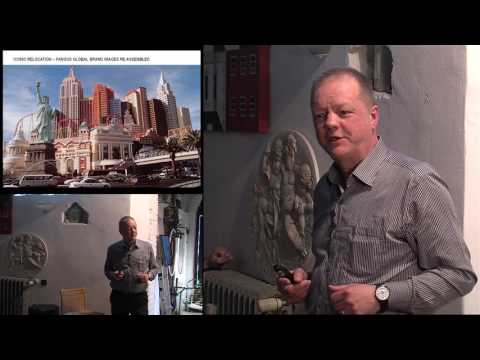
from or you get ideas like this we get
famous icons collected and just
assembled in the place wish again where
the hell are we are we in New York no
we’re in Las Vegas as it turns out but
it doesn’t really matter so what can we
poor architects do about it what can we
do against because it’s so powerful all
this technology much more powerful in
architecture which is this old-fashioned
play something about place well I’ve
been playing around for the last couple
years buying to ignore traditional
architecture which is really material
architecture that lasts and lasts and
lasts buildings streets infrastructure
all of this earth and instead thinking
about the architecture of things which
change very quickly that are disposable
but are not serious and enduring
inspired by some architects again from
the 1960s Archie Graham from London who
were passionate about this idea of the
architecture of change rather than the
architecture of permanence so we worked
at the southbank centre we took a
nowhere like at the top and made it into
into a gar we take a problem of
disconnection in the kind of concrete
nowhere and for no money we just add
some containers on some throwaway bits
and pieces and make a great Civic
staircase we take another biscuit
act of a miserable place and add some
jolly bit of color a bit of connectivity
a bit of people life and that seems to
work we take a miserable piece of
architecture like this which is just
temporary and throw away add some colour
for no money and suddenly inside it
becomes a place to have your wedding
photographs taken so making architecture
and emotion out of throw away nothing
and you end up with a up celebrating the
temporary rather than the permanent in
architecture is perhaps a way forward
for us to tackle this this thing that
architecture has lost his power place
has lost its power perhaps is the way we
architects can bring emotion back to
place because there’s been a shift a big
shift from the architecture of
permanence of space of form which is
very important in architecture to an
architecture of transience of networks
and the surface and that’s the paradox
of place the paradox of places that we
demand mass mobility mass connectivity
and freedom from place we have to free
ourselves from place but on the other
hand we also demand local authenticity
we demand vivid experiences we demand
engagement with place at the same time
and we have these two things that I had
simultaneously it’s probably more of a
problem for me as an archetype and it is
you for a member the public but
nonetheless that is the paradox of place thank you very much