
thank you thank you for being here
however you want to change the world you
need funding
but the good news is funding you mean is
all around us in fact I believe that by
looking at problems differently and
adding some creativity there are
essentially unlimited funding
possibilities so let me explain what I
mean by telling you some short stories
the first story is about an important
failure the other four have chosen
because each one involves a different
solution for seemingly impossible big
problems and none of them involve
government funding for fundraisers so
let me start with the failures my
failure in 1979 I was becoming
increasingly upset by the stories I was
reading in the news about the yet deniz
boat people refugees fleeing that
country after that war because of
terrible oppression they were leaving
behind everything they knew crowding in
the leaky boats setting out to sea and
in many cases being brutalized by
pirates I was also angry about this I
was angry at the United States to me
this was a humanitarian issue but it was
also a matter of responsibility the
United States really wasn’t doing very
much for these people at least at that
time and the more I thought about it
well I came to a realization that before
I complain about what other people
should be doing I really should look at
myself what was I doing about this I was
young was partway through law school I
had no career family no mortgage what
was my excuse so I decided that I would
go to the refugee camps
first they had to find a leading
humanitarian organization that was
already doing this they were British by
the way I contacted them explained my
desire answered some of their questions
and the very politely said no thank you
so I discovered that my care and my
commitment were a good start but I
really didn’t have much more than that
awful all I could do at the time all I
could think of to do at the time was to
trying to raise awareness of the problem
as a photojournalist
so I scraped together what Lane I could
I’ve been able the freelance assignment
from a newspaper and I went to the camp
said these are just some of my favorite
photos from being there every place I
went I was mobbed so it was really
actually pretty enjoyable still at all I
had failed my caring and concern alone
were really not enough so when I got
back to law school I put some time into
thinking about this and I realized that
almost any social cause is that any of
us care about need funding and that’s
what I focused on finding ways to create
new funding sources for the social
causes that we care about
I call it nonlinear funding and the key
to understanding this the stories we
have but when you’re conscious of it or
not there are revenue streams flowing
around us all the time every day we
can’t necessarily see them but they’re
there and what I determined I needed to
do was find the way for each of these
clauses to identify the right revenue
streams and then create some way to bend
some of that to the social cause that I
cared about I’m going to tell you four
stories that I worked on there I’ve
arranged them to start with the simplest
one
sort of move up in complexity and size
as we go forward the strategy in each
case is the same the solutions are
different but I think when you look at
these collectively you’ll come to
understand what I’m talking so let’s
start with Story number one Story number
one I was contacted by a small urban
high school serving low-income families
in another city and they were doing
remarkable they charged virtually no
tuition yet 100% of their graduates were
accepted to college 100 percent went to
college and 100 percent of finished I’ve
never heard of that from another school
that was pretty remarkable now they were
working in rented space very crowded and
they had no assets so they’re
essentially living hand-to-mouth with
whatever they could raise each year to
keep their doors open and everybody
loved them they loved the outcomes but
the donors were getting fatigued so what
was the issue here what was the
challenge this was the fine financial
sustainability something long-term
to support this school so that it
continued to do us good work to make it
a little more difficult for me the
school said you can’t access any public
sources of money you can’t raise tuition
and that’s kind of why we’re here is not
to charge tuition and our staff is
already working very long hours so you
cannot assume that there will be
increase in the annual fund race
otherwise in office so here’s the result
this is actually the solution this is
their learning campus now it’s an eight
acre wooded campus all new construction
designed just for the where do you teach
and they have a multi-million dollar
endowment and new revenue strands so how
did we do this one it’s a campus two
buildings you can see the academic
building and the athletic build and when
I started this process with them their
big dream was to someday have a
gymnasium of their own this is their
gymnasium and their students but my
strategy here was to actually come up
with a campus that was better than what
they’re asking for and what we put on
the other side of the athletic building
is an indoor soccer field the only
indoor soccer field in that city
these are their students using it during
the day but when they go home at the end
of the school day other people come in
the evenings and weekends other schools
clubs not-for-profits play lacrosse
soccer or whatever and with those people
who come to the campus who are attracted
to this campus come the revenue streams
my green arrow the revenue streams that
work for the school and those revenue
streams are continuing they come in
every day and as I told the school this
campus is going to be your biggest asset
and you really should look at it the
same way you would in and out it should
keep working for you
going home so that’s what it that’s what
we did the strategy was to design
something even better for the school of
the students that would effectively
import people and rebels
story number two this is the current
project it’s bigger and I think it has
more scalability there are more places
for this to work in this case I was
contacted by an urban elementary school
a charter school but they’re housed in a
very small very overcrowded worn-out
temporary building sitting in a parking
lot was adding stress for the students
as well as the faculty and of course the
school had no money for a new facility
making it a little more difficult this
is the neighborhood where the school is
located and in fact so we have some
difficult conditions these images are of
the site where the new campus is going
to be and I still remember going in this
location the beginning and standing
there turning around slowly and thinking
how am I going to do this I don’t I
can’t imagine coming up with any way to
attract people and revenue streams for
this new campus nice as we will be until
this community really lifts up and
changes for the better and I’ll tell you
at the outset here right I really didn’t
know what I was going
and that is normal when I start with
these things I never know where we’re
going to take it but I started with the
way I always start and that is to get to
know the students the families and their
goals for those students staff the
school the community the city that it’s
you know I try to gather up as much
information as I can walk the
neighborhood sit in the classrooms
any information I can get is somehow
going to help me find what therefore we
put in employment in this instance so
here’s a quick sketch of the campus the
answer here is to export this campus
which i think is about seven acres of
property the circle in the middle is the
school’s kitchen and so we will over
build the kitchen and indeed it will
obviously feel good the students with
their staff but we’re going to export
the more affluent parts of that city so
that kitchen is also going to be selling
food under contract to a sizeable and
university elsewhere in the simulator we
also added some job training the kitchen
and a small bakery for the neighborhood
on the Left what you see there
greenhouses a nursery and a little bit
you can see a small farm actually for
these urban children and again if we’re
going to export here we’re going to
export plant materials to landscapers
who work elsewhere in the city selling
all of this at the same price as
everybody else so we still have to
deliver the quality on time reliably but
we’re going to export and as we export
those income the revenue streams for the
school so again this was not really what
the school had in mind but
happy with the plan and that’s what
we’re going to do you can see a campus
here and actually on the right are the
classroom buildings laid out efficiently
and securely we added a few nice touches
there’s a little sand carton in there
there’s a butterfly house gallery it’s
going to be a very peaceful secure
environment the kitchen as you can see
right in the middle of the screen if you
look closely you’ll also see the
shipping dock there for our food sales
and the entry of the small bakery that’s
there and then on the left you can see
the nursery and even our little farm
where the kids would be able to attend
some raised beds it’s really going to be
a wonderful environment so different
solution different situation Story
number three Story number three I was
contacted by a group of educators who
wanted to open a new high quality
college prep high school in a low-income
community in a large city and they told
me that they wanted it to be free so I
said after three years here but start
with what you’ve got that you share with
me what you’ve got
I remember very ceremoniously they got
home and I’m pretty sure was two pages
they had a neatly tight mission
statement a handedness to me okay this
is where we’re going to start this is
what you’ve got and what it did is it
reminded me it went back to here’s the
caring here’s
commitment what’s missing how are we
doing the Solomons so again I set out to
understand more of who these young
people were what their needs were what
their families dreams for them or about
what the educators wanted to achieve
here local community the city that they
were added etc and what I concluded was
that what these young people really
needed what all the other people is more
experience more confidence and more
aspirations and I also concluded that in
this instance we’re not going to buy or
build a new campus I argued rather
strenuously I’m going to rent some space
inexpensively to get started we have a
lot of other things on our plate I said
well do you want open a school in five
years is this tenure is when do you find
out for the school I remember these big
grants you know remodel the school next
year okay so what I ultimately decided
was that what these students needed was
more than just collecting academic
credits most of them did not travel more
than a couple of blocks for the
neighborhood they needed that experience
so in my mind I felt we needed to create
we need to enhance the educational plan
and to do it in a way that work for the
students but also I can tell you that
the next year we opened the school
successfully it’s still there
and today there are 32 of these schools
in the United States and quite a few
more in the works nationally from all of
those schools they’re graduates 99% of
them are accepted to college so what was
my nonlinear solution here I decided
that what we would do is have the
students in the classrooms for extended
days
we still have to have the clock time to
get those wonderful eternity and
instigated ecology but the other day of
the week every student those works an
internship in a professional setting law
firms banks corporate headquarters
entry-level positions making copies
filing where people start but what that
does is it puts them in the adult world
as participants they’re having adult
responsibilities adult conversations
adult relationships that is really what
makes the difference now to do this we
had to secure the business funds so we
ran instead of a capital campaign
remember I’m not building a campus field
campaign and we went around to the
businesses and got pledges for
entry-level positions a year in the
future and we had all of those locked up
before the school over I’m going to show
you now how it worked for one student at
that first school it’s a short video
clip very senior Alex Macias remembers
her first day on the job
arriving at the looming corporate towers
of downtown Chicago was the culture
shock of her young life what do you get
out of this I think it’s the experience
I mean it’s been the experience of a
lifetime so what does your resume look
like already it’s great I mean I’m gonna
graduate high school saying that I’ve
worked at four different corporate
offices for most of these kids the idea
that they could succeed at anything is a
revelation in these offices they learn
just how far they can go were looked at
as equals you know it it surpasses that
were Hispanic it surpasses that were 16
17 14 and says you know here go into the
corporate world it Dustin to work in
these big buildings and who knows maybe
ten years ago the Chicago community had
a dropout rate that soared as high as 75
percent
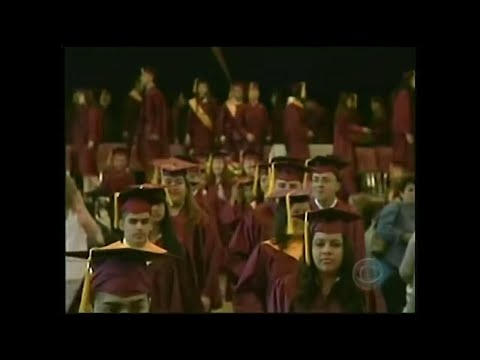
for the Cristo Rey class of 2004 the
dropout rate is 1% and everyone of the
students marching today has been
accepted to college Alex Macias was
accepted to several colleges her choice
was made easier by a phone call from
Ohio Xavier University ilex graduated in
the top 10 of her class and the girl who
had never been downtown before who had
missed only one day of work in four
years reaped her reward I just talked to
the Dean of Admissions from Xavier and
they’re gonna give me the 15,000 plus
another presidential scholarship or
something like that all the rules the
work
the discipline came down to this joke
that every time I see you never I can
never get asked that but it works and it
works pretty much that well for
everybody goes through this system I
really believe in this model and now I
have to show you the other part this is
so you can understand how it works yeah
they taught me I’m sorry first I had to
create the school as a 501c3 a
tax-exempt so far so good and indeed a
donors want to give charitable
contributions they still make those to
the school we did decide that the
families to pay some tuition maybe
$2,000 a year but here as you look at
this you can see it’s a little unusual
there’s our
plan what I did next was create the
subsidiary corporation of the school and
that corporation contracts with the law
firms the banks business sponsors to
provide the services under contract the
subsidiary corporation also payrolls all
of the student interns every student in
that high school is a part-time employee
on the payroll of that corporation which
maintains some controls of training
Quality Assurance job performance this
is an educational experience but for the
businesses there’s no pay rolling
there’s no permitting there’s no
paperwork they just write a check they
pay for services they get them
it’s kind of an employer is being here
to make it work for them it was pretty
important to guarantee for them that
their work would actually get done and
then wouldn’t cost them any more than if
they have hired anybody else now every
one of these green arrows represents a
revenue stream and you’ll know this no
matter how they get there they all wind
up at the school the program pays for
the majority of the kauffman it costs to
operate the school a little bit of
fundraising a little bit of tuition but
the program doesn’t is I believe it’s a
better result these are so far all
private schools across the country right
now I’m talking with some charter
schools and even a public school
district they’re very interested in
adopting this model in their
environments 43.2 I’m going to slip this
one in here with the new charters in the
public school district we’ve enhanced it
a little further and we’ve said for any
student who graduates for one of these
high schools goes on to college and
earns a college degree they will qualify
as
of a private and incentive trust we’re
gonna be set up for just this purpose
it’s totally self-funded again there’s
no fundraising to this but if one of
those alums comes back and shows that
they have a college degree the trust
fund will pay off up to fifty thousand
dollars of their college debt they can
start they’re an independent adult lies
with little or no debt
and yes this really my last story number
four we’re getting more complicated even
bigger and this is a current problem in
this instance I was approached by some
philanthropists who focus a lot of their
their time and money on refugee issues
they wanted to know if I could come up
with any new funding sources to support
specifically education for children and
emergencies and protracted places what
does that mean it could be a natural
disaster it could be an epidemic but for
the most part it’s conflicts it’s
human-made conflict the day that are a
little bit imprecise these are not
places where you go out and do pet
accounts easily but it’s roughly 65
million children that we’re talking
about they’re either the current sources
of funding for those 65 million children
for their education is primarily coming
from the governments of the country
where they’re located but as you can
imagine these are not wealthy countries
not surprisingly that funding is nowhere
near what is needed for those children
the best estimate is that that funding
gap is nearly 5 billion dollars and
that’s 5 billion dollars every year
that’s not a 1
okay and that’s likely to grow and they
couldn’t be higher so what’s our
nonlinear challenge here it is to find a
totally new private source of funding
that is not susceptible to politics and
that it’s sustainable year after year
where do you look for something like
that well this is the tip of Story
number four if you’re going to look for
a very large revenue stream the best
places to look are we’re extremely large
revenue streams are already flowing I’m
optimistic that I found the way to get
started on this so we’re working on stay
tuned I’m working on it
but I really believe that we found a way
to do this we’ve been working on this
for two years so stories I’ve given you
some stories today
and to me looking back at these the
funding solutions seem obvious they seem
to fit naturally at the beginning they
weren’t so obvious
these things take time but what I have
to tell you here today is that if you if
you look at problems differently and
apply some creativity what I call
nonlinear funded there are unlimited
funding possibilities or really any problem