
[Music]
[Music]
[Music]
[Applause]
the cap l
what is this only noise only noise
simply noise and you have to distinguish
between the noise that we have all the
days when we listen to the radio when
someone conveys a message when
someone communicates any event
what is to be highlighted and what is
what should not be stressed
Well, sometimes it’s very difficult to know
identify what is the signal that we
import
of all the noise that surrounds us in
this case is difficult but there was
an image stuck inside that noise
well something similar will happen the system
nervous
I’m going to talk about the technology of
how can we be able to understand
when a person wants to try
move and with that I will try to help you if
is that he has suffered a paralysis
solve that paralysis of some
what happens in the system
nervous, well, there’s an activity
brain that goes from the brain to
our muscles when we start to
move then we see it we see
how it moves we feel that movement
this makes good this generates some
connections between different parts of the
body
and these connections are fibers that are from
different sizes by which the
messages go at different speeds
for example when I want to move
spend 22 thousand seconds since I send
my signal from the brain until my
muscles contract
then these are roads by
that the signals go to different
speeds some roads are
they are only one lane
others are multi-lane, others are
roads that go in parallel that
send these signals and this generates a
series of signals that are the signals
that we the black technologists
we use to assemble our
neuronal interfaces that sounds weird
but it is not already I will comment you a
a little bit later
those are the signs we see is not the
end down if you see the last thing you see
that’s where all the signs are
adding to it the noise of what was
commenting on all the noise there
around our etcetera and from there
that signal I have to be able to see
when a person
to move and how you want to move towards
where and so on explain how
we do this kind of thing
this is what happens when a person
is trying to move and we can
use the example of children
little ones when they are playing with this
game of putting the star through the hole
from the star et cetera etcetera what
try
it seems that it does not get about those
learning and instrumental are
learning that those connections in the
brain those neural connections are
generate jobs is the law of action
reaction reaction reaction that goes
happening then that after this of
do it for quite some time
lose connect neurons and you
they begin to generate that those connections
not that the neuron starts saying some
way to extend the arm lengthen the
arm until it touches the other and they join
and these connections are generated that we
allow to do activities for example
learn to play tennis things activities
motors that are generated and we are capable
to do it in a much more way
quick and simple
well this is what is generated but what
happens when there is an injury in the
nervous system
what is happening, for example
we have a stroke or cerebral infarction or a
accident because there is a part of the system
that does not work then the signals do not
They get to where you need to not
get to the muscles but that for
US
the idea is good and what does it matter if we are
able to detect those signals the
intention move directly from the
brain activity because we are not going to
make a bridge to two
well that’s what can be done
thanks to signs like the
electroencephalography that is activity
brain puts some electrodes that are
remains with a kind of gel on the leather
scalp and then time activities are
potential micro that that activity
electrical at the end not all electricity
then in the end I am able to see
how that activity is generated by those
connections in the brain that mean
that the person is trying to move
and also muscle activity
this happens if this person is healthy and there
a direct connection of the brain and the
muscles
I see muscular activity but what
happens if this is the injury the means
Well, that muscle activity
existing or sometimes it is so small that
it does not produce a movement that does not leave us
move and that produces paralysis
So what is the solution for the
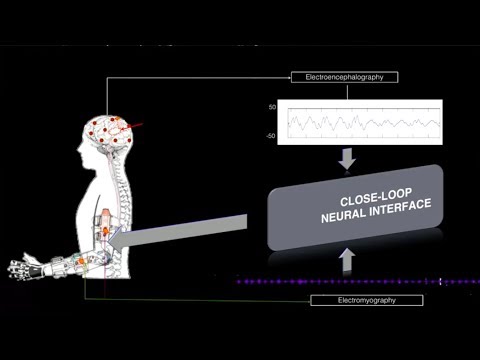
solution is a neuronal interface
brain activity recorded
brain but it could also be the
muscles and there’s a small residual and
we with the algorithms
mathematicians we analyze it we are capable
to understand when that person wants
move towards where and so on
we send a control signal to a
robotic exoskeleton that is put
in the arm of the patient who is
paralyzed and that patient can go back to
move your paralyzed arm and you can
move back with a delay in the
signal equal to 200 milliseconds that
it is imperceptible for us not
then we are generating again
closing the loop and we are generating a
system that works but the idea was not
only this but and this and what
explained before the neurons that were
they go together etc. you could not
use for the rehabilitation of
these patients
well that’s what we tried then
what is happening, despite the fact
that the signal does not reach the muscles
started before we analyzed with
mathematical algorithms we know
interpret the one a bit and and know
when a person wants to move
where and how we move that arm
during an instrumental training
bonuses to the high what we said before
of the children when you try to put in the
star for the star not the star
by the circle and so on and it goes back to
produce that neuroplasticity our
nervous system is very plastic
we are having microinfarctions at each
second all of us me too but
the system that we have is redundant not
nothing happens
problems with the injury is too much
great but if we are able through
of neural interfaces closing
again cycle the loop and generate
this neuroplasticity and that things are
they are going to collect, maybe we are
in the beginning of something interesting in the
beginning of the rehabilitation of the
paralysis
Well, this is what a system looks like
we have developed this is the
non-invasive system that is to say they are the
electrodes that stick when they are
Cap
head with some electrodes gets a
gel then we detect those micro tables
potentials and we move an exoskeleton
robotic in this case is a fact is
what robotic eto’o allows you to do
all movements of the hand to
move objects from above a table by
example
and of course when you do this kind of
studies is not worth saying to good
we try it on a person and it’s already in
working that well not what there is
what to do are clinical analyzes is
say many patients while
this happens and besides not only that
but you have to have a group of
control that guarantees that the result
it’s because of what you’re doing
then in 2007 we started a
study with 45 patients that ultimately
produced to 30 in which 32 in which
some of a group of patients
we connect the brain with the
exoskeleton is to say they were capable
to control the movement of your arm to
through the Grona interface and in another
group
this connection was random they
they thought they were controlling the
robotic exoskeleton with its activity
brain but it was not like that
the movement was random but it was
done in such a way that they did not
obviously account that he was
being random and what happened then good
this is an example of a patient
controlling 2007 we are talking now
the technology advances a bit and then
we’ll try a little bit about it but it’s
controlling only and exclusively with
your brain activity
the movement of his arm that carries
paralyzed more than five years
this arm is moving etcetera made
this for 20 days
uu four and up to five days to the
week to weekend to rest and
then see what happened
well, this is simply doing
this and then with an an exoskeleton of
a robotic hand what we get is
this result
this result is after more than
five years of absolute paralysis
we have returned to get
very tiny movements and
millimeters in some case of a
centimeter but it ‘s a pretty step
important from absolute paralysis to
movement seems little but
it’s very important because because that
small movement can be allowed
do things like what are we going to see now
same in patient
I repeat that it was completely
paralyzed the arm and hand and then
of 20 days of therapy that is
using robots and closing the loop
he was able to do this he was capable of
Orient your hand towards a nail grab
the screw lift us from the air move it
and put it back on the table
this that seems so trivial to
us for a person who has been
paralyzed for many years supposes
a great emotion
obviously emotional patients
mental and not only that but in
this case I am evidently teaching
the star patient was capable and
it was a bit obsolete and said good
I can do the same for something heavier
and we gave him a half-liter bottle of
Water
then I picked up the water bottle and it was
able to grab the lifted in the air
and return to leave the table
this is a small step is a very step
teeny with non-invasive technology
of the year 2007 a period of five years
but he is teaching us that
the neuro technology is capable of
rehabilitate from using mechanisms of
nervous system that can help us
recover from brain injuries and I
I’m talking here only about
motor injuries assist and centering
in the movement but we can extend
the house for example patients from which
they can not communicate and so on
etc
I here or a project that
started in 2007 2013
Now what are we doing?
doing and trying to solve
together with neurotechnology the
technology started with the pacemaker
that seems like it was recently but
a few years ago it is good
evolving to what we
we want to call the closed loop is
say in which we not only stimulate
the nervous system in some way
but we are closing that cycle and
producing as as commented before
that hug between the neurons and that
new connection then where to
we go then we want and
towards technologies that can be
implant micro implants nano implants
that can detect that activity
cerebral and that can allow us
differentiate the relevant signals from
noise that I commented at the beginning is
say the noise we do not want that noise
so what I want to do is
as if I have a microphone and I’m
outside highlighted conference room and
I want to hear what I’m saying
what the first person is saying
who is sitting in the front row
It is difficult but if I get involved
inside the room I get inside the
brain and I put the microphone in front
I see much better and ignored much more
noise I can read the signal much better
whereby reaction between such action
the two neurons will be much better
because the quality the signal that I’m going to
have is going to be much better and we believe that
we will be able to get link again
the neurons to produce realization
thank you very much
[Applause]
[Music]
[Music]
[Applause]
the cap l
what is this only noise only noise
simply noise and you have to distinguish
between the noise that we have all the
days when we listen to the radio when
someone conveys a message when
someone communicates any event
what is to be highlighted and what is
what should not be stressed
Well, sometimes it’s very difficult to know
identify what is the signal that we
import
of all the noise that surrounds us in
this case is difficult but there was
an image stuck inside that noise
well something similar will happen the system
nervous
I’m going to talk about the technology of
how can we be able to understand
when a person wants to try
move and with that I will try to help you if
is that he has suffered a paralysis
solve that paralysis of some
what happens in the system
nervous, well, there’s an activity
brain that goes from the brain to
our muscles when we start to
move then we see it we see
how it moves we feel that movement
this makes good this generates some
connections between different parts of the
body
and these connections are fibers that are from
different sizes by which the
messages go at different speeds
for example when I want to move
spend 22 thousand seconds since I send
my signal from the brain until my
muscles contract
then these are roads by
that the signals go to different
speeds some roads are
they are only one lane
others are multi-lane, others are
roads that go in parallel that
send these signals and this generates a
series of signals that are the signals
that we the black technologists
we use to assemble our
neuronal interfaces that sounds weird
but it is not already I will comment you a
a little bit later
those are the signs we see is not the
end down if you see the last thing you see
that’s where all the signs are
adding to it the noise of what was
commenting on all the noise there
around our etcetera and from there
that signal I have to be able to see
when a person
to move and how you want to move towards
where and so on explain how
we do this kind of thing
this is what happens when a person
is trying to move and we can
use the example of children
little ones when they are playing with this
game of putting the star through the hole
from the star et cetera etcetera what
try
it seems that it does not get about those
learning and instrumental are
learning that those connections in the
brain those neural connections are
generate jobs is the law of action
reaction reaction reaction that goes
happening then that after this of
do it for quite some time
lose connect neurons and you
they begin to generate that those connections
not that the neuron starts saying some
way to extend the arm lengthen the
arm until it touches the other and they join
and these connections are generated that we
allow to do activities for example
learn to play tennis things activities
motors that are generated and we are capable
to do it in a much more way
quick and simple
well this is what is generated but what
happens when there is an injury in the
nervous system
what is happening, for example
we have a stroke or cerebral infarction or a
accident because there is a part of the system
that does not work then the signals do not
They get to where you need to not
get to the muscles but that for
US
the idea is good and what does it matter if we are
able to detect those signals the
intention move directly from the
brain activity because we are not going to
make a bridge to two
well that’s what can be done
thanks to signs like the
electroencephalography that is activity
brain puts some electrodes that are
remains with a kind of gel on the leather
scalp and then time activities are
potential micro that that activity
electrical at the end not all electricity
then in the end I am able to see
how that activity is generated by those
connections in the brain that mean
that the person is trying to move
and also muscle activity
this happens if this person is healthy and there
a direct connection of the brain and the
muscles
I see muscular activity but what
happens if this is the injury the means
Well, that muscle activity
existing or sometimes it is so small that
it does not produce a movement that does not leave us
move and that produces paralysis
So what is the solution for the
solution is a neuronal interface
brain activity recorded
brain but it could also be the
muscles and there’s a small residual and
we with the algorithms
mathematicians we analyze it we are capable
to understand when that person wants
move towards where and so on
we send a control signal to a
robotic exoskeleton that is put
in the arm of the patient who is
paralyzed and that patient can go back to
move your paralyzed arm and you can
move back with a delay in the
signal equal to 200 milliseconds that
it is imperceptible for us not
then we are generating again
closing the loop and we are generating a
system that works but the idea was not
only this but and this and what
explained before the neurons that were
they go together etc. you could not
use for the rehabilitation of
these patients
well that’s what we tried then
what is happening, despite the fact
that the signal does not reach the muscles
started before we analyzed with
mathematical algorithms we know
interpret the one a bit and and know
when a person wants to move
where and how we move that arm
during an instrumental training
bonuses to the high what we said before
of the children when you try to put in the
star for the star not the star
by the circle and so on and it goes back to
produce that neuroplasticity our
nervous system is very plastic
we are having microinfarctions at each
second all of us me too but
the system that we have is redundant not
nothing happens
problems with the injury is too much
great but if we are able through
of neural interfaces closing
again cycle the loop and generate
this neuroplasticity and that things are
they are going to collect, maybe we are
in the beginning of something interesting in the
beginning of the rehabilitation of the
paralysis
Well, this is what a system looks like
we have developed this is the
non-invasive system that is to say they are the
electrodes that stick when they are
Cap
head with some electrodes gets a
gel then we detect those micro tables
potentials and we move an exoskeleton
robotic in this case is a fact is
what robotic eto’o allows you to do
all movements of the hand to
move objects from above a table by
example
and of course when you do this kind of
studies is not worth saying to good
we try it on a person and it’s already in
working that well not what there is
what to do are clinical analyzes is
say many patients while
this happens and besides not only that
but you have to have a group of
control that guarantees that the result
it’s because of what you’re doing
then in 2007 we started a
study with 45 patients that ultimately
produced to 30 in which 32 in which
some of a group of patients
we connect the brain with the
exoskeleton is to say they were capable
to control the movement of your arm to
through the Grona interface and in another
group
this connection was random they
they thought they were controlling the
robotic exoskeleton with its activity
brain but it was not like that
the movement was random but it was
done in such a way that they did not
obviously account that he was
being random and what happened then good
this is an example of a patient
controlling 2007 we are talking now
the technology advances a bit and then
we’ll try a little bit about it but it’s
controlling only and exclusively with
your brain activity
the movement of his arm that carries
paralyzed more than five years
this arm is moving etcetera made
this for 20 days
uu four and up to five days to the
week to weekend to rest and
then see what happened
well, this is simply doing
this and then with an an exoskeleton of
a robotic hand what we get is
this result
this result is after more than
five years of absolute paralysis
we have returned to get
very tiny movements and
millimeters in some case of a
centimeter but it ‘s a pretty step
important from absolute paralysis to
movement seems little but
it’s very important because because that
small movement can be allowed
do things like what are we going to see now
same in patient
I repeat that it was completely
paralyzed the arm and hand and then
of 20 days of therapy that is
using robots and closing the loop
he was able to do this he was capable of
Orient your hand towards a nail grab
the screw lift us from the air move it
and put it back on the table
this that seems so trivial to
us for a person who has been
paralyzed for many years supposes
a great emotion
obviously emotional patients
mental and not only that but in
this case I am evidently teaching
the star patient was capable and
it was a bit obsolete and said good
I can do the same for something heavier
and we gave him a half-liter bottle of
Water
then I picked up the water bottle and it was
able to grab the lifted in the air
and return to leave the table
this is a small step is a very step
teeny with non-invasive technology
of the year 2007 a period of five years
but he is teaching us that
the neuro technology is capable of
rehabilitate from using mechanisms of
nervous system that can help us
recover from brain injuries and I
I’m talking here only about
motor injuries assist and centering
in the movement but we can extend
the house for example patients from which
they can not communicate and so on
etc
I here or a project that
started in 2007 2013
Now what are we doing?
doing and trying to solve
together with neurotechnology the
technology started with the pacemaker
that seems like it was recently but
a few years ago it is good
evolving to what we
we want to call the closed loop is
say in which we not only stimulate
the nervous system in some way
but we are closing that cycle and
producing as as commented before
that hug between the neurons and that
new connection then where to
we go then we want and
towards technologies that can be
implant micro implants nano implants
that can detect that activity
cerebral and that can allow us
differentiate the relevant signals from
noise that I commented at the beginning is
say the noise we do not want that noise
so what I want to do is
as if I have a microphone and I’m
outside highlighted conference room and
I want to hear what I’m saying
what the first person is saying
who is sitting in the front row
It is difficult but if I get involved
inside the room I get inside the
brain and I put the microphone in front
I see much better and ignored much more
noise I can read the signal much better
whereby reaction between such action
the two neurons will be much better
because the quality the signal that I’m going to
have is going to be much better and we believe that
we will be able to get link again
the neurons to produce realization
thank you very much
[Applause]
Please follow and like us: