
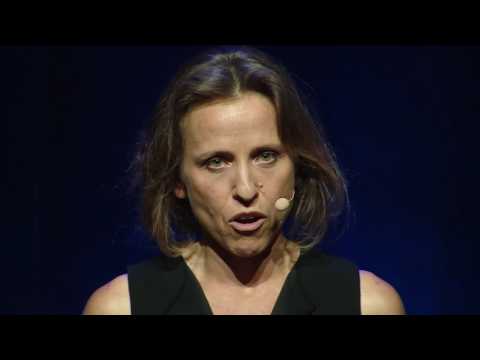
Translator: Shadia Ramsahye Reviewer: Stéphane Roger
What is your story?
Because mine really started
when I understood that I had been taken over by at least three stories,
that they had raised and made me.
Those stories, you know them as well I do.
Those stories are:
“Enjoy”,
“Just do it”,
“Because you’re worth it”.
I see you smile.
(Laughter)
We were born at the same time, in the mid-70s,
and we grew up together, like sisters.
I believed so strongly in these stories that they became my story.
And since I was a good girl,
was well taught, meant to do well,
I, as marketeers of that time would put it, overperformed.
So, at 28, I am living in New York,
I have a start-up, clients, investors, employees.
I am on the fast track:
elite education, the US, entrepreneurship, New York, the internet bubble.
Until I witness this.
On the roof of my office on 26th Street,
far enough away not to be swallowed up by it
but close enough to never turn away,
I am not afraid.
Something obliterates my fear,
freezes my thoughts, forms a screen.
Instead, the inanity of my current life blows up to my face.
It’s true, I am 28, I live in New York,
I have a start-up, clients, investors, employees.
But I don’t have a family,
not a single friend,
no political conscience at all.
I work 16 hours a day.
I run every other day, I count my calories, I do sports.
During my free time, when I’m not working,
I pay a pittance to Korean women with no papers
to paint my toenails.
I wanted to be rich? I’m getting sadder and sadder.
I wanted to be “with it”?
Except that being “with it”
is to have the ambition of a dead leaf towards the wind,
said the poet.
(Applause)
On that roof, on 26th Street, something is being ripped apart for me.
Under the veil of appearances, there’s some form of truth.
What crushed my fear on that day was shame.
It still gives me goose bumps … really.
There is something profoundly obscene in the story I embody,
me, global capitalism’s good girl,
with my degrees and certainties,
in those stories where I’m a great asset, a great result.
“Enjoy”, “Just do it”,
“Because I’m worth it”, “You’re worth it”,
I don’t know any longer.
These slogans that have made me, supported me, cloaked me,
crumble and fall in pieces.
I will tear down what’s left like old wallpaper.
Because fear overwhelms, shame seizes, but anger sometimes propels.
Anger, itself, always wants to get out,
and it always does.
And that may be why, from time to time, we have to let it out.
So I start by bailing myself out of that race,
out of that trajectory.
I leave New York, I close my start-up down,
I also leave the man I was to marry
despite his being a great guy.
I disappear from photos, from lives lived as they should be,
from lives without question, from lives on the level.
I, who never questioned myself, I let myself be invaded.
What happened on that day?
What was I doing there?
Who was sending us bombs?
What was the story I believed in and that was dead that day.
And that story, who wrote it?
Whom does it serve?
Who holds the big pen?
In the end: Who rules?
Is it the US? Is it the financial markets?
Is it oil?
Is it Google’s algorithms?
Is it fear? Is it hatred?
Trying to answer these questions propels me along a sort of route
since I don’t have any other choice than to try to answer these questions,
to regain control of my thoughts which perhaps I never had,
to never let myself be dictated to again.
I start writing, investigating, in order to understand,
not necessarily what happened, but how I came to be there, me.
So I am no longer at all “with it”,
but on a sort of route that, frankly, is not so easy.
On bad days, the most numerous,
I wander without having thought out
how I could lead a useful, meaningful and responsible life.
On good ones, I tell myself I’m doing something of absolutely incredible worth:
I doubt, I learn, perhaps I understand.
An idea comes.
If it goes the distance, if I succeed in making sense of chaos,
then it becomes a meeting, a book, a novel, an article, a film.
So I become an author, a director.
I realize now that writing, it’s making sense of chaos.
It’s hanging on to a thread, for me, a lifeline.
And for me, it’s going to be that question: Who rules?
It becomes my life.
I start by writing my first book,
the story of the explosion, that of 9/11, the towers, mine;
then a second
on the power of finance and technology over our lives.
It’s so easy, not only to write –
that’s true, but then again rather rare –
but also to pass on,
that I tell myself that it doesn’t have to be exactly true,
it’s more complicated than that.
It’s true, finance and technology have assumed power over our lives.
But if that’s the case, somebody gave them it, didn’t they?
So that happened when? Who is it, what is it?
That’s my third book,
on the relationship … relationships … between the media, politics and finance.
Who rules? – I get a little closer.
It’s our compromises, our forfeitures,
it’s our own collaboration with the system.
It’s my least popular book.
There are hundreds of reasons for that, including that I didn’t write it so well –
but there is also the notion
that posed like that, head on,
the question “Who rules?”
with its response, or one of its responses,
“our consent”,
is not popular – at least, not right now.
I think that’s about to change –
the supporters of the system,
whoever they might be.
So, along my investigative path with its variant
“But why don’t we have the right to talk about these things?”
I bump into Larry Lessig at the Avignon TGV station
on a freezing November evening.
I cannot believe my luck.
I really feel something’s on my side.
You might not know him,
but for me, Larry Lessig, professor of law at Harvard,
is like the Usain Bolt of the “Who rules?” question.
He is, I would say, a somewhat crazy constitutionalist,
who, at Harvard, examines the influence of money in politics
at a research centre he founded dedicated to systemic corruption.
According to him,
no reform of health, education, climate,
arms, financial markets,
can be passed so long as elections are about money.
He is a former political adviser to Obama,
he’s also one of the pioneers of the free internet.
When I was living in New York a century ago, fifteen years ago,
I would devour his columns.
We were all ecstatic about the internet bubble,
and he was one of the few to warn us,
and to see Orwell, which is to say Big Brother,
fiddling with lines of code.
Moreover, when I met him 15 years later
at that train station on a freezing November night,
he was one of the few Americans
to defend the actions of another American, Edward Snowden.
Edward Snowden is a former contractor to the NSA
who, in November 2013, revealed the extent of mass surveillance
by the US on its population and that of its allies.
This story also fascinates me
because it’s the same old story of an individual faced with machines,
faced with the system, faced with history, faced with himself:
if you witness something bad,
should you keep quiet and go along with it
or speak out and expose yourself, with all the risks that that implies?
Anyway, at that train station, Larry Lessig is alone as am I.
He has nothing to do there. Nor do I.
It’s a weird place to meet this kind of person.
So I go up to him, I lie, I put together a story,
uncommissioned, I ask for an interview, and we get on the same train …
from certain points of view, anyway.
I interview the great professor gloriously in the bar car of the TGV.
But nothing goes as planned.
40 minutes in,
he breaks into tears on the mention of the suicide of his friend Aaron Swartz.
Aaron Swartz had been found nine months earlier –
so the beginning of January 2013 –
hanging from the curtain rail of his Brooklyn apartment
at the age of 26.
Born with the internet,
he coded it with his ideals of freedom all his young life.
For Aaron,
the internet was the great hope for humanity
for the generations of our age,
because the internet allowed the sharing of information and knowledge.
He coded the RSS feed
that you use every time you share or you read an article online.
Together with Lessig, he created the Creative Commons
which allows you to watch TEDx videos for free.
He also co-created that enormous platform,
that absolutely brilliant discussion forum, Reddit.
The Obama administration,
the one we’re supposed to love, especially now,
clobbered him with a 35-year prison sentence,
a one million dollar fine,
and a criminal record for life.
What had Aaron done?
Had he looted, polluted, assassinated, given away state secrets?
No, Aaron had mass uploaded academic publications
to an MIT open access server, his paradise.
Aaron was dangerous for the US authorities because he wanted us to be strong.
What?
The US hates intelligence and murders its children.
Faced with the absurd on that train,
Larry Lessig spoke to me of his survival plan –
because it was one, it’s what it had come to.
Aaron’s death, his friend, his master, his disciple, his son,
in turn threw him on the open road.
Who rules? Up to now, Larry had told himself,
by means of courses and lectures, he was going to convince us.
However, filled with rage, anger, sorrow,
he was going to strip off his great professor guise.
This story is being rolled out in front of me,
it has not got going yet.
He tells it to me, he advances it to me.
Chance has him right in front of me.
So I grab the branch it’s proffering me
and go with it.
I follow him, I write, I film,
when he organizes public demonstrations throughout the US
to denounce the influence of money in politics.
I also follow him to Washington
when he was about to start his presidential campaign
and to stand as a candidate in the Democratic elections.
His goal is to put the theme of the influence of money on politics –
I think we all agree that that’s a problem –
at the heart of the presidential debates.
But the Democratic Party blocks his access
to the television studio and to the primaries.
What?
The “democratic” party is blocking the access of a candidate
that has all the trappings of the intelligentsia?
So again, who rules?
Interview, story, film,
in the end I feel like I am always telling the same story:
the struggle of a few figures of the resistance,
men, women, even children,
who are trying to warn us and thus pave a path of dignity.
For resistance is everywhere.
As an author, for me really, it’s a marvellous catch.
I can’t understand why there aren’t more of us after it.
As a citizen, I must admit that these stories help me to live.
As a mother, it makes a wonderful story I can tell my kids,
a world in which I can believe.
So I do it as much as possible, everywhere, all the time,
like in Iceland with Birgitta Jónsdóttir.
Her story fascinates me.
This woman entered into politics following the subprime crisis in Iceland.
She was completely self-taught,
she founded several political movements,
she became a member of parliament in 2010 –
most notably she founded the Pirate Party in 2013.
In 2016 – a few months ago – she was close to forming her government,
or more precisely, she had the mandate for doing so.
Birgitta has had an extraordinary career, and has ideas full of common sense.
What do we hear? It’s naïve, it’s impossible, it’s dangerous.
When too isolated, too alone,
and the likes of Birgitta, Larry, Edward and Aaron,
fail to make themselves heard by us,
the system jeers at them and the experts with them,
repeating to us over and over again how well they’d told us.
And everywhere, almost everywhere,
enabled by populations petrified with fear,
authoritarianism installs itself into the presidential seats.
So, that’s the end of the story?
Me, I’ve no desire for this story to come to an end.
Because if it comes to an end, I’ll have nothing more to tell.
And I believe in this story that no one sees.
Isn’t that what an artist, an author, a writer, does?
Draw lines, straight ones, curves, links,
between events and people that no one else is seeing?
But they who are on the ropes,
Larry, Birgitta, on the ropes,
how can they go forward?
So I reflect, a little within constraints, it’s true.
And I say to myself, after all, me, I also have a pen.
It’s not that big, but I have a pen.
What if I stopped using it
to tell their story once it’s done and over,
but rather to formulate it, elicit it.
What if I tried to create a setting like this evening
so that something happens, so that something goes on.
After all, Larry, Birgitta, Edward support each other from apart:
they know each other but have never met in person.
What if that changed? What if they got together?
Them, and us too.
What if I got all of them together in Moscow, where Snowden is stuck,
for a conversation that’s taken place nowhere before,
overtaken by pointlessness,
a conversation on their common goal,
their struggle:
how to save democracy, the one that – because that’s it, the story –
was put on hold that day?
Surprisingly – and to be honest, I was not expecting it –
they all agreed.
We even got our visas, a small window of opportunity,
and then I was the only one blocking the process.
In truth, I was scared to death.
I’d no idea where this story would lead me.
I’ve still no idea, by the way.
It’s as if you decided to go the North Pole,
you’ve been finding your way forward in the fog for years with a compass,
and all of a sudden, a short distance from your goal,
the compass goes crazy.
For a few weeks, the compass, that’s been me.
But the story is stronger, it wants to take place.
So we go to Moscow, take a look around, and then that’s it.
The film is made, the meeting takes place.
And, for me, it’s an unbelievable experience.
So, who rules? What keeps us going?
Or more precisely, and perhaps more interestingly:
What keeps them going?
From these travels, from this filming especially,
I have understood a few things.
The first is that if Birgitta, Larry, Edward are still alive,
it’s because they don’t want to make history, but to let it happen.
And that’s crucial.
In these uncertain times, a fraction of an inch from the abyss,
if we dare open our eyes,
it’s a tremendous lesson in life, in surviving,
in what it really means to be alive.
And good news!
This will to protect life, to favour life, is everywhere.
It’s the most common denominator among all those who stand up,
whoever they are, wherever they are, in France, anywhere in the world.
But we don’t see them,
we are looking elsewhere.
Fear is being induced.
Something forms a screen, starting with, for you and for me,
those damn slogans, those overbearing messages,
that zeitgeist: “Enjoy”, “Just do it”, “Because I’m worth it”,
that aim to signify to us just precisely the opposite
of their pseudocall for happiness and self-confidence.
In reality, they mean:
“Slave away”,
“Don’t think”,
“Because you’re not worth a thing”.
And thus they make us do their bidding,
they chain us down, they turn us into the living dead.
Doubtless, very few of you know about the work of Birgitta Jónsdóttir,
Larry Lessig and Edward Snowden, let alone mine.
Because that’s also something I have come to understand:
that writing, exercising your own free will,
makes you neither rich nor popular.
You become someone no one wants anything to do with, unbearable,
because it makes you alive
in a world that has specifically chosen fear, that is to say, death.
And this stance is priceless.
In that world,
to doubt, to seek,
is to disobey, to free oneself.
So go on, get rid of these stories that have been imposed upon you.
Refuse to be the object of a story; choose the story yourself.
Write your own narrative.
It may well be the only thing that is true.
Thank you.
(Applause)
Please follow and like us: