
my father is a mountain climber and he
climbs really big mountains with names
like Renier and Denali and aconcagua one
of the reasons to climb to the top of
the mountain is because it allows you to
see a very different perspective of the
journey that got you there you can see
all the different contours the valleys
and it really gives you a different
sense of perspective I’m going to tell
you a story today of hope and
exploration but not to the top of the
highest mountain but rather to the
depths of your biology now to do so I
need to give you a little historical
context so one of the early biological
explorers was Charles Darwin and so when
Charles Darwin looked at the world
around him what he concluded was that it
wasn’t the strongest of the species that
survives nor the most intelligent but
rather it was the one most responsive to
change change is intimately connected to
time and so to look at biology and time
I think this organism paints a very very
interesting perspective and that is the
caterpillar and the butterfly so this
organism has the same genetic template
but it depends on when you look at it to
specifically see what sort of its
behavior is now similar to a rosetta
stone what we do is we try to map all
the molecules at this this organism
expresses and then map them on to some
sort of of map like like framework now
to do that you might ask yourself what
would a map like this look like so in
the 1950s shortly after the discovery of
DNA Waddington started devising ideas of
specifically what would the contours of
your life look like now similar to this
marble it might roll down the various
slopes that are there but it was
recognized early on that one could
change the contours in the valleys and
how that marble would roll through like
the trajectory of life
based on social traits your environment
the drugs that you take and so forth now
a map like I’m describing here also
might be something like say the traffic
patterns in a Google map so you might be
in a major metropolis such as Washington
DC and you want to get from point A to
point B as quickly as you can
so what you would do is pull up the map
and look at the traffic patterns that
are going through the various arteries
and through through ways so that you can
get there most efficiently now when we
measure all the molecules we can create
a map as well and I’m just sort of
focusing on a small bit here but you
also see things like roundabouts and
what we want to do is measure the
molecular flow through life the hope is
that in about 50 years from now or
sometime in the future you’ll be able to
go to your physician and she’ll run a
systems wide molecular test
she’ll map this out for you personally
and she’ll come back to you and say you
know in approximately two to three years
your map indicates that you would have
developed diabetes but what we’re going
to do is change the contours of your
life and that disease won’t present
itself as it would have now wouldn’t
just be diabetes but it would be a whole
range of different disease states that
you might encounter now we have three
major challenges that we have to address
to make a map like what you’re talking
about
I’m showing here in iceberg and the
first challenge is how do we measure
everything that we need so we can see
everything that’s poking out of the
water right and that’s similar to being
able to measure all of your jeans but
then lurking under the water line are
many molecules things like proteins and
small molecules but really daunting are
all of the chemical exposures that you
could encounter in your daily life and
so if I were to tell you
the number is it’s a 1 followed by 50
zeros and it’s difficult for me to
conceptualize what such a number looks
like so let me try to put the numbers in
perspective so right now there’s
approximately 8 billion people living on
the planet Earth representing a small
fraction of the hundred and fifty
billion that have ever walked the face
of the planet in the past 50 thousand
years that’s a small number compared to
the 30 trillion cells making up your
body where the close to 40 trillion
bacteria that live on you and within you
and call you home
that too is a small number compared to
the 75 million trillion grains of sand
covering the planet Earth across all the
oceans and all of the deserts combined
now the number that we’re talking about
that we may need to be able to measure
is this one shown here right this is a
very large number so what we need is we
need to measure things fast so what our
group and a number of others have
embarked upon is to develop technologies
to allow you to measure things very
quickly so by today’s standards we have
the capacity to measure close to a
billion molecules per second and we can
generate approximately a terabyte of
data every hour now what do we do with
all of this data because we have no hope
and being able to look through this
manually so to do that we take
inspiration from those that have come
before us and so for example visionaries
like Fritz Khan what he would do is he
would take complex ideas of biology and
simplify those two very simple pictures
about what your body’s functioning is
doing and on the right is a quote from
Lewis Carroll so Lewis Carroll of course
was a famous mathematician
but probably more well known for writing
Alice in Wonderland and what Lewis
Carroll said was the cartographers guild
struck a map of the Empire which
coincided point four point with them now
what this is is this is basically a map
of the scale bar of one mile equals one
mile which is completely useless so what
we need to do is we need to be able to
measure everything we possibly can and
very quickly figure out what are the
important parts so what we do is we ask
the data to organize itself and for the
data to tell us what is important about
it and so what we do is we borrow tools
from places like astronomy cattle
ranching internet commerce and that goes
by names like artificial intelligence
and machine learning so to give you an
example when Amazon wants to give you
for example a recommendation of what you
might like to do what they do is they
create a picture of you that picture
represents your pageviews you’re buying
history and other pieces of information
they create a tile they then say we have
200 million customers so we’ll create a
picture for each of those 200 million
and we’ll start sliding them around much
like a sliding puzzle game what they’re
looking for is they’re looking for the
picture which most closely resembles you
and they ask those two customers to do
what the other one did last as a
prediction of what you would like to do
next and that is precisely what we do
with the biological data now I’d like to
give you an example of where we’re
moving with these strategies and it’s in
building so called humans on a chip and
so approximately ten years ago the
Department of Defense and the Food and
Drug Administration created a
partnership to create to solve a very
large problem and that was the cost of
drug development what they recognized
is that in the normal course of events
you do drug testing on cells then animal
testing in a mouse or a dog for example
and then in humans you lose
approximately 40 percent of the drugs
when you move from the animal to the
human because you’re not a mouse or a
dog you also lose about 40 percent of
the drugs because you tested them in the
animal first and they failed when they
would have worked if they went directly
to you so right off the bat we lose
about 80 percent of the potential drugs
that would have been helpful for you so
what they embarked on was to build human
organs on functional chips not unlike
this and that is to create things like
livers and hearts and kidneys and brains
and then use those to monitor health
status in response to drugs and so for
example you can start linking these
things together and what we do is we
then take the drug that we want to test
and we feed it to our human on a chip
and it’s a little bit like hitting a
bell and we listen to how it rings
molecularly
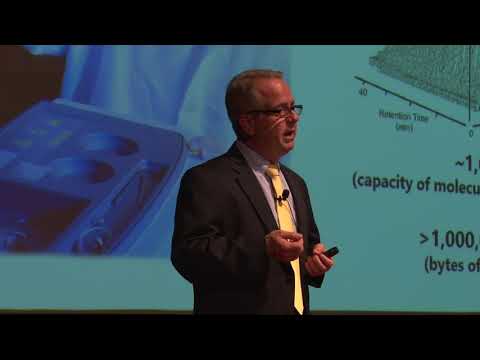
and so I’d like to just show you what
this type of data looks like and so this
is a functioning human liver on chip and
this shows you what those self-organized
maps of the data look like when we feed
this liver acetaminophen or Tylenol and
so in approximately 24 hours what we can
do is we can reproduce decades and
decades of research on what your body
does in response to Tylenol now moving
out of the laboratory and back into the
world I’d like to leave you with a call
to action the United States has begun a
program called all of us and all of us
is a program to enlist over a million
Americans so that we can very accurately
define your biology based on in buyer
geography and the things to which you’re
exposed and so the ultimate hope is that
we could get to that place in 50 years
from now where we can map your biology
when you visit your physician and so
what I encourage you to do is to help us
map your life and everything else thank
you
[Applause]
climbs really big mountains with names
like Renier and Denali and aconcagua one
of the reasons to climb to the top of
the mountain is because it allows you to
see a very different perspective of the
journey that got you there you can see
all the different contours the valleys
and it really gives you a different
sense of perspective I’m going to tell
you a story today of hope and
exploration but not to the top of the
highest mountain but rather to the
depths of your biology now to do so I
need to give you a little historical
context so one of the early biological
explorers was Charles Darwin and so when
Charles Darwin looked at the world
around him what he concluded was that it
wasn’t the strongest of the species that
survives nor the most intelligent but
rather it was the one most responsive to
change change is intimately connected to
time and so to look at biology and time
I think this organism paints a very very
interesting perspective and that is the
caterpillar and the butterfly so this
organism has the same genetic template
but it depends on when you look at it to
specifically see what sort of its
behavior is now similar to a rosetta
stone what we do is we try to map all
the molecules at this this organism
expresses and then map them on to some
sort of of map like like framework now
to do that you might ask yourself what
would a map like this look like so in
the 1950s shortly after the discovery of
DNA Waddington started devising ideas of
specifically what would the contours of
your life look like now similar to this
marble it might roll down the various
slopes that are there but it was
recognized early on that one could
change the contours in the valleys and
how that marble would roll through like
the trajectory of life
based on social traits your environment
the drugs that you take and so forth now
a map like I’m describing here also
might be something like say the traffic
patterns in a Google map so you might be
in a major metropolis such as Washington
DC and you want to get from point A to
point B as quickly as you can
so what you would do is pull up the map
and look at the traffic patterns that
are going through the various arteries
and through through ways so that you can
get there most efficiently now when we
measure all the molecules we can create
a map as well and I’m just sort of
focusing on a small bit here but you
also see things like roundabouts and
what we want to do is measure the
molecular flow through life the hope is
that in about 50 years from now or
sometime in the future you’ll be able to
go to your physician and she’ll run a
systems wide molecular test
she’ll map this out for you personally
and she’ll come back to you and say you
know in approximately two to three years
your map indicates that you would have
developed diabetes but what we’re going
to do is change the contours of your
life and that disease won’t present
itself as it would have now wouldn’t
just be diabetes but it would be a whole
range of different disease states that
you might encounter now we have three
major challenges that we have to address
to make a map like what you’re talking
about
I’m showing here in iceberg and the
first challenge is how do we measure
everything that we need so we can see
everything that’s poking out of the
water right and that’s similar to being
able to measure all of your jeans but
then lurking under the water line are
many molecules things like proteins and
small molecules but really daunting are
all of the chemical exposures that you
could encounter in your daily life and
so if I were to tell you
the number is it’s a 1 followed by 50
zeros and it’s difficult for me to
conceptualize what such a number looks
like so let me try to put the numbers in
perspective so right now there’s
approximately 8 billion people living on
the planet Earth representing a small
fraction of the hundred and fifty
billion that have ever walked the face
of the planet in the past 50 thousand
years that’s a small number compared to
the 30 trillion cells making up your
body where the close to 40 trillion
bacteria that live on you and within you
and call you home
that too is a small number compared to
the 75 million trillion grains of sand
covering the planet Earth across all the
oceans and all of the deserts combined
now the number that we’re talking about
that we may need to be able to measure
is this one shown here right this is a
very large number so what we need is we
need to measure things fast so what our
group and a number of others have
embarked upon is to develop technologies
to allow you to measure things very
quickly so by today’s standards we have
the capacity to measure close to a
billion molecules per second and we can
generate approximately a terabyte of
data every hour now what do we do with
all of this data because we have no hope
and being able to look through this
manually so to do that we take
inspiration from those that have come
before us and so for example visionaries
like Fritz Khan what he would do is he
would take complex ideas of biology and
simplify those two very simple pictures
about what your body’s functioning is
doing and on the right is a quote from
Lewis Carroll so Lewis Carroll of course
was a famous mathematician
but probably more well known for writing
Alice in Wonderland and what Lewis
Carroll said was the cartographers guild
struck a map of the Empire which
coincided point four point with them now
what this is is this is basically a map
of the scale bar of one mile equals one
mile which is completely useless so what
we need to do is we need to be able to
measure everything we possibly can and
very quickly figure out what are the
important parts so what we do is we ask
the data to organize itself and for the
data to tell us what is important about
it and so what we do is we borrow tools
from places like astronomy cattle
ranching internet commerce and that goes
by names like artificial intelligence
and machine learning so to give you an
example when Amazon wants to give you
for example a recommendation of what you
might like to do what they do is they
create a picture of you that picture
represents your pageviews you’re buying
history and other pieces of information
they create a tile they then say we have
200 million customers so we’ll create a
picture for each of those 200 million
and we’ll start sliding them around much
like a sliding puzzle game what they’re
looking for is they’re looking for the
picture which most closely resembles you
and they ask those two customers to do
what the other one did last as a
prediction of what you would like to do
next and that is precisely what we do
with the biological data now I’d like to
give you an example of where we’re
moving with these strategies and it’s in
building so called humans on a chip and
so approximately ten years ago the
Department of Defense and the Food and
Drug Administration created a
partnership to create to solve a very
large problem and that was the cost of
drug development what they recognized
is that in the normal course of events
you do drug testing on cells then animal
testing in a mouse or a dog for example
and then in humans you lose
approximately 40 percent of the drugs
when you move from the animal to the
human because you’re not a mouse or a
dog you also lose about 40 percent of
the drugs because you tested them in the
animal first and they failed when they
would have worked if they went directly
to you so right off the bat we lose
about 80 percent of the potential drugs
that would have been helpful for you so
what they embarked on was to build human
organs on functional chips not unlike
this and that is to create things like
livers and hearts and kidneys and brains
and then use those to monitor health
status in response to drugs and so for
example you can start linking these
things together and what we do is we
then take the drug that we want to test
and we feed it to our human on a chip
and it’s a little bit like hitting a
bell and we listen to how it rings
molecularly
and so I’d like to just show you what
this type of data looks like and so this
is a functioning human liver on chip and
this shows you what those self-organized
maps of the data look like when we feed
this liver acetaminophen or Tylenol and
so in approximately 24 hours what we can
do is we can reproduce decades and
decades of research on what your body
does in response to Tylenol now moving
out of the laboratory and back into the
world I’d like to leave you with a call
to action the United States has begun a
program called all of us and all of us
is a program to enlist over a million
Americans so that we can very accurately
define your biology based on in buyer
geography and the things to which you’re
exposed and so the ultimate hope is that
we could get to that place in 50 years
from now where we can map your biology
when you visit your physician and so
what I encourage you to do is to help us
map your life and everything else thank
you
[Applause]
Please follow and like us: