
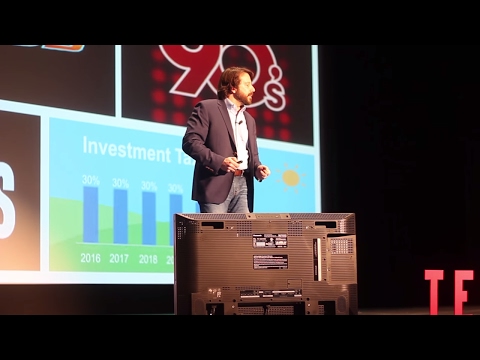
everybody to just close your eyes relax
take a deep breath now keep them closed
for the remainder of this talk only
because I just don’t want to know that
you’re just staring at me the whole time
but I would like open your eyes by the
way I can’t see anything I would like to
ask a question by a show of hands who
likes to eat okay good it’s not
surprising that everybody answer raises
their hand because we need food we need
food to sustain life in fact it’s not
surprising that you’re driving down the
roads and you see bumper stickers such
as no farms no food it just makes sense
and in fact our agricultural community
is necessary for sustaining life now I’d
like to start with a small short story
an involute it involves farmer Joe a
pitcher that my daughter drew drew for
me so farmer Joe he is he’s concerned in
fact I’d say he’s gravely concerned
because the quality of his crops are
going down and he’s fairly confident
that this has to do with this global
decline in pollinator species in fact he
knows it to be true because of stories
he’s heard from his father and his
father’s father there’s kind of
generational folklore stories that we
know and come to love and he can’t
recall the last time that he’s seen a
honey bee or a wild bee or another
pollinator but what he doesn’t know is
solar farms are they impacting him at
all he doesn’t know the answer that and
he does not know exactly where he’s
going to go from here but what he does
think any questions is can they be part
of the solution and help can they be
part of the solution that’s the question
at hand and that’s exactly what I want
to talk to you about today and again my
name is Chris Rambi when I was afforded
this opportunity to come and speak today
I was very excited because
want to talk about the passion that I’ve
been doing for the last nearly two
decades tromping around in the woods
studying wildlife looking at them in
their own ecosystems and making
solutions for people solar energy is a
growing renewable clean energy that is
growing at rapid pace basically we’re
taking light from the Sun and creating
this clean energy to the end-user in the
form of electricity it hasn’t always
been that way though if there’s a high
visibility for solar at one point was
during the Carter Administration if you
recall where solar was put on top of the
White House one would argue that equally
visible was when it was removed by the
Reagan administration setting up the
controversy and discussions that we
still have today in fact a small town of
north carolina they banned solar farms
all together because of the potential
for this for the light to be robbed from
the sun and us not to have the
opportunity for life we know that that’s
just not the case as scientists the
evolution of solar has been up and down
in the 80s and 90s we were plagued with
high costs and long payoff returns but
in the 90s things started to shift a
little bit the energy market went to
deregulations in some states and as a
result that opened up opportunities for
energy markets competition thus
renewables things like solar but it was
not until the mid 2000s 2006 time period
with its investment tax credit which
really spurred solar development driving
down costs with the application of new
technology solar is where we’re at today
and they call it the perfect storm
Maryland specifically is a smaller state
in comparison to some of the much larger
states like California 42nd and land
area but it’s ranked 12th in solar power
brick
Buddha or 11th in solar megawatts but
5th in solar megawatts per square mile
Maryland is very invested in solar and
renewables and they have plans for
additional solar throughout the state so
reflecting back to farmer Joe of his
problem of poor quality in his in his
fruits suppose as of declining
pollinator species are present now when
we think about pollinators one thinks
about bees wild bees domesticated bees
but there’s many other wonderful
organisms of pollinators things like
butterflies and bats and birds many
other wonderful creatures that help with
our pollination system when we talk
about pollinating we’re talking about
taking the pollen from the male anther
of the flower and depositing that in the
stigma the female portion that’s just
plant romance now after we have
fertilization we get our vegetables in
our fruits what would life be like
without wonderful vivid red tomatoes to
utilize tequila anyone without this
wonderful relationship of bat and flower
you wouldn’t be able to have margaritas
or make poor choices at 3am at the local
pub it just wouldn’t be possible
blueberries I don’t know what life would
be like without blueberries and these
wonderful insects watermelons Maryland
is rich in history as it relates to
watermelons what happens if we did not
have these wonderful species or this
past Tuesday there would have been a lot
of unhappy folks during Valentine’s Day
if it wasn’t for these species here
there would not be an opportunity for
chocolate so this is at the very root of
farmer Joe talking about quality of crop
and as a result of the decline in
pollinator species and available
habitats we’re seeing this decline in
our fruits and vegetables and that
experienced and seen through these
production of lack of production of seed
and malformations in the fruits and
vegetables which then talks about a
dictates the quality and the taste it’s
just not there so I want you to look at
this and I want you to see this
wonderful wonderful example of what our
bees are doing what our wild ease and
our domesticated beasts what they
provide all these wonderful fruits and
vegetables now I want you to think about
this what happens if we removed them
they were gone and off the system this
is what we’ll see do I have your
attention now the importance of these
animals to the well-being of the human
there we go so you may ask why is this
happening there’s a number of reasons
why our pollinator species are declining
the use the indiscriminate and
inappropriate use of chemicals is one
they are plaguing our pollinators
species and declining populations
rapidly diseases the varroa mite
impacting our honeybee populations
habitat loss and fragmentation the
transition of land-use from optimal
habitat conditions into less suitable
conditions for a pollinator species
large monocultures of intensely farmed
areas and then invasive species as we
change land uses and we have these
shifts and community types there’s a
more opportunity for invasive non-native
species to come in which provide little
to no food and habitat for these
pollinators species what are we doing
about it we’re right here at the
University of Maryland itself dr. dennis
van angle stewart who leads the honey
bee research at the University of
Maryland B lab they’re a major partner
and founding member of the be informed
partnership his lab conducts the largest
and most comprehensive
honey bee surveys in the world and
fairly recently the US Fish and Wildlife
Service just listed the rusty patch
bumblebee because of declining habitat
availability for them so what this means
is it’s been added to the endangered
species list and now afforded protection
under the Endangered Species Act so
we’ve now talked about this global
decline in pollinator species we’ve
talked about why the solar market just
got so hot and one may say that these
are competing issues completely separate
but what happens if we reframe this and
we say how can solar farms help
pollinator species if we plant within
these solar farms pollinator friendly
landscapes and plantings right there
we’d be cutting down on habitat loss and
fragmentation and invasive species so
right now when you see a solar farm you
wonder why they put where they’re put
well there’s many criteria that we look
for but when we’re citing these
oftentimes they’re flat landscapes they
have no trees we want to make sure that
they do not have any federally regulated
waters of the u.s. or wetlands or rare
threaten endangered species cultural
resources and they need to be in close
proximity to a substation so when you
look at this picture you can understand
that it fits in the landscape here in
Maryland and throughout the mid-atlantic
region so this is a picture of a solar
farm that has been implemented and
planted with a stabilization mixture of
just grasses and seeds seeds that
provide minimal habitat for pollinator
species this is my question is can we do
better can we push the envelope and
plant pollinator friendly land
gate that’s the question the answer is
yes yes we can and we’re doing it we’re
doing it in other countries we’re doing
it here in the US but we need to be
doing more of it beyond just the
wonderful look and the aesthetics of
these rich biodiverse meadows they
provide optimal habitat conditions for
our pollinator species they also provide
opportunities for better water quality
by having deeper root zones and root
structures which helps infiltrate
pollutants out before they hit our
aquifers they provide soil stability and
many other benefits you know this isn’t
something that we haven’t done before
we’ve been restoring meadows and
creating upland habitat restoration
projects for many many years but what we
can do now is take this expertise gained
over the last several years and apply
that to a growing emerging technology in
solar energy in fact in Minnesota right
now they are the pioneers in pushing
this through in that they have this
habitat assessment form that in order to
claim that your solar facility is
pollinator friendly you have to achieve
a score on this to claim that Paula near
friendly criteria in Marilyn right now
we’ve got stakeholders engaged and we’re
working through the process so we can in
fact have our own Maryland centric
scorecards we can implement pollinator
friendly landscapes and claim creation
of such habitats so when you look at
this picture here I want you to think
that this is basically anywhere in the
landscape in Maryland it could be from
the blue ridge and the ridge and valley
all the way to the coastal plain in
every physiographic region in between
and as we apply pollinator friendly
plantings to these facilities there are
a number of benefits that we can have
first and foremost is a clean renewable
energy secondly opportunities for native
seed banks as we implement these
pollinator friendly plantings into other
programs throughout the landscape we’ll
need a reserve of native seeds there’s
opportunities for community gardens to
come in with the craze and the growth of
the farm-to-table concept I see
community gardeners getting it close to
proximity these solar facilities
utilizing these newly planted pollinator
friendly landscapes or what about the
craft brew craze that is currently
around the country you could have honey
bringing colonies in close proximity to
these solar farms supporting your local
meter ease and restaurants but my
favorite is what about the opportunities
for living laboratories to bring our
next generation of young engineers and
scientists into an area to understand
the overall sustainability of life and
this brings me back everything comes
back to farmer Joe and as we reflect and
we say 10 solar farms help with his
dilemma of pollinator declines and the
answer is yes by implementing these
pollinator friendly landscapes into our
solar farms provides the opportunity for
farmer Joe to not only have a clean
renewable form of energy but he will
allow us to have a clean local source of
food that’s a win-win for farmer Joe for
us for the pollinators and for the
environment thank you very much [Applause]