
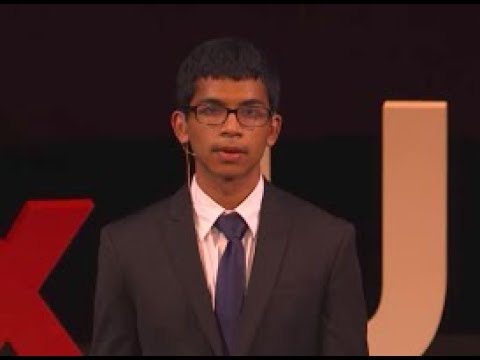
hello my name is Prateek Kola and today
I’m going to talking about how to make
your research a reality so first a
little bit about me um I’m 18 years old
I’m a senior in high school in other
words quite a bit younger than the rest
of you and I go to the Texas Academy of
math and science essentially it’s a
program at the University of North Texas
that allows high school students to take
college-level courses it’s been really
great to me mostly because of the
opportunities I’ve gotten to do because
of it especially research I’ve been
researching for the past two years and
I’ve been able to do extremely well at
some higher level prestigious high
school research competitions including
the Siemens competition and the
Goldwater competition which is a
competition for undergraduate students
and I’ve come to love research it’s
something that I wants to do for the
rest of my life
however in these past two years I’ve
also seen a lot of the problems in terms
of research and that’s what I want to
talk about today so first to understand
my background research you got to
understand my research and to understand
my research have to understand the
problem that I was trying to help solve
so in rural communities especially in
Ethiopia and Somalia mercury poisoning
has become a real problem
um gold mining operations known as
artisanal small-scale Gomukh mining
operations have been putting mercury
high low concentrations of mercury into
local water sources
similarly poisoning villagers who have
no way of protecting themselves mercury
poisoning has been known to cause renal
failure
neural degeneration and in some cases
death there are currently 15 million at
villagers who are threatened of being
affected and this is a real problem that
we have to solve now the easiest way to
solve this problem will be to give these
villagers a way to tell whether or not
their water is safe to drink however it
is this isn’t as simple as it seems
currently mercury sensitive technologies
are woefully inaccurate in adequate
their high cost not easy to use they
tend to be non portable and non-reusable
making them hard to use in these rural
nice to solve this problem I helps
create a mercury sensor a luminescent
mercury sensor essentially what it does
is it emits green light and when mercury
is added to it especially at low
concentrations the green light goes away
it becomes translucent by correlating
changes in concentration of mercury with
changes in concentration of or emission
of the system we’re able to sense how
much water mercury is in a water source
the system is so effective because it’s
low-cost it’s extremely easy hues easy
to make and it’s reusable thus making it
perfect for these rural communities I
personally thought it would be an easy
step to take this system and give it to
these people who really needed it the
most
however it wasn’t as easy as it seemed I
thought all I would need to do would be
to do a couple of field trials prove
that the thing actually worked in the
real world and then patent my products
in a month and have it in the field as
soon as possible however the first thing
I reached and my first big pitfall was
the patent process how many people here
have tried to patent something yeah so I
thought not very many it’s an extremely
difficult process that can take months
if not years and I didn’t I went in not
understanding this it I kept being asked
the same questions I thought my
credibility was being called in to
suspect and Pat’s thing just became a
drudgery for me something I really did
not want to do and so I did what I
always do I went back to my research I
can patent it became a secondary process
and my research became my primary focus
again while listen did mean I got to do
some cool new projects it also meant
that my sensor was put on the back
burner
it was stuck in the paper face
essentially it never got to the real
world and this is something I’ve been
trying to work on fixing I have been
reworked getting back onto patenting the
project and I hope it had this patent
done by summer of this year but this
this problem having the project stuck in
the paper phase isn’t something that is
isolated to me it’s something that a lot
of researchers face
a quick Google search shows thousands if
not millions of possible drugs that can
be used to help cure cancer however
we’re still eating the same chemotherapy
that we’ve been using for the past 50
years which has been shown to cause high
levels radiation poisoning sickness and
in some rare cases death why is there
such a huge disconnect between the
number of drugs were producing drugs
that are being tested in laboratories
and the real benefits that we’re seeing
a society these drugs are made to be
given to the people they’re made to be
have practical use and they’re not
getting to them there’s this huge bridge
and I believe that there’s two reasons
from two main reasons for this the first
reason is the disconnect between the
graduate school and PhD admissions and
undergraduate or in real-world
application one of the first things you
learn as an undergraduate researcher is
that the thing that graduate schools are
looking for is who has created the most
papers and who has them in the most
prestigious journals
there’s nothing about how much time you
spent on a project how much time you
expect perfecting something and so
there’s very little incentive to do just
that people are forced to drop projects
after they’ve written the paper and move
on to something new because there’s so
much risk involved with taking the time
to patent and market a project where all
that time could be spent creating a new
project that can be used to pad one’s
resume the next major thing is what I
faced as a researcher the fear of the
unknown and the unknown was the
patenting process very few graduate
researchers even fewer undergraduate
researchers understand how much work
goes into patenting project and so once
they realize how much work it takes and
how long it takes they start to drop out
they leave their papers stuck in the
patterning phase or their stuff and
leave the paper stuck in the in
submission phase and they move on to
something new and
that’s something that we need to fix the
scientists it’s important that projects
which have practical application get to
the people who need them the most
now this is a huge structural problem
which I can’t solve myself which we as a
school can’t solve ourselves but there
are small things we can do to bridge the
gap to make it so that these projects
which do have practical application get
to the people who need it most
one of the first things we can do is
have more panels for undergraduate and
graduate researchers to meet with
business interests now this may scare
some of the researchers out there
thinking that we’re becoming beholden to
business interests something that many
of these are so loud to do but we have
to remember that businesses do have
something to give back to us as
researchers they can teach us how to
market our products better make sure
that we have the correct procedural
things to make sure that the product
gets off off the ground and one of the
main things they can help us with is
understanding what we need to do as
researchers to make sure that the
project gets to the real world
whether that be patenting or field
trials or just marketing these are
things that businesses do all the time
in their R&D departments and they can
help us undergraduate and also a
graduate researchers do that as well
another major thing that we can do which
may seem a little bit smaller which but
which I believe is just as important is
having patent writing writing classes
for graduate researchers well this will
do is remove a lot of the fear in the
patent writing process people won’t be
scared to write these patents anymore
because there’s they know what they need
to do they know the amount of time it
will take and that will just make it
easier for them to justify taking their
project and really working on it and
really making sure it gets the people
who it needs to get to
in conclusion we don’t just need more
science what we need is more science
that can really make a difference and
the only way that’s possible is if we
have
if the projects that really can help
people are getting to the people that
they need to help we need to be able to
make our research a reality thank you
[Applause]
Please follow and like us: