
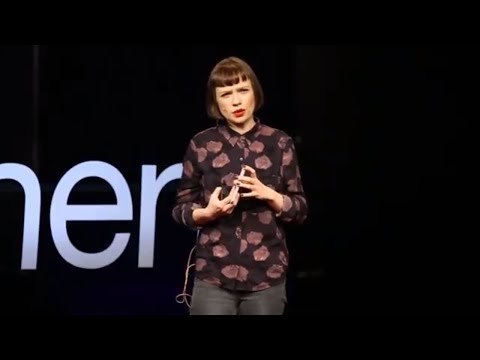
my name is Hannah hull and I am a mad
person
I’ve lived with a mental health
disability for most of my life what’s
wrong with me
well my symptoms include OCD anxiety
depression and panic attacks but the
real question the question that’s not
asked often enough of people with mental
health problems is what happened to me
when I was a child I suffered a series
of traumatic events that my brain is
trying to stop me from experiencing
again so anytime that I’m reminded of
those events and that can be in quite a
deep subconscious way a smell or the
change of light and things that I can’t
quite put my finger on one there when
they’re actually happening my brain
tells me I’m in danger
and this misplaced self-preservation is
what makes me crazy and I’m not alone
mad people are taking over the world
more now than ever one in four of you
will experience a mental health problem
within the next year in the UK somebody
takes their own life every two hours one
in 15 people attempt suicide which means
about 40 people in this room either has
or will try to kill themselves in
England and Wales suicide is the most
common cause of death for men under the
age of 50 and globally by 2030
depression will be the largest health
problem that we have despite these
pretty depressing statistics
most of the time I don’t mind being mad
like many people who have suffered
traumatic life experiences those
experiences change you and you don’t
know how you would be without them I’m
not proud of my disability but I have
come to accept my madness is simply a
part of me I have a beautiful and
fulfilling personal and professional
life and at best my mental health is a
small if constant consideration and most
of the time I can handle it mostly but
when I can’t when my past experiences
overwhelmed my brain and completely
control me the world can be a difficult
place to experience my madness in a safe
way half of mad people say that the
isolation and shame that come with a
mental health disability is worse than
the condition itself I’m afraid to tell
people when I’m thinking about hurting
myself because I don’t want to scare
people away from me a third of the
public think people like me are likely
to be outwardly violent I fear going to
the doctor because I don’t want to be
pressured again into taking medication
that makes me feel worse in many ways or
told that I have a chemical imbalance in
my brain just a myth that has been
created by pharmaceutical companies I
know from extensive psychotherapy that
my brain is just trying to protect me
I’m afraid at times to even be honest
with my therapist who I pay to help me
every mad person knows if a therapist
asks you if you’re feeling suicidal you
say no you lie because the true answer
to that question is we’re patient
confidentiality legally and
and when I’m at my very worst when I’m
afraid that I might kill myself
I fear calling an ambulance because I
know that depending on the training and
the personal outlook of the paramedic
and depending on whether they see fit to
bring a policeman with them for their
own protection from me and depending on
how I respond to having strangers in my
home I could end up in a psychiatric
hospital against my will and have my
rights taken away from me and that
really is the deepest fear prison for
people that have done nothing wrong
where other people decide what’s best
for you the current system and social
perception of mental health is stopping
people like me from getting help when
they need it most
what if madness was accepted as a normal
experience what if instead of trying to
fix madness we gave people a safe space
to go mad and then as them how they want
to be treated
mad love a designer asylum the lunatics
are taking over the asylum for the past
five years myself and my collaborator
James Ledbetter have been trying to
design the most crazy bonkers asylum we
dare dream of this is a radical
reimagining of psychiatric care we’re
reclaiming the word asylum and taking it
back to its true meaning a safe space
we’ve been working with hundreds of
other mad people the idea is not
necessarily that this designer asylum
would be bill although it is a
possibility the main purpose is to
create a new vision that will inspire
change within the current system and to
raise awareness and understanding
of people with mental health
disabilities and to help them and
ourselves to understand more about self
and mutual care most of our design
process happened on psychiatric well
wards and some of them secure
psychiatric wards and some of them very
very secure psychiatric wards James and
I went into places that most people
would never want to go and spoke to
people who don’t have a voice we’re
trying to put the power back in the
hands of people with personal experience
of mental health
this was not an easy task we’re asking
disempower people who often don’t have
control of their own minds some of them
will spend the rest of their life behind
shut doors people who have got very
little hope left to imagine the
seemingly impossible we call these
people experts by experience people that
have got lived experience of mental
health and the systems in place to
support it we ask them to forget about
the laws of physics and money and to be
creative and imagine the most positive
and playful space to support mental
health this took a lot of bravery from
all of us and a rigorous creative
process redesigning mental healthcare
isn’t just about changing what space
looks like or the list of services that
are available when you’re inviting
patients to help redesign a space it’s
not about sitting them in a room with a
cup of tea and asking them what’s wrong
with the current ward or increment in
fighting incremental change it’s not
about adding a TV room or having a
couple more cigarette breaks in a day or
having some extra options on the menu or
a change in uniform color or just
putting some art on the wall to truly
redesign mental health care based on the
expertise of those who have lived
through it you need to support their
creator
Vivat II you need to liberate them from
their past experiences and you need to
ask the right questions in our work
workshops after doing creative warm-up
activities to get people thinking
laterally we started by asking what
should good mental health care feel like
this was the starting point of our
design process what emotions do we want
this space to evoke one patient in
Bethlem Royal Hospital said to me if
they don’t want us to escape why didn’t
they build somewhere we don’t want to
escape from how do you need to feel
emotionally to not want to escape from
somewhere among many other things our
participants said they wanted to feel
human hopeful free and validated they
want to feel safe to be experimental to
try new ways of thinking and being they
want to feel that it’s okay to not be
okay the next question we asked was not
just what should this space look like
but what should it smell like and sound
like and taste like and feel like to
touch these questions allowed us to
create a full sensory palette to design
from the sensory experiences that
support mad people are the same as the
sensory experiences the support those
unfortunate enough not to be mad people
said the taste of familiar recipes fresh
food nobody said hospital food and being
able to cook for yourself imagine not
even being able to make yourself a cup
of tea in your favorite mug the sight of
nature the sight of your family the feel
of your pet of rainfall or of getting
into a freshly made bed with good
quality bed linen
the sound of birdsong music the sound of
the weather or of silence or being able
to control the volume of your
environment in many psychiatric wards on
the upper floor you can’t open the
windows or barely at all to prevent
people from jumping out of the windows
and but also preventing fresh air one
person said to me instead of locking all
the windows why don’t they just put
bouncy castles underneath them
we collected hundreds of sensory
suggestions and integrated the most
popular and also the most imaginative
into our designs the next question we
asked was about people it matters who is
giving the care people make up the
fabric of an environment as much as
anything else our participants mentioned
personal qualities like being practical
honest respectful and funny particularly
someone with a dark sense of humor is
useful when dealing with crazy people
many people wanted to be supported by
staff that had personal experience of
mental health you’re more likely to
trust somebody who shares the same
experience of the world as you one
person suggested professional huggers
and my favorite suggestion was somebody
with kind eyes I love the idea that
doctors and nurses and psychiatrists
could be rejected or accepted into a
position based on the kindness within
their eyes and finally we asked people
what activities and facilities support
them people wanted a gym and a pool
outdoor space for gardening a farm art
workshops a library full of books and
music and film that helped other people
in their recovery and the librarian who
could help you to get a book or a film
that had a sad ending if you needed to
have a good cry or happy one if you
didn’t one suggestion that I loved was
that we keep the padded cell as a place
to scream and shout and punch the walls
but that we were giving the key to let
ourselves in and out when we wanted and
my favorite answer was a young man in
Birmingham he said he wanted to have a
room full of Faberge eggs and a hammer
to smash them with
so here are the designs with Rosemarie
Cunningham and illustrator van Kozlovsky
a designer and James Christian and
architect we came up with this
installation at the Wellcome collection
which is a major Museum in London and
exhibit was visited by a hundred and
fifty thousand people the model features
many of the ideas generated from our
research process and allows for diverse
needs to be met in a single space it’s
definitely not one size fits all here
you can see the bakery which is the food
hub where you can smell home cook food
cook for other people or be cooked for
eat in a quiet nook on your own or
community here is what we’re calling
treehouses which are private pods with
no disruption if your neighbor is having
a bad night
no jangling of keys along a corridor at
night and you can arrange these spaces
however you want with your personal
possessions around you and nearby
there’s pods for friends and family to
stay and be close by you if you need
them and just outside your door is a
running track around the hills this is
the Town Square where there’s always
something happening there’s always
somebody around if you need help we just
want some company and of course little
dogs to pet and here is a lake with a
bird house to attract birds and birdsong
tennis courts overlooking the water
little spots for making our a boat for
you to take a trip now onto the water
we’ve tried out some of these ideas in
real life so here’s part of an
installation fact in Liverpool this was
open for three months as an experiment
in mutual care this space had over 3,000
visitors and over 350 mad people
participated in workshops that were
designed by and for people with mental
health disabilities at the back you can
see an attempt at what we call the
cooling tower the padded cell for people
to shout and screaming you can control
the weather by the projections
there’s projections on the umbrella
canopy and as you come into this space
you can pick what weather you want to
have that day in the central area is a
workshop space for lots of patient led
activities such as aromatherapy
chocolate making critical reading groups
making a postcard to send a friend all
ideas that most people have come up with
themselves and then there’s a quiet
comfy pod shaped a bit like a piece of
Turkish delight at the back and here you
can have private chats you can draw a
curtain across while you’re in there and
people can tell that the room is
occupied by the feet underneath rather
than occupied signs and locked doors the
space featured as simple out indoor
garden with growing workshops again run
by mad people with a focus on fragrant
and edible plants and these bookcase
stairs house the library of good mental
health which all of the books have been
recommended by people and there’s a note
in the front about when it helps them in
their journey and it’s not limited to
self-help all medical books or
psychology books it’s any work of
literature that’s helped somebody in
some way and then at the front of the
space is a scent station where as you
come in you could pick a room scent that
you found comforting and we found this
amazing place that could
Sallis room scent of a thunderstorm the
mad love concept is not a space to cure
or stop madness it’s a space where good
mental health can flourish and bad
mental health can be experienced safely
and it’s not just an unrealizable utopia
we found that if you’re willing to
imagine utopia people will come and help
you build it
we’ve already had three major health
partnerships in the UK including
redesigning a children’s mental health
unit in Edinburgh designing a recreation
area for a high-security psychiatric
hospital and developing new training for
mental health nurses to help them be
more creative and empathetic but also to
understand their own mental health
better we’ve also received lots of
really great press coverage on BBC
Worldwide and the National UK papers and
even a pilot for a television show this
willfully optimistic vision gives people
hope an agency for those working in the
mental health services and those who
need them and this just isn’t just about
the big picture and people come away
from the workshops with ideas on how to
improve their immediate environment
planting a lavender bush or baking a
cake with their grandma’s recipe or just
opening a window next time it’s raining
and listening what would it take to
improve your mental health the answers
might be simpler than you think and they
might not be that dissimilar to mine we
need to create a more flexible and
empathic world for everybody because at
least a quarter of you will go mad
within the next year and when you do
you’ll need some mad love
[Applause]
Please follow and like us: