
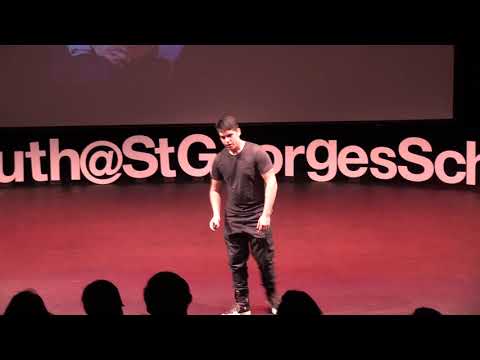
all right so we are youth as we are
often reminded we are the future but as
youth what is our relationship with the
future what does our future look like
in short we don’t have one we don’t have
a future
to quote the greatest futurist of our
time William Gibson we don’t have a
future because the present is too
volatile but what am I talking about of
course we have a future the future is
tomorrow next week ten minutes from now
that’s not the same future I’m talking
more the capital F future as in the
Atomic Age of the 1950s then an iPhone
without a headphone jack as the future
you see in the 1950s there was a
distinct idea of what the future would
look like and a plan to make such a
dream real there was an idea of a
fission bomb and efficient reactor with
a with a fusion bomb and a fusion
reactor what would the world of
widespread highly efficient energy look
like the government artists filmmakers
advertisers of the age decided that it
would look like this it would be a
pastel colored smooth lined atomic
inspired glory this if you’ve ever seen
an episode of the Jetsons you know
exactly what this future looks like in
this era this literally was the future
and there was it was leaking into the
world in film in television shows in
books of course cuz that’s where fiction
exists but it was becoming real when it
was entering Carlin’s car design was
visible in what on the wallpapers of
office buildings or in architecture in
the most permanent of public art this
was a dream and it was becoming real
because people were making it real
unfortunately the atomic future was
blindsided by subsequent history by the
Cold War as the 1960s approached or
rather its end approached atomic no
longer meant clean cheap accessible
energy but meant
bomb ready to annihilate you and
everyone you know the atomic was no
longer the future but the wooing fret of
the end it left a space that was to be
filled by something new by the age of
the computer the first home computers
work it’s much like this one the MIT s
Altair 8800 it was bought and built
mostly by computer enthusiasts and was
not at all popular the first accessible
computer that was widespread was the
Apple 2 it was connected to a pseudo
Internet as in you could have very very
minimal connection and it changed the
way that people understood media yes
sure
computers themselves were nothing new at
this point it was public knowledge that
the government had been using computers
on closed networks for security reasons
for years they were just never publicly
accessible much like the futurists of
the 1950’s there were people who
imagined what the world of the
widespread computer looked like it was
almost a response to the optimism of the
nuclear age it was a much more dismal
future it was a world of a neon haze
illuminating an endless urban sprawl
this aesthetic was pioneered by Ridley
Scott in his 1982 film Blade Runner and
the themes of the cyberpunk in protest
with the past was established in
Neuromancer Gibson’s first novel both of
these pieces had themes of artificial
intelligence of high-tech and of an
extremely large wealth gap by extreme
corporate control a lot of the
notability of Neuromancer especially
comes from its idea of cyberspace the
concept of a space accessible to anyone
that houses any information that could
be desired if you knew how to get your
hands on it
a year after this books Oh gypsy defines
cyberspace himself as a consensual
hallucination experienced daily by
billions of legitimate operators in
every nation later that year
later that year in 1985 America Online
went lives people began to connect with
others on other saw opposite sides of a
continent of the u.s. four years later
the World Wide Web launched and people
were began to think maybe this is what
this dream of cyberspace feels like and
looks like information began to travel
around the world at the speed of light
earlier in that same year 1989 the
Berlin Wall fell the Berlin Wall marked
the end of the Cold War it guaranteed
NATO’s victory over the Soviet Union
yes sure mad had been in place for a
couple of years so nobody was under any
real threat of nuclear annihilation
anymore but it was still the end of the
longest war in the history of the u.s.
forty years long or some later that year
in the summer of 1989 the American
political scientist Francis Fukuyama
published his famous essay the end of
history he treats the Cold War in this
essay as it was as an ideological
conflict between the Western world with
Western liberalism and democracy against
an updated Marxism of the Soviet Union
and the Warsaw Pact nations he called
with Western world’s victory over the
Soviet Union the total exhaustion of
viable systematic alternatives to
Western liberalism
to Fukuyama the victory of democracy in
the Cold War made it the end of
mankind’s ideological evolution it was
going to be the final form of human
government the only thing that would
ever happen past this was the
transportation and the exportation of
consumerism and democracy and capitalism
there was nothing more this would create
a universal homogenous state defined by
the availability of stereos and Vesey
what this really meant is it would be a
capitalist consumer-based economy ran by
a democratic government think similar to
what the US did to feudal Japan after it
essentially bombed the country flat in
the Second World War it took a few
donation that wasn’t in the best
economic State and turned it into a
manufacturing powerhouse in under 15
years in the 90s and the late 80s the US
was at a kind of peacetime there were no
real wars that had any lasting effect on
its culture or its economy or its
politics especially as they were in the
shadow of the women future in the year
2000 in his 1997 articles the end of the
millennium or the countdown end in the
shadow of the millennium which very well
might be the same article just
translated by two different people she
said that we are straining the past
events through the filter of memory not
to give them meaning which they have
lost in the course of time but to
launder them to see them for all of
their beauty and none of their pain to
see the past as a nostalgic dream to
Baudrillard the past was always with us
at this point it was following us around
as an artificial double of itself frozen
in a sham exactitude in film in
television in media whether it is a new
film 1995 that was remembering the good
old days
or it was an old piece of media that you
could remember its first viewing this
was mostly aided by the increase of
accessibility of the prosthetic memory
the VCR the cassette tape the CD the DVD
you no longer had to wait for ABC to air
an episode of your favorite television
show anymore if you wanted to watch an
episode of Seinfeld you just had to buy
season four on VCR if a show was
finished it wasn’t gone anymore it was
incredibly easy to relive the past
so people stopped worrying about the
future it wasn’t any in any risk it was
being sold
you every commercial break despite all
of its anticipation the arrival of the
year 2000 was a non-event
there was no change the 21st century
didn’t really start culturally until
September 11th 2001 Gibson called in his
2003 best-selling novel
pattern-recognition he called 911 an
experience outside of culture it was the
point where the Western world realized
that it had enemies
that couldn’t be deterred from taking
action by flying a squadron of fighter
jets carrying a nuclear payload into
enemy airspace or by sending a Navy
Armada near the territorial waters of an
opposing force this was an enemy that
could strike anywhere at anytime without
notice and there was no infrastructure
to stop it people were terrified they
were scared to enter tall buildings or
fly because they were fairly reasonably
worried that they wouldn’t come out
after 20 years or so of making a hell of
a lot of money predicting the future
Gibson said that we didn’t have one
anymore
we have no idea now of who or what the
inhabitants of our future might be now
in that sense we do not have a future
not in the way that our grandparents did
before we imagine cultural futures are
the luxury of another day in which now
was of some greater duration now of
course things can change so abruptly so
violently so profoundly that we no
longer have sufficient now to stand on
we have no future because the present is
too volatile Gibson is talking about two
kinds of volatility conflict that of
constant fear that made just ordinary
life a hell of a lot more complicated
and technology in 2003 the internet was
very much so resembling the way that it
works now you had eBay for the better
part of a decade and
you could download movies watch movies
YouTube would come out in the next
couple years and it was the easiest way
to relive the past especially in a time
so complicated where you didn’t know
what was safe and what wasn’t people
just wanted to return to the time where
they could leave their front doors
unlocked or their car keys in their
vehicle they didn’t want to have to
worry about civil unrest in Egypt they
just wanted to be able to live their
lives this of course was aided by the
fact that there was a stream of constant
remakes and sequels of remakes and
sequels there was no end even the future
was later this year going to be
something that is part of a nostalgic
economy but what about us the youth that
never knew what this time was I never to
me the 1970s is more so the setting of
fictional films that an actual place I
don’t know what it is I only know what
films like American hustle tell me it is
weird Forrest Gump or what I know from
my dad’s music tastes what I know of the
90s is only from cartoons that I watched
as a kid that’s I feel a nostalgic for
those cartoons sure but it’s an
artificial kind of nostalgia it’s not
real it’s for the products not the time
it’s sort of like that William s
Burroughs quote we were not you were not
there for the beginning you will not be
there for the end you are not your
knowledge of what is going on it can
only be superficial and relative I
cannot dream to know what it was like in
those time periods I am just told that
this time period is an untouchable
greatness to be honest I’m a little bit
frustrated with it and there are other
people that are too there is a certain
kind of underground internet group that
is producing music that is entirely
foreign but totally at home it takes the
music of the 1980s pop music elevator
music takes a chorus or a line of a
chorus or a single riff and tears it
apart it slows it down shops it up loops
it and makes it something totally eerie
you can recognize where it comes from
but you have
no idea you recognize it but you have no
idea where it comes from or it is
incredibly hard to touch it is it is
created mostly online by people like us
mid 20s or late teens people who feel
like we are under an inescapable blanket
of not having anything that we can look
forward to yeah we get it the future
sucks you want to go back to the 60s but
what’s wrong with us why can’t we have
our own future we don’t know what our
future is but why can’t we have
something to look forward to if anything
we need it if we are in order to leave
the future we need to work to make that
as bet the best place we can because
this past that we are dreaming about is
so distilled by aging memory that it
feels like the way this music sounds
it’s this warped mass I’m not
comfortable with it I don’t think many
people are but what does our future look
like tell if I know we don’t have a
future but let’s make one thank you
[Applause]
Please follow and like us: