
does your food come from where was the
food that you had for lunch grown
geographically do we know it was grown
do we know who grew it do we know if
chemicals were used to grow that food
and if they were used which chemicals
and how many chemicals do we know how
the food was transported do we know how
it was stored what sort of food
processing it went through the fact is
these days we don’t know where our food
comes from we three times a day and we
have no idea we’ve lost the relationship
with where our food comes from and
that’s a symptom of a much deeper loss
and that loss is our relationship with
Mother Earth the foundation of all our
life Chuck this this soil is alive from
Solitude farm in Oroville millions of
microorganisms molds bacterias insects
earthworms fungi small animals it’s the
life in the soil that’s directly
proportionate to the fertility of the
soil life is fertility and if you like
we could interchange these two words
with Mother Nature or in India Bumi dev
every single every single civilization
on this planet has recognized the
divinity of the soil and had a dynamic
relationship with where it’s food comes
from you know you take India look at the
architecture the vast array of languages
the almost infinite diversity of cuisine
the music the dance this the
spirituality the Ayurveda it’s all
inspiring this country the culture and
it has emerged due to a society that’s
recognized the divinity of the soil and
had a dynamic and healthy relationship
with where its food has come from
now where are we today in the world
industrialized agriculture it’s defined
the nutritional profile of our society
it’s the coin that decides what we shall
eat now I give you an example if of
bananas so if you put a coin in the shop
and you buy a banana that’s what you get
a banana that’s passed through this
whole industrialization you go to a
field and you go to there take the
bananas from the tree the first thing is
you don’t take a banana you take the
banana flower now the banana flower you
can make var days with a curry a sub G a
salad and then you have banana stem
again curry sub G salad you also make a
juice very good for the kidneys for
removing kidney stones and then you have
the bananas themself for planting
plantains high in vitamin C and
absorbing acid in solitude we make we
peel it and make of chips and dry it and
make a flower we mix it with rhaggy very
delicious doses and you see that it’s
it’s by honoring though that diversity
of nutrition that Nature has to offer us
as opposed to the coin you get one
banana you know that’s all you get from
a very arbitrary you know evaluation
economic valuation we lost the diversity
of mother nature and that undermines our
society and our very well-being and our
culture so 25 years ago I came to settle
in India was 19 years old and I had
spent the last 4 years in the J
Krishnamurti school in England where I
discovered Masanobu Fukuoka while
helping run the the vegetable garden we
had a wall Victorian garden where we
produced a lot of the food for the
school now Fukuoka was a Zen master
farmer and he had a very profound
insight that nature is already perfect
there’s nothing you can do to improve
upon nature so he developed a type of
farming called natural farming or
do-nothing farming which contrary to the
sort of industrialized way of farming it
was a non interventional way of farming
it recognized nature’s natural
and process and try to work with that
rather than you know trying to do more
and more things now about 13 years ago I
had a chance to meet him in London I she
was farm in Dehradun and he’s a short
guy with the indigo kimono and the
wooden chapels and he didn’t talk so
much but he he drew a spiral and he said
this is symbolic of man’s action on this
planet you know man’s always spinning
out from himself
economics healthcare agriculture
education he’s always going out so
Fukuoka was a you know if you if you
take agriculture it starts off with like
machinery tractors combines the whole
petrochemical machinery thing and then
it goes to chemicals herbicides
pesticides fertilized destroying of the
soil ecology and also polluting the
waters then you have things like
genetically modified crops which are
responsible for a genocide of
biodiversity so solitude farm is a
direct response to this problem in our
world today not only on an agricultural
nutritional level but on all levels of
our society and we’ve basically
identified three steps where we
authentically demonstrate this
philosophy of non-intervention of doing
less do-nothing farming the Fukuoka laid
out and those three steps are firstly to
honor all the organic matter around us
we see leaves and we sweep them up and
we burn them and we throw all this
organic matter away but it’s a gift of
Mother Nature the biomass the bio
resource around us is our profit it’s
not the financial profit it’s a
nutritional profit because when you look
at nature naturally the leaves and all
the organic matter forms it makes a
healthy soil ecology and you get Amazon
rainforest from there it’s not the
product of a clever mind so that’s the
first step and when we develop systems
and techniques where we use all the
organic matter return it back to the
soil the soil becomes very alive and
healthy it takes on a dynamic soil
ecology which is Bumi dev that is the
Shakti of this country and when we have
that great
type diversity of soil ecology the
nature will offer us a lot of gifts so
in solitude farm we have over a hundred
different plants that we are honoring
it’s not that I am growing them they are
growing and we honor them so the first
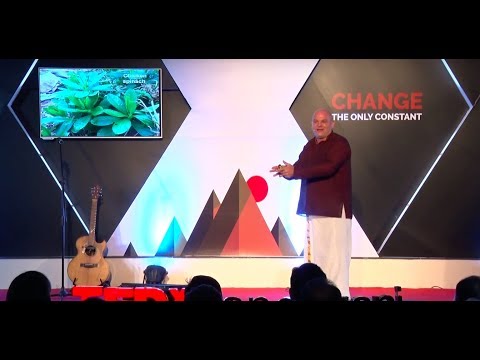
example of that is a chicken spinach now
I choose this plant because it’s growing
in abundance where I live everywhere it
grows outside schools outside homes
outside offices and for me you know this
is just like it’s it’s considered a weed
but for me it’s a shamanic superfood
this this is like a character in in the
drama that’s our beautiful food forest
in our cafe that’s in the end of on the
farm we use it to make a green smoothies
vegan sugar-free ice cream it’s used in
pesto’s it’s used in salads in sub G’s
in soups it is highly honored and the
we’ve created an economic value for it
and the irony of that is is not giving
an economic value we’ve understood its
nutritional value and its medicinal
value which are one and the same is not
a cliche food and medicine is one and
then we’ve understood that it has a
social and cultural significance and an
ecological importance and and thus it’s
a very prominent part in in in our in
our cafe on our farm
now the next character is the the green
papaya so the green papaya for me this
plant could start a social revolution
you throw the seeds of your shoulder you
come back in a few months time the plant
is up you peel the papayas you grate it
a little chilli and peanuts it’s Indian
a bitter soya sauce it’s Asiatic you can
make kimchi you can make chutneys we
make a cordon bleu lemongrass coconut
milk soup with the green papaya that’s a
Thai salad this dish here is a vegan raw
noodles with the green papaya with a
pesto sauce it’s very very special it’s
accessible to everyone this is not
exclusive everyone can be eating that if
they will open their eyes and understand
the value of these plants it’s simply by
eating them by recognizing
the value it leads you to the next one
and the next one also they have no food
miles and that’s a very significant
point you see in Oroville when we or
anywhere when we win we eat carrots for
example where I live and carrots they
have a they have they come from far away
so they have food miles they have an
ecological cost there were a number of
factories built to manufacture a lorry
that brings a carrot to our plate that
ecological cost is our responsibility
it’s not anyone else’s so when we start
to see what this is everywhere the
quantity is in abundance the nutritional
value is very high this is touted as a
cancer cure it’s good for
gastrointestinal problems it has a high
amount of carotenoids which changes into
vitamin A in the body much higher than
than carrots and you see well why aren’t
we using those things that leads us to
ask you know where are we going if we
don’t value these things the third step
of of of the of the farm of valuing
honoring mother nature’s to honor the
community and honoring the community
with celebration so on the farm we
started lively up your earth which is an
eco music festival and the last one in
particular was very beautiful it had a
giant butterfly parade and shiatsu
massage circle and music and
permaculture workshops and someone was
in a tree house reading your fortune a
very beautiful moment of bringing people
together you look in the religious
traditionally there was festivals all
the time a month of buttons and a puja
here and and music and street theater
and the art with the columns and always
together with food people were coming
together the coming together was like
affirming our identity on a social on a
social level and now what are our
festivals there one day today highly
commercialized Diwali Christmas these
type of festivals it’s very very
important that that that that we honor
the creativity in our society
as we honor those those local plants
which are which are there reflected into
this community when we use them
there are three levels of engagement
that the farm offers to to our community
to start exploring this road back to
nature the first level engagement is to
invite people to come and have lunch in
the cafe so every day there’s food on
the table that’s banana stem and pumpkin
flowers and millets in the doser and all
sorts of beautiful food which as I say
has no ecological cost and has a
nutritional medicinal social cultural
and ecological relevance now hopefully
if you come and eat that that would lead
you are these are leaves of the soursop
tree ten thousand times more effective
in the treatment of cancer than
chemotherapy the Sun kapu the chancre
Bushmen the hibiscus we make juices with
this is the green smoothies which is
very well known with the Sangha push for
also good for memory good for uterus all
these plants are shining lights of
Ayurveda and we buy our medicines in
little brown bottles four hundred and
thirty through Peas they’re all around
us so the three steps of engaging people
after the cafe hopefully that would lead
you to take a basket of fruit and
vegetable once or twice a week so you
sign up for six months in advance and
you don’t choose what’s in your basket
if you don’t know how to use a banana
flower you come to the cafe and you
learn because you’re part of a community
that’s empowering you to make this
adventure together
now the third step which hopefully that
will lead you to is to have your own
circle garden now this circle garden is
a beautiful little module because it’s
very simple to do it honors this
utilizing a large amounts of organic
matter and and a diversity of inter
crops and the beauty of it is it’s easy
to replicate anywhere three or four of
us we could make one in the next hour
and you can make it in a school in an
outside offices in public spaces outside
your garden in hotels like this in this
particular picture it’s some kids who
have reclaimed a wasteland in their
village and they’ve grown that garden
like that and most importantly they
start to eat that food cook it and eat
it and so you see over the years
in this in solitude I can see something
beautiful is emerging and it’s simply by
honoring the soil which is this earth
this country honoring the soil and
honoring the gifts that she offers to us
and using them honoring them by eating
them and I see that reflected in my
community in the cafe in the education
in the workshops in the festival music
and dance and it’s as though that
culture the arts are there very adhesive
that brings us together as a community
and what’s interesting is I can see
change emerging but it’s not strategic
there’s nothing clever about me Fukuoka
said any only a fool will understand
natural farming we’re talking about
change as the only constant but change
isn’t something that we can bring about
mother nature is already perfect you
know so I invite you to look in your
bioregions look where you live explore
what is local food and start to honoring
it start to honor it in your diet in
your in your food and you will see
change happens change starts to emerge
of its own accord I’m gonna sing you a
a lone enjoy crime bear it all myself a
column just an echo on a distant wall I
couldn’t be in that beauty’s kiss
tonight
trust me Fox for my tomorrows say my
prayers and I’ll say them right
and I get so tired of being stuck in
this place where there’s just no room
and there’s no spaces like this
buildings they crowd the sky very lemon
which new status so so dry nothing seems
fair Oh have you seen my mind it’s hard
to say where it begins and where it ends
well as I’d live for I was born
[Music]
[Applause]
and the wife and no child back to the
skies to deliver the child that from her
eyes like constellations may shine the
alone is me ey balonus sweet for the
cries from my eyes
[Music]
I think assumed a loud has come together
these dreams and perceptions integration
forever cuz there’s nothing you haven’t
know there’s nothing to hold and what
you really want you don’t even know
where was i before I was born
[Music]
and well who pay a co the coaches no
mother the remnants of a genetic code
stars overwhelmed by the mobile phone
repair Nilofer cyber seats with soma
compromises getting wider rivers
polluted racing we are beholder be will
there not belonging believing I defy the
lime that strong to define me
[Applause] [Music]