
Mahatma Gandhi in his time stated that
the earth has enough for human need but
not enough for human greed the rate at
which our generation is extracting
natural resources from the earth
resources that take billions of years to
form is shocking every development
leaves in its wake a trail of
destruction of the environment
degradation of human life and habitats
architects planners policy makers play a
major role in this kind of destruction
but we don’t have to be destructive if
we make the right choices of
construction processes and materials we
can in fact reverse the destruction like
these permaculturist have done they have
greened a desert retardant in our own
small way we can make a difference with
the works that we do the way I do it is
simple I minimize the Bilt footprint
while maximizing the use of the built
space so I use less resources when
people come to me to say I have an old
house I want to break it down and do
something new I tell them tell me what
you need to live in today and I will
teach you how to live in the same old
house cut adapting it to contemporary
use and whether it’s a house or an
institution we can do the same every
building can be readapted repaired
retrofitted rather than demolishing it
and reconstructing by extracting new
resources if I do have to do new
buildings
I am very conscious that I use
ecologically friendly materials local
materials that can be biodegradable
regenerated and recycled and as far as
energy requirements go I tried my best
to rely on non depleting sources of
energy so in my quest for sustainable
building materials I was fortunate to
have clients who thought the same and
who are willing to explore possibilities
so I tried out local materials like
stone coconut wood mud lime
we even recycled windows and doors from
existing old houses which had been
demolished
he used coconut we used bamboo screens
we used we even did and molded beds
devons
bamboo furniture and we even made
coconut shell floorings and wherever we
didn’t need walls rooms that don’t need
walls we left them open with just a roof
and a plinth and even a redundant
defunct
parachute became a roof for a restaurant
and the end result was that the boat
this was the site when we took it on and
this was what we did with it
so rather than cutting down trees when
we take on a new job we have in fact
greened an area that was taken for
construction throughout my quest for
materials I found and in my studies I
found that historically we have one
material that has been primordial
element for building through time and
this has been mud excavations in the
Indus Valley Civilisation and various
civilizations around the world have
shown that mud structures have withstood
the test of time and even reservoirs for
water have been built with mud in the
desert of Yemen in a flat plane of
shabam these are sixteenth century
seven stories seven storied buildings
that have been done with mud clothes a
home we have we see these all around us
mud structures unplastered no overhangs
that are still standing and still being
lived in so is it that our generation
refuses to accept this material that is
historically withstood the test of time
problem that it can be built with and
take on loads even seven storeys
why have we decided to do away with it
and build with concrete it is because
social perception of what we have seen
in our recent times mud houses are
supposed to be for the underprivileged
we see them as dark
ock interiors leaky roofs damp walls
unhealthy unhygenic conditions however
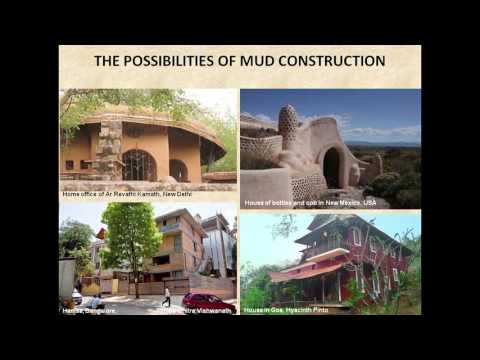
with proper design and engineering we
can have houses that can satisfy
contemporary needs and yet be aesthetic
like the houses that you see here so
realizing that our education did not
equip us to build with these mud houses
build with mud I decided to take a
course at development alternatives in
New Delhi this building itself the
building of development alternatives has
been built with mud brick compressed SOI
blocks and it was a demonstration piece
for all of her students there when we
went to learn we were we were taught how
to soil we were taught how to build
domes arches all kinds of all kinds of
elements of a building and we made the
soil blocks on the site ourselves and we
had to take soil architects from all
over the country came with different
kinds of soil and I was happy to learn
that the laterite soils that was taken
from Goa was the best in terms of
variants oil variants for building
without the addition of any stabilizers
so when I came back to go I decided that
I should tell my clients instead of
building with the regular brick and
motar
we should go in for we should go in for
mud however my colleagues ridiculed me
for a while they said that I was being
suicidal because first of all our fees
are related to the cost of construction
and mud costs nothing okay
secondly they said I was going to be
homicidal because on the first month
soon the house would wash off but I had
the opportunity to disprove this pretty
soon
and this farmhouse withstood the worst
cyclone that ever hit gone the 6th of
June of that year only a small 3-inch
portion of the wall was washed off and
that too because the country tiled roof
had blown off portion of it and we had
not yet finished rendering the wall that
means plastering the wall so with this
existing house now I had a demonstration
piece to show to other people of how we
can really weld with mark even in a high
monsoon climate of goa so mud for
construction of a mud house is taken
right from the site all excavate all
portions that need to be excavated like
some septic tanks and foundation benches
give you enough soil to build the entire
house with and surplus which can share
with the neighbors if you feel like an
excavated portions and pits you can also
be used in the landscape as event decks
amphitheaters water harvesting areas
natural swimming pools and the process
is very simple you just need three
dedicated people to to get into the
shuttering planks and compact the earth
and want to ensure that the compaction
is done the way it’s meant to be so that
it’s strong enough to withstand loads
one important factor for a mud house is
that no water should get into the walls
whether it’s from the base or from the
roof so you protect the walls by putting
a good roof now if you’re using
terracotta or something that can break
then you have got to give a good
waterproof underlay and you can even
take a concrete roof though I never
suggest concrete but there are people
who can even take on concrete roofs very
thin ferro-cement shells you can put any
kind of roof that you want on a mud
house so the volumes and the spaces that
a mud house can enclose are as large as
you would like them to be just like a
vernacular go and homes have large halls
so you can see it here that there are
large windows clear story lighting all
kinds of things that a modern house
would have and you don’t need to fear
that you’ll have a dark dingy interior
more than anything the interiors of this
house are
school has 23 degrees through the
hottest of summers and the coldest
winters we’ve actually tested that and
so you don’t need air conditioning and
you really use fans here you can see
that we have the bathrooms with
concealed plumbing concealed electricals
you can have all kinds of interiors
contemporary interiors of the way you’d
live in a house of today and more than
anything you can personalize your
interiors shape out niches carve out
your seats and even in the exteriors it
will house blends with the exteriors it
looks like a contemporary house you
would never know it was built of mud if
I had not showed you those mud slides
now for our bird house the clay is the
best plaster because clay absorbs water
and it it soaks up the water but it
keeps it on the external periphery it
does not let it penetrate inside because
the rest of the wall is mud and not clay
so what happens is when the Sun comes
out it it lets the water go out and the
mud walls are protected and structurally
are not disturbed so now what is
happening is the government is promoting
eco sensitive structures eco resorts but
it’s still remaining as well as a niche
project so so these eco resorts so to to
keep a tradition of mud building alive
but they can also serve for us to draw
inspiration from and you can build
houses doctors houses but commercial
complexes institutions schools
multi-story dwellings you can build any
kind of contemporary building with mud
it should not just stay as a house or or
a you know individual residential unit
and the best part is when the house or
the mud construction Falls to dust it
goes back to the earth where you can be
used reused by generations and
generations what can be more sustainable
than that
thank you
[Applause]
Please follow and like us: