
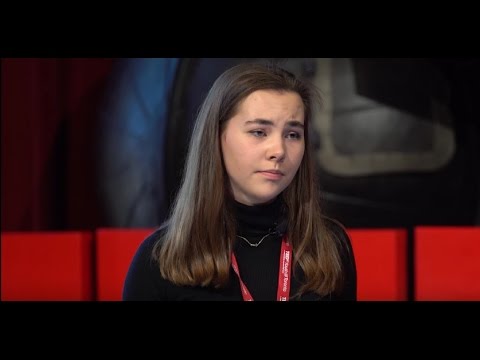
I’m Claire Morneau and like many of you
here today I’m from Toronto I’m 17 years
old and I’m in grade 12 and I was born
and raised in Canada I’m also the author
of the book you see right there Kakuma
girls so what I really want to tell you
about today are my experiences with
Kakuma refugee camp and the refugee
girls living there so my talk today is
really about the challenges that refugee
girls face when trying to get an
education and how we can mobilize youth
to be engaged in our efforts to help
refugees so I’m sure many of you know
that in many parts of the world
it can be extremely difficult for girls
to get an education and I’m sure that
many of you also know that if girls
don’t get an education we all lose
so I want to tell you a bit about my
story today
a story that really started out of
friendship so a couple of years ago I
decided to start a discussion between my
school here in Toronto patrocle college
and a girls boarding school in Kakuma
refugee camp Kakuma refugee camp is a
place near the border of South Sudan a
dusty desolate place where nearly a
hundred and fifty thousand people live
people who fled from war famine and
impossibly difficult conditions so I’m
sure many of you know that the issue of
refugees is an extremely challenging one
at the moment because of climate change
large portions of our world are becoming
inhospitable and because of religious
conflicts between and within countries
people are being displaced at a rate
never before seen at the moment there
are more than 65 million refugees and
displaced people around the world which
is pretty shocking
so I decided to start this conversation
with girls from my school and girls in
Kakuma so girls at Harvard oh my school
started writing letters we’ve sent some
letters we sent some books we had a few
Skype calls because we really wanted to
get connected connected to this place in
a different part of the world where
heavy rainfall can mean floods that
sweep away houses where rape is an
everyday fear where people can go days
without food we’re getting an education
as a girl can be an intensely difficult
experience because girls often feel like
they need to stay home and do chores or
they need to marry young to support
their families or because they fear
violence on long walks to school or
simply because they don’t have access to
sanitary pads so they don’t go to school
when they’re on their periods which is
pretty shocking so I’ve started writing
this book after reading a letter from a
girl Rita in my room one night I thought
someone needs to tell these stories
stories of girls who are fighting to get
an education in an intensely difficult
place so this book really is about
raising awareness about the lives of
refugee girls in Kakuma refugee camp and
it’s it’s an effort to bridge the
enormous gulf between the experience we
have living here in Canada in such a
peaceful country and the experiences
refugee girls have in Kakuma refugee
camp I personally believe that stories
are a very compelling way to get across
messages and to help people understand
what life is like in a very different
place so when I was done writing my book
I sent a copy to the UNHCR because they
had been extremely helpful in all of my
efforts and they really wanted to make
sure that people understood the
difficulties that girls faced so a
couple of months ago my mom and I
received the opportunity to try
to Kakuma refugee camp with the UN to
meet the girls who I had been talking to
for three years the girls who had become
my friends the girls who had rest’
revealed the most intimate details of
their lives to me so that I could tell
their stories so Kakuma is really not an
easy place to get to you fly from
Toronto to London London to Nairobi and
then take a United Nations plane to a
dusty desolate airstrip in the isolated
refugee camp near the South Sudan border
only then do you get in a secure envoy
to go to the UN compounds in the camp so
my mom and I were in Nairobi very
excited to go to Kakuma and we spent a
couple days meeting with the UN there
and the World Food Programme to learn
about some of the challenges facing
refugees in Kakuma so we went to bed
really excited to go to Kakuma the next
morning but at 2:30 a.m. we got a phone
call from Ottawa it was not good news
the Canadian government had identified a
specific terrorist threat against
Westerners entering the camp the very
next day we were the only Westerners
entering the camp the next day so we
tried to go back to sleep but then we
got a phone call from the Canadian
ambassador to Kenya telling us that his
deputy minister and chief of security
were waiting for us in the lobby of our
hotel so at 5:30 in the morning we learn
that al-shabaab the Somali arm of
al-qaida one of the most terrifying
terrorist groups on the planet could be
specifically targeting us since neither
my mom nor I particularly wanted to star
in the refugee camp rendition of the
movie taken we decided that we could not
go and as it turns out our decision
really didn’t matter because the
Canadian government decided that under
no circumstances would we be traveling
into the camp but if you didn’t think
the UNHCR was great before
they decided to fly five refugee girls
five of my friends to Nairobi to meet
with me and what I heard from those
girls made me cry
so today I want to tell you some of
their stories
Sarah a New York geek is a South
Sudanese refugee when she was a little
girl her father was killed during a
disruption by the Sudanese people’s
liberation movement soon after she
watched as her pregnant mother was shot
and then taken to a hospital by the
Kenyan Red Cross at five years old
Sarah was left alone in war-torn Sudan
and had to fend for herself until one of
her neighbours found her
several months later Sarah miraculously
heard news that her mother was alive in
a Kenyan hospital and she traveled to
the hospital only to find her mother
living there with no money for food or
clothing for her newborn baby after
three months of living in this hospital
Sarah and her family were transported to
Kakuma refugee camp by the UNHCR Sarah
didn’t go to school until she was ten
years old
Sarah doesn’t have a father and her
mother cannot take care of her because
she has disabilities from her gunshot
wounds somehow Sarah has made it through
all of these challenges and through high
school all she wants is to go to
university and to have a life in a
peaceful country she wants to make a
life for herself and her family that
brings me to Esther Nikon Esther knows
what true hopelessness feels like Esther
fled to Kakuma refugee camp from South
Sudan with her mother and her two
sisters the journey was long and
dangerous and she almost died along the
sorry but somehow Esther survived that
journey and ended up in Kakuma refugee
camp and last year Esther’s grandfather
sponsored her older sister to go to
University in Nairobi but halfway
through her first semester her
grandfather died an Esther sister had no
money to continue she had to go back to
Kakuma there is no hope in Kakuma for
Esther her only hope is her connection
with hierarchal girls she hears about
our lives in Canada and she is filled
with the desire to learn and to make a
Lulla mod har is one of the smartest
people I have ever met she was born in
Kakuma refugee camp
she knows no life but the life of a
refugee
she has no country no nationality and no
home last year
Lula’s family was given the chance to
relocate to the United States they gave
away everything they owned including
their home to friends in the camp
because they knew that they would have a
better life once relocated but when
Lula’s family reached nairobi one of her
brothers was missing a fingerprint so
her whole entire family was sent back to
Kakuma refugee camp they had to rebuild
their entire life to this day
Lulla still cries when she hears
airplanes but through all of this she
wants to be a neurosurgeon she wants to
live in the Canada that she has read
about in letters she wants to make a
better life for her family and really
more than anything she wants a home
so by raising awareness and by helping
some of these girls to get a university
education I hope to inspire Canadians to
be a part of our efforts to come up with
a solution to end this global problem
the issue of displaced people is not one
that will go away the only way to help
these refugees and displaced people all
around the world is for us to stand
together and come up with a solution
every single one of you here has a
platform and should know that change is
possible more than anything I hope to
share the message that education is what
will create the leaders of tomorrow I
know from personal experience that girls
like Rita girls like Esther Sarah Lula
they are the hope for tomorrow and my
friends like millions of others can be
part of a better world
these Kakuma girls have intense
determination and perseverance an
unlimited potential and all they need at
this point is the opportunity to unleash
it thank you [Applause]