
by the standards of our grandfathers we
are living in a science fiction world I
firmly believe that within the next 20
to 30 years the first actual human Mars
mission is going to happen we have
people landing on an alien world and
other planet for the first time in
history so that actually in 1st that I
also believe at the very first human to
walk on Mars is already born and might
be going to an elementary school here
inclusion who knows so here’s my journey
of truly going beyond so my day job is
developing one of the most advanced
space shields simulators for Mars
exploration I log about more than 100
hours of simulated extra vehicle
activity which is the term for spacewalk
I had about 30 minutes of weightlessness
so far and here’s what I would like to
share with you first of all in my day
job sometimes I get to do pretty cool
things you know like this most expensive
car I’ve ever driven it’s about a 1.4
million euros took about 10 years to
develop and I was one of the first to
make it dirty and the maximum speed it
has is about
like so it’s not a lot of bang for the
bucks however it’s very intelligent
cards you robot gram prototype which we
used in their real tinted area in
southern Spain to simulate a Mars
mission there or we go to even further
remote place in the surface of this
planet which to some extent is Mars like
so this is me working in the north on
Sahara with the Puli Rover which has
been built by our friends from the
Google Lunar XPrize team in Hungaria in
Budapest and so we’re we’re also looking
into human robotic interaction this this
old quasi-religious debate if you send
humans or robots to Mars it’s old-school
so we think about send them both because
they have their each respective
advantages and disadvantages we not only
explore on the surface but we go below
sub surface because we have good reason
to believe that there are cave systems
on Mars we know those but since about 10
years or so where we believe if if and
that’s very big if if life ever arose on
Mars like let’s say 4 billion years ago
and then the environmental parameters
got less favorable for life like a
colder you lose part of the atmosphere
you lose the magnetic field this surface
becomes chemically react defense on life
would withdraw to what we call
ecological niches we call those niches
the Swansea Ecology’s when the last
songs of life are being sung and a dying
world now we don’t know if it happens
but if we want to do this on Mars we
need to be prepared also for Mars in
cave expiration that’s exactly what we
do here and the amazing data in giant
ice caves in upper austria well we went
a few hundred meters below the surface
to see what the operational constraints
are of going there with the spacesuit
and as you can imagine there these are
magnificent sites when you have enough
elimination power you can actually light
up the entire major cave there and look
there for all traces of life with an
advanced trader which is actually slated
for launch of the ExoMars mission a
couple of your views from now so we go
to place which is Mars like as we can
have it so on the left you see a picture
taken on the 15th of February 2013 in
the north on Sahara so just
a few hours after a severe sandstorm
would hit our base camp so even the
color of the sky is not blue anymore
this is not Photoshop this is what it
looks like there and the picture on the
right has been taken just one week after
at Gale Crater actually looking at Mount
sharp here by the picture taken by the
math-science LED curiosity so there’s
those two pictures they are just one
week apart but there are also two worlds
apart I mean this is living through
science fiction isn’t it anyway but I’m
not doing this alone this is there’s a
large team in the background this is one
of one of our flight control room
information supports and an Innsbruck in
western Austria which is Earth so to say
where we communicate with about ten
minutes time delay so when you’re
standing on the surface of Mars and say
how are you doing back on earth and then
the answer comes back 20 minutes Alfa’s
yes well and how about use a small talk
gets pretty boring on Mars after
sometimes you have to be pretty precise
it skill you develop balsa for everyday
life here on earth as well but you also
have to make some concessions we have
people from 23 nations which took part
in this expedition with more than 100
mostly volunteers we had such a strong
passion for this exploration theme that
there are willing to come with us so you
have to build up a high bandwidth
Network for telemetry transfers in the
middle of nowhere literally and then
little of in the middle of nowhere but
you also have to make some concessions
because you’re still on earth that means
you have to make those kemmal proof so
that no you no drunk amble runs it over
in a night throws out and you do serious
science like here you know this is an
experience which is really serious about
traverse planning or so but ok you were
right I mean let’s be honest driving in
an air-conditioned spacesuit in the
middle of the desert with a quad bike I
mean how cool is that so it’s also part
of it not everyday but part of my work
as well we also think about what happens
if things go wrong and we’re not talking
about fistfight with aliens we’re not
talking about head exploding scenarios
we’re talking about simple things like
what if you sprained ankle you cannot
walk back to the mission to the base
station anymore so you’re stuck on Mars
and by definition you’re gonna run out
of oxygen you’re gonna run out of power
gonna freeze to death you’re gonna die
within a few hours so I will did that
thing happen so what do we do as
Austrians I’m part of the Austrian space
from an all students get stuck in the
mountains they usually have that by walk
backpack he knows a little tent with
them so they basically cuddle into a
small tent and tough it out for night
and hope for the rescue party to arrive
on the next day and that’s exactly what
we asked our colleagues from the
Technical University of Vienna like can
you make us a space-age version of this
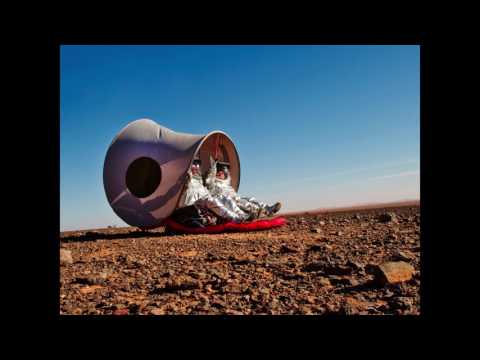
and they said sure how about this so
what is see here it’s what we call the
deployable shelter it’s basically the
abstraction about the size of a car
wheel and we when you’re in trouble you
simply unzip it you unfold it it goes
bloop bloop bloop bloop bloop and you
have this and then you pressurize it
with a compressor you close it you seal
it and then you can survive the night
there the only thing we forgot where was
the in-flight entertainment we didn’t
bring a beamer for the late-night movie
however it was pretty comfy because you
have hydraulics inside so depending how
you navigate within hydraulics you can
make a bench a couch a table you just
inflate whatever furniture you need
inside that’s pretty cool we also work
with Rovers as I said um this is again
the Puli Rover from our friends from
hungaria from the putti team and we have
the magma Rover in the background which
was developed by ABM space in Poland now
when you have then to control centers
for each one control center for each of
the rover’s so could to controls and us
placer controls and for humans you need
to start coordinating right now all the
robots on Mars they are Taylor operated
as a single they’re doing solo missions
so to say but if you’re doing several
Rober missions at the same place you
need to call it otherwise you’re risking
in this case the first simulated
interplanetary traffic accident I think
magma Buddha phone is just big like
monster trucks on Mars but you need to
be careful with the coordination
obviously here another thing is we not
only go subsurface or the general
surface of the northen Sahara we go as
high as we can we have high aspirations
we go to high place what about glaciers
so we know the relations of Mars
glaciers our water source on Mars and
their astrobiological hotspots as well
just like the caves are and so we set
the high altitude record at almost 3,000
meters two thousand eight hundred eighty
seven meters actually that record was
set by our analog
my colleague Karthik Kumar who comes
from the Netherlands distance so so we
are we’re doing extreme things sometimes
so these are magnificent moments moments
of high aspiration moments of sheer Wow
are you being paid for this let’s go and
then you go back to the laboratory you
you do performance ml of measurements
you go in the sensor calibrations you’re
measuring the electromagnetic emission
as precise as a can of the suit
understand how it works with developing
this suit for eight years now and we
still don’t understand it yet fully yeah
it’s called Buddha X I would is this
Indian princess from the children’s
novel journey around the world in 80
days you know that the novel maybe it’s
Indian princess he rescues in the end
and that marries at the end of the novel
so to ask she’s like a princess she’s
really very beautiful to look at
but she’s also high maintenance I have
to say okay so we are the whole place a
crowd test at minus 110 or in this case
minus 75 degrees Celsius so we’re
looking for Martian temperatures that’s
something we did also in January this
year or you take him high risk risk that
are potential life-threatening as well
so what we do here we’re simulating dust
devils on Mars we know there are dust
tales on Mars they have electrostatic
discharges and so lightning strikes of
Mars are able to happen although you
don’t have really thunderstorm happening
on Mars and so this is a Tesla coil
which is ejected lightning strikes X 6
million bolt and when you standing in
this spacesuit you know this happened
less than about more than a month ago
actually and this is those moments when
okay people have got killed by Tesla
calls previously and now I voluntarily
are exposed to those strikes and those
are this moments when you have to trust
the numbers you have to trust your
engineering team you have to trust the
paramedics in standby if something
happens so so we are taking risk
obviously here and then being asked why
are you taking those risks why are you
putting so much effort into it and then
I then I think about this this picture
this is very old picture actually what
imagine being the archaeologist of
circuit or who
was this what is that one of the
discoverers of the of the tomb of
tutankhamun in in Egypt which means
you’re looking at a untouched seal which
is 3,200 45 years old so nobody knows
anymore
what’s behind the door and this moment
of going through the seal and opening
the door that’s exactly what we’re doing
the difference is we’re not looking into
what our ancestors did but we’re going
much deeper into what’s the universe is
about it’s like entering a library with
full of books not a human soul has seen
before and that’s what is what’s it
about when talking about exploration so
when we think about Mars we talk about a
a barren dry cold desert look looks a
little bit like your last Egypt vacation
I guess however you have to understand
it’s a high device diverse world it
might be you know very dry right now you
know you have minus 70 degrees Celsius
average temperature one less than 1% of
the atmospheric pressure of the earth
only warm therfore gravity a highly
chemically reactive surface and so on
and so forth but we also see things like
this sedimentary structure see all the
layer rings you don’t have to be a
geologist to realize oh there have been
sediments going down from from a lake or
maybe even the ocean we have good reason
to believe Mars had liquid water up to
3.5 billion years ago including oceans
with a depth of 3 kilometers
you could go deep-sea diving on the Red
Planet 3.5 billion years ago in the core
now the thing is that all these evidence
we had suggested here and this is a
another self feel like the first speaker
indicated this is also one of the most
remote selfies ever taken by the Mars
Science Lab curiosity and know these are
on the left side these are not the steps
of the photographer this is where the
shovel up yeah there’s the surface
samples so all the evidence suggests one
then and that is Mars once had all the
prerequisites for developing life it was
warmer denser atmosphere had an intact
magnetic field it was much more
hospitable
it was we believe it may be even
habitable but we don’t know if it was
inhabited these are two different things
habitable inhabited and so there’s one
way to find out in this hell let’s go
there and and and find out so so instead
of what Hollywood tries teaches of like
bringing home I said no no no no no no
take us there we want to know take it
there so this picture is one of my
favorite pictures and it’s similar to
what we saw in the first presentation is
a picture of Earth seen from Mars just
after sunset and the the nice thing
about this picture is it’s taken with a
wide-angle camera which somewhat
reproduces the angle of view of a human
sight so one day some someday there will
be human standing there and seeing this
picture in full color with somewhat the
same resolution that’s asked that’s as
all we are everybody you know what who
ever lived
every dream ever lived every story ever
told that’s in this little dot right
there
and so yes we we have the privilege of
working for the next generation maybe I
will be too old for doing this voyage we
just we call ourselves analog astral so
in an analogy to future missions we’re
preparing for this we’re doing this also
for the next generation so by the way
this this picture it’s also a father in
thought in real life so they’re at the
picket when she kisses him on the helmet
and so we’re doing this for the for the
next generation trying to find our way
trying to explore something nobody else
has been doing before using technology
which which is not yet existing we have
to develop so many things which you
cannot simply buy on an eBay you have to
really go beyond and do it good for
yourself in a way so for those missions
we understand for the actual mission
going to happen in the next 23 years it
takes engineering ingenuity a a society
with the will to explore dreamers with
that everlasting itch
for things remote do you know that that
feeling when you’re just about to plan
your next big vacation this itching oh
where am I going to do what am I going
to discover there you need also poets to
tell a story you need people who are
able to communicate as a human what’s it
like to stand there and literally feel
the winds through space suits or to say
and it will not be easy there will be
problems there will be setbacks there
will be people saying I don’t know we
cannot do it there will people saying
you know we shouldn’t do it we have
enough problems here but like for all
dreams going beyond means rising to the
challenge
and that’s the pattern we see again and
again throughout our history the world
we’re living in remember what I said at
the beginning the world we’re living
according to our standards is pure
science fiction world we are living in
science fiction was because of all the
dreamers because we’re standing on the
shoulders of giants but everywhere it’s
not an easy and easy thing
so I am and trying to encourage you here
to going beyond and there is a wish a
recommendation and an offer I can make
to you and it’s such an important wish
such important offer for to hear this
offer I would all ask you to stand up
please everybody stand up stand up in
the audience please everybody standing
all the rules stand up all the way okay
here’s my wish to you may you believe in
yourself may you play big even when
there is no safety net may you rise to
the challenge and then rise again may
your risk may you explore may you go
beyond and above all may you shine thank
you
[Applause] you