
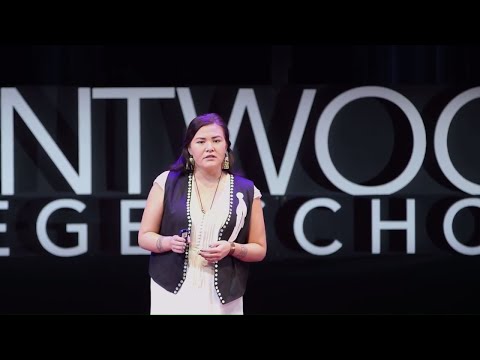
yo hey have yo doc in yellow smoke Alexi
got to us con agua Heil stuff do Neutron
off I want to start off by first
acknowledging the ancestral homelands of
the malahat people so I’m going to tell
you a story of the salmon people this is
a part of Helsing oral history that was
told to me by my brother
Ajitha in Klotz jaw within Helsing
territory the people had a fish we’re
and the Chiefs had a set of twins and in
our culture twins signify a good return
of salmon that the year that they’re
born and he had a boy and a girl and the
boy misused the salmon the fish we’re he
left them in there to die he didn’t let
them return up the river and he also
didn’t use them for food so because of
his actions
the salmon did not return to the fishery
or to the river and his sister became
very ill and she died because of this
the boy decided he needed to do
something he went to the river and he
prayed and his prayers were heard
supernatural forces sucked him beneath
the water into the underwater realm he
was taken to the house of the salmon and
there the salmon told him of how their
anger for his great disrespect to the
salmon but they also offered to teach
him to teach him the ways of the salmon
so he stayed there for what he thought
was four days and he learned the ways of
the salmon but eventually he was sent
home and as he began to move towards his
village he realized he could breathe
beneath the water he realized he had
become a sad
and suddenly he was speared he heard
crying from his mother who recognized
the copper necklace that he always wore
all the people of the village gathered
because this was the first time a salmon
had returned to the river in four years
and the mother she called a spiritually
enlightened individual a shaman and he
showed the people the salmon with the
copper necklace he then placed a mat
over top of the salmon he spread some
eagle down and he began to pray he began
to chant he then removed the mat from
the salmon and beneath the mat was the
boy from that day forward the boy taught
his people the lessons of the salmon he
taught them that we should never waste
that we must respect the salmon we must
respect their sacrifice of their life
that they give to people and to animals
to trees and the nutrients that they
bring to the forest so this story is
about the ocean and it’s backed up by
archaeal recent archaeological studies
that prove that reaffirm my nation has
existed in our place for at least
fourteen thousand five hundred years
that’s eight thousand five hundred years
before the pyramids were ever built
I come from an ancient society so the
ocean it’s a magnificent thing it’s a
life-giving force we give it all types
of names we call it the Atlantic the end
the Pacific Ocean but in reality there’s
really only one ocean and it covers over
70% of our world it connects us from
coast to coast so I want you all to do
me a favor right now if you could take a
deep breath in and out one more time
take a deep breath in and out
now just think that over 50% of the
world’s oxygen comes from our ocean but
it is a tremendous life-giving force to
all living beings on earth we are all
connected to the ocean just as we’re all
connected to one another and to earth
and it is this relationship that I’m
here to talk to you about this
relationship that we must uphold to the
ocean so the place that I come from on
my mother’s side the house that nation
of the new channels people and the house
ik and the Central Coast
both have recognized this reciprocal
relationship with the ocean for
thousands of years we’ve always realized
that the ocean gives us sustenance we
worked to maintain sustainability and
then enhance our food sources our
relatives this is my grandmother
Margaret brown she’s in herself she’s in
her late 70s
she’s affluent health six-speaker I
talked to her about the ocean and she
told me a story of her late grandfather
Louie ha who worked very hard to harvest
and prepare seafood for his large family
her favorite was and dried herring eggs
dipped in to seal grease within her
lifetime she has watched her food source
degrade before her very eyes
her grandson still actively harvests the
majority of herseif
but it tastes different the texture
imagine going from abundance of food
that’s harvest from the ocean by your by
your family within your homelands to the
aisles of a grocery store that all of a
sudden your staples your eggs bacon and
bread your daily coffee it’s not
available to you anymore imagine the
suffering that you would feel the
desperation of your body for the foods
that you’ve evolved eating your
ancestors have evolved eating and too
often the degradation of indigenous food
systems is overlooked for convenience
and capitalism this is affected
indigenous peoples health for example 33
percent that’s one in every three people
in my community now has diabetes and
that’s from the rapid introduction of
Western food and poverty but people
today up in health of territory along
this coast
they still Buffalo they gather
traditional foods foods that have
sustained us and our relationship so I
want to give you an example of what
indigenous science is so the image
behind me this is herring eggs when I
talked with my grandmother viking aunt
so for example when you think of
ecological or seasonal indicators so
those are natural signals that tell us
when it’s time to harvest and so for the
moon when the moon tips over new sea and
it’s at a quarter moon it’s very small
it signifies that the herring will soon
spawn it’s the healthy new year
so this is an example of my people
observing the gravitational pull and the
effect the moon has on tides because
when the moon is smallest the tides are
smallest so our science is not just
based on what a lot of people deem is
folklore story it’s based on a practical
relationship in place so there is a
difference between indigenous knowledge
digitus science and Western science so I
think I’ll explain that first so the
difference is indigenous science we you
can’t have indigenous science without
having indigenous culture we put nature
at the center whereas Western science
often distance itself from culture and
we often put man at the center of
Western science and different scientists
and different indigenous people will
have different opinions on this it’s
controversial but this is what I believe
this is my grandfather Gaia and I asked
him about these seasonal indicators
these ecological indicators and their
importance to our culture he responded
that these natural signals they’re no
longer as important because our
environment is changing it’s all
changing this is showing that Gaia has
witnessed shifting baselines in his
lifetime he’s experienced climate change
firsthand within our home territory
witnessing the collapse of salmon Co
abalone and now our herring stocks but
Western science is telling us this is
not rare to the house of people on the
Central Coast that global fish stocks
are collapsing that oxygen deficient
dead zones in the ocean are expanding
that debris and pollution are increasing
they’re working really hard to figure
out solutions
Solutions for our relationship with the
ocean on ways we can mitigate these
negative effects these changes so as
Canada celebrated its hundred and fifty
years of nationhood a lot of indigenous
people felt the pain of a hundred of
fifty years of ongoing colonization
so it’s this difference in experience
this difference of dichotomy that we
need to overcome as a society in order
to have effective management of our
oceans so on the Pacific Northwest Coast
we have great biodiversity and it’s the
ocean that is the equalizing factor
giving us this biological diversity and
it is this ecosystem that we need to
maintain that’s very rare on this planet
in order to obtain our cultural
diversity as coastal indigenous peoples
so to work to mitigate the effects or
the contrast in values between
indigenous science or indigenous science
and Western science I work for ocean
networks Canada because I believe we can
learn from both ways of thinking we’re a
deep-sea research facility out of the
University of Victoria we’re world
leading in cabled observatories we have
instrumentation in the deep sea in
coastal communities and in the Arctic
and we’re looking at our changing ocean
we’re looking at climate change we’re
putting instruments down and collecting
24/7 real-time data and what I think is
all people have always adapted to change
and as coastal indigenous communities we
were also adapting to change and
utilizing for example innovative
technologies such as ocean networks
Canada to understand
our natural world we’re no longer
necessarily having those long
observations based in place but we’re
using these technologies and our
relationship with place so that we can
understand what is going on in our
environment so in conclusion I want to
ask each of you to do something for the
ocean to remember our relationship with
the ocean to tell at least one other
person that every other breath they take
comes from the ocean we need to honor
our agreements with the ocean so she can
continue to sustain us to sustain human
society as water is life and ocean is
everything Wallis Gaia Sokka thank you
for your time
[Applause]
Please follow and like us: