
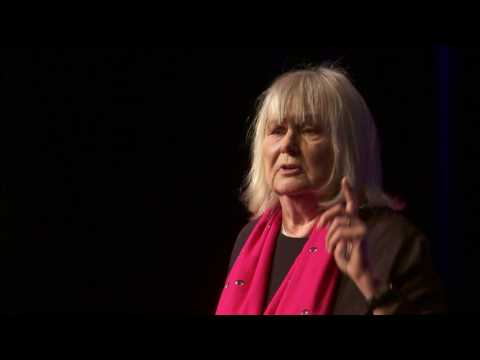
hello everybody and thank you Branksome
for giving me the opportunity to speak
today I’m very flattered to be asked and
included in such August company first of
all happy Earth Day and let’s have big
shout out to all those people around the
world who are marching for science today
my story yes my sort story is sort of a
scientific a little bit but anyway it
started here within it’s the story of
how an advancing technology and evolving
technology impacted my life and pitched
me into fields of study that I never
thought I would encounter and it all
started back in the Stone Age here at
Branksome Hall where I received an
extremely good education but I had no
idea when I finished what I wanted to do
in life and I went on to the Ontario
College of Art because I was interested
in design and painting but it became
rapidly clear that I was not destined to
be a full-time painter but a friend told
me about an extremely intriguing job
offer which was to go work for a film
editor I had no idea what that even
meant but it sounded like fun so I went
along to investigate and dog Ginsberg my
future boss had a studio in an attic
very small attic there and it was there
from his assistants that I learned all
the tricks of the film editing trait on
the this machine called a movie Ola it
was the age of 16 millimeter and 35
millimeter film men and I learned how to
make a splice and it was the age of
scissors and glue as you can see from
the beehive hairstyle there so act by
accident really I learned all the skills
I needed to edit a film and fortunately
went on to work at the CBC and on
several
a film series one problem I was in love
and my boyfriend was a musician and he
was not in Toronto he was in New York so
I was spending a lot of time in New York
and I happened to meet there a person
who would change my life entirely he he
was a filmmaker and went on to be the
co-inventor of IMAX
his name was Graham Ferguson and he was
also a cinematographer and a producer
and he was just beginning a project for
Expo 67 in Montreal and it was about
life in the Arctic in the Antarctic and
he said how about would you like to work
on it
I couldn’t believe my luck and said well
of course absolutely not realizing that
this would be I would say the second
phase of the technology into my life the
film the film editing being the first
that in at Expo at Expo all the rage was
multi image technology and our film was
the mother of all multi image films 11
35 millimeter screens arrayed in a
circle to tell the story all of which
had to run perfectly in sync with one
another the audience to keep them moving
through sat inside looking out of the
screens you can see the projectors
behind them there
the problem was they were on a moving
floor to keep everything rolling and as
the Edit slave it was my job to keep all
of those film projectors in sync so if
you were editing the film and you
shortened one screen that rippled all
the way through all 11 so that got
Graham and his his partners to thinking
we need to get rid of all these
projectors let’s invent a film format
large enough to take all these multiple
images then we won’t have all we won’t
kill Tony anymore and they started doing
that I was just about dead so I’ve took
a long vacation and went
Londyn well it was the swinging late 60s
I was a hopeless tourist just hopeless
so I wound up working for Canadian
filmmaker named Alan King you may have
heard of him doing documentaries and
also pioneering the first rock videos
and you may recognise to the people I
did quite a bit of work for at that time
and you can see that the movie Ola then
in 1968 was still in use and so was the
beehive hairdo
meanwhile back in Toronto I went to
visit my parents and saw what Graham and
his partners had been up to and it was
as big as a truck and more noisy than a
locomotive and this was imax projector
number one which ran 70 millimeter film
projected on a bedsheet so I I thought
they were totally crazy I didn’t get it
at all but the rest is history
and imax was born the first film that I
that that well here’s a little bit about
the the actual format you can see that
the two pieces of film on the right
there the IMAX format but you can see
how the 35 and even 16 imagery could fit
many times inside that but needless to
say when people saw the beautiful big
lovely frame multi-image was never
mentioned again Graham was asked to make
the first film for the first permanent
on Mac Theatre which was at Ontario
Place down on the waterfront here and
here he is shooting with the first
camera the famous forest fire scene from
that film we realized that with the big
frame it’s a 60 by 80 foot screen and
immersed its audience very very deeply
inside the picture and we realized that
it could take you places you couldn’t
normally go that was its attraction for
audiences and space was one of them so
we tried to persuade NASA that they
should take off one of our cameras to
space and we made a proof-of-concept
film and they said okay
so we started to build a space camera
and this is the first space camera not
that much different from the ground
cameras it weighs about 80 pounds
nothing in zero gravity of course and we
said about all that you have to do to
fly a camera in space first thing you
have to do is test your equipment and
you do this on a diabolical aircraft
called the vomit comet and the vomit
comet flies has its own airspace and it
flies a series of parabolic arcs for
hours and at the top of each arc you get
thirty Seconds to a minute of
weightlessness and that’s when you do
your testing of your equipment if you’re
not being really really sick but
fortunately Graham and the team here
they they have brass guts as they say in
the airforce and they didn’t get sick
then you have to train your crews
because we we would really like to have
gone ourselves to space but couldn’t so
you have to train your astronaut crews
how to be directors cinematographers
sound recordists actors and that’s
astronaut Marsha Ivins looking through
the camera she flew five times and
eventually came to work for me on my
last film which was released last year
she was a great great after she would
retired she was a great asset to the
team finally we get to space and you see
now that a 25 pound magazine doesn’t
weigh anything in space and we were
assigned three flights in the mid-80s to
make a film called the dream is alive
which was really took audiences to zero
gravity for the first time ever and that
was the point at which new fields of
study kind of entered my life because to
support all those flights at NASA you’ve
got to learn all about orbital mechanics
how to capture a satellite with the
Canada arm how a spacewalk is done etc
you can’t you can’t support the flight
and be part of that infrastructure
without
so I found myself learning all sorts of
new stuff and that is the the camera
about to go into the window to take a
picture of Earth and when we saw what
the earth looked like from orbit I mean
I said stupid things like it’s really
round I can’t tell you how how amazing
it was we decided right then that our
second film would be about the earth as
you see it from that platform we made
another camera that went outside in the
shuttles cargo bay and it it shot
spacewalks and beautiful refuses you can
see there and blue planet was our second
film it was a all about earth and enter
again other fields of study because I
was a scriptwriter on all these films
for this one I had to learn all about
Earth System science geology
oceanography all of the natural factors
that affect our changing earth as well
as what humans were doing to it and back
in 1990 we we were discussing climate
change back then and the next film we
made looked exactly the other way and
that was about what it takes to explore
our surroundings in the solar system and
maybe even go to the Stars one day and
that was a big learning curve because
what I learned there was really the vast
distances that I think today even most
people don’t totally grasp that Mars is
you know you just don’t go to Mars
because you want to explore it’s 49
million miles away and that’s the
closest one so we learn that really if
we’re ever going to go to the Stars that
it’s going to be a multi-generational
endeavor and it is going to take many
different nations to do it it’s just too
big for one to do alone and at that time
NASA was talking to the Russian space
agency about building a permanent
International Space Station
the Russians already had me
and they were going to talk about how do
we build can we build a space station
together to learn about how to explore
the solar system among other things and
they flew us a series of flights to the
space station Mir with American and
docked with Mir and so American cruise
and Russian cruise could work together
and that proved okay they could they
could work with within different
languages and their technologies could
meld and they decided to go ahead and
build a space station meanwhile back at
IMAX they’d been busy and invented
technology number four which was IMAX 3d
that was a whole other level of
experiencing cinema now the images
floated off the screen and we decided we
would go ahead and make try and make
Space Station in IMAX 3d and Space
Station was the single most I think
demanding and untried engineering feat
that humans have ever done other than
maybe building a cathedral in the in
ages past because it was done by over
over many many years there were now 16
different countries contributing to it
and many languages and many many many
astronauts and would these would these
pieces all go together because it was
all built in orbit and this is a shot
from the early stages of the space
station going together about three
pieces of it are there in that shot and
we worked over this seven flights
oh here’s the narrator of the film we
live to tell the tale
Tom Cruise was very close to becoming an
astronaut himself he really wanted to
fly and he’s a very accomplished pilot
and sadly the Columbia tried
intervened and commercial spaceflight
possibilities were terminated then but
it was great working with him he was
absolutely absolutely terrific
so next you’ll see us at the opening
there and that’s with most of the Space
Station crew at the Air and Space Museum
at the film’s opening but of particular
interest in the back row second from
left is a commander Scott Altman and he
turned out to have been Tom Cruise’s
flight instructor for Top Gun I don’t
know if any of you saw Top Gun sort of
what goes around comes around but anyway
Scott turned out to be he was going to
be the commander of the final flight to
repair the Hubble Space Telescope and if
ever there was a candidate for a
technology that had huge impact on
humanity it’s the Hubble Space Telescope
and we’d been covering its original
deploy for and repairs before this and
we decided to make a film of this final
repair and that involved not only not
only shooting what the astronauts were
doing in these incredible spacewalks
where they climbed right inside the
telescope and changed out circuit boards
that were not designed to to be messed
with like that they just did incredible
work but I also wanted to try and take
everybody in the audience through the
Hubble imagery so that it so that we
could approximate something like star
travel and I found a team at the
national supercomputing Center at the
University of Illinois
Donna Cox and her team and they made
that possible this is not CGI it’s not
special effects that’s a real Hubble
imagery of the Orion Nebula and we flew
all the way from Earth to the Orion
Nebula then we went forward from this
view right down to where you see the
bright stars in the middle and that’s
where solar systems are being born it’s
absolutely incredible
in another sequence we flew into the
hubble deep field to the very edge of
the visible universe and back it was a
really astonishing what we could achieve
with with the Hubble data at the same
time we were exploring a completely
different world which is the bottom of
the ocean there you can see the IMAX
camera and it’s housing I seem only to
work in airless environments but you can
see the camera in its housing and that
is a picture of Howard Hall and his wife
Michelle there are very very talented
underwater filmmakers themselves it was
a real privilege to work with them that
that whole rig you need lights there’s a
team of eight divers that whole
assemblage weighs one ton and you can
imagine every well every three minutes
you run out of film so it has to be
winched up onto the dive boat and
changed out again and then redeployed
you can imagine working with wild
animals there’s no kind of setup no
tanks anything to try and actually shoot
enough good stuff of wild animal
behavior to make a film is really quite
a feat and they did it beautifully so we
made three different films like that for
those of you who are interested Johnny
Depp and be still my heart
and we had Jim Carrey did this one but
you know what they taught me was what an
exquisite fragile diverse world that we
inherited you know whether you’re
looking at it from the platform of space
or whether you’re seeing the bottom of
the ocean and it was something that I
just thought it hasn’t we haven’t got
the news out to enough young people yet
that why it’s worth taking care of it
and why we need to so desperately so I
wanted I decided to go back to the space
station after all these years it was now
complete as a 20-some years after
the planet was made and sort of take
stock and see the state of our planet
and also see the inside of the the newly
finished station and that was all fine
except NASA said you can’t fly film
anymore
we have no shuttle the shuttle retired
so there was no no room to or vehicle to
really take big seventy millimeter film
back and forth in a timely fashion so
enter technology number five of the film
variety and that was digital we had to
find that solution and as you can see
there the cameras a quarter the size of
the original which is great and also we
had you can have pretty much unlimited
storage capture storage because you just
flew these little cards as many as you
wanted and and you could erase them and
do things over and there we are training
our first commander on the Digi camera
and we flew two of them on station for a
year this was just a couple of years ago
and the film came out last year and we
were able to not only look at the earth
and the state of the earth now but we
were able and one thing I wanted to get
across to young kids was the fact that
the station is a great metaphor for our
planet it’s a closed loop you know close
life-support system and you need to
recycle and conserve exactly the way we
need to do on earth very very carefully
to keep everything going and you can’t
step outside or because there’s no air
the only difference between those the
station and our planet really is the
fact that Earth doesn’t get resupply
missions with food and stuff so that
that really hit home that message I
think here’s Commander Terry Virts
shooting in the cupola which is a great
place where they get to observe the
Earth from and in all we we shot
something like hundreds of thousands and
thousands of frames I can’t even
remember
the number it was so big and I was very
pleased with the result I know it
changed the way we do business up there
in the early days you had to go through
the flight director you couldn’t talk to
anything on orbit and now Terry would
just call me from the space station on
his cell phone I’d be lying there in my
nightie at 6 a.m. hi Terry I’m thinking
about doing a shot we haven’t discussed
what do you think and I could say well
try it and he could I’d get it within a
day he’d send it down on the kayuu band
and then I’d put it in a PowerPoint and
mark it up if I you know needed to
change things I give him advice and then
he’d do it over it was a fantastic way
of doing business and he shot they all
shot fabulous pictures like this one
which we could never capture on slow
IMAX film that’s the boot of Italy
looking from the top of it and really to
sum up that’s the story of how
technology took me really from a little
attic in downtown Toronto to the edge of
the universe and back I’d like to thank
Graham Ferguson and IMAX corporation and
so many wonderful team members that I’ve
had along the way because it is a
collaborative process making film and I
just like to leave you right now with a
slide that sort of summarizes our
activities in space and the outreach
thank you so much for the opportunity to
speak to you
I’ve really enjoyed
[Applause]
Please follow and like us: