
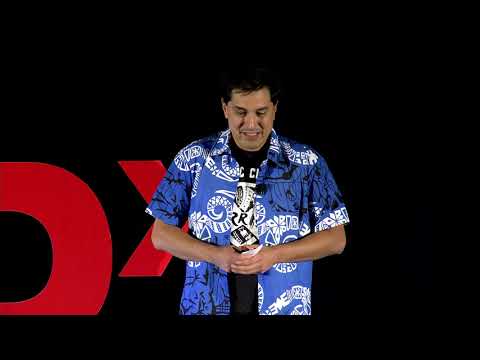
climate change is the world’s greatest
moral challenge of the 21st century
I found out firsthand by going to a
small little Pacific island nation
called Katie bus when I was 21 years old
I’m going to talk about climate change
but I’m not going to talk about it in
the usual way not the science or the
politics or the money I’m going to talk
about it from the front lines of climate
change so let’s go on the trip let’s go
to the public of Katie bus it’s made up
of three island chains the first island
that we’re going to go to belongs to the
Line Islands it’s Christmas Island next
Brigade jettison off to the Phoenix
island chain there we are going to land
on an island called Canton next we’re
going to go over to the capital Island
Tarawa that’s in the Gilbert Islands Ain
and last but not least we are jetting
off to the biggest island that there is
banaba where ocean Island the farthest
Western island this is the only island
that rises above three feet most of the
islands are coral atolls the last one
that we’re going to go to is my Island
tamanna Island it’s where I served as a
Peace Corps volunteer from 2000 to 2002
the entire nation it’s the world’s
largest smallest nation the entire
nation is roughly the size of the
continental United States and that’s the
only country in the world to straddle
all four hemispheres of the globe it is
also the first country to welcome the
light of day week millennium and it’s
also predicted to be one of the first
countries to be wiped off the face of
November 16th 1989 babiracki Tata
Minister of Home Affairs and
decentralization for the nation of Cuba
is at the small island states conference
on sea-level rise at the conference he
addresses everyone
by saying over thousands of years the
question of sea-level rise was never
thought of our ancestors lived happily
on our islands for centuries without
worrying that one day a change in the in
the environment would cause us to lose
our homes we today in the present
generation are proud inheritors of those
homes
if sea-level were to rise it would have
drastic impacts on our agriculture on
the lands that we live on and the
communities that we call home 1989
Peter brass was talking about this ten
years later how much I’m a senior in
college at Miami University Oxford Ohio
I’m wearing my one and only suit to the
interview for the Peace Corps it’s my
first time thinking about going overseas
to volunteer two years of my life I
arrived 15 minutes early for the
interview and the lady at the front desk
says it’s alright Mike I’ll take you to
the back room and there you can wait for
Jeff Jeff is the Miami University Peace
Corps recruiter the rooms cold I’m
nervous and I’m uncomfortable in the
suit first time I wore a suit
Jeff walks in and starts the interview
about 30 minutes after the 30 minute
interview he asked me is there’s
anything that I would like to say yes I
say one I hate hot weather too I’m
allergic to fish three I’m severely
prone to motion sickness
especially on boats November 16 2000 I’m
a Peace Corps trainee in the Republic of
Cuba
where there is nothing but fish heat and
boats travel my second week there in
Kate Abbas I experienced something that
I will never ever forget I was walking
home from a celebration they call her
the bull hockey from this school the
winds picked up the trees rocked back
and forth the ocean grew larger and
larger all the Sun the waves came
crashing deep down into the land as if
their mission were only to flood and
destroy the night went on not sure if I
would live or die 8 o’clock 9 o’clock 12
o’clock 1 o’clock 4 o’clock the disaster
that felt like forever past before
sunrise and that sunrise all of us came
out of our hiding spots there were trees
down roofs blown off there were leaves
everywhere branches coconuts everyone
worked together to recover in the
community men were bending down picking
up down foliage women and girls were
weaving the thatch that had been
destroyed and passing it to the young
boys and the teenagers who were on top
of the roofs trying to repair what had
been destroyed you see Incubus micao
told me my language teacher the we is
bigger than the I that day they didn’t
wait for FEMA they don’t wait for the
Red Cross they didn’t wait for outside
organizations we took care of the we
Mikayla said we’re not like you
Americans who only think about that III
add me me me we are different lesson
number one the we is bigger than the I
20 months past June 24 2002 I went home
for a good ten-day vacation when I came
back I brought boatloads of presence of
spices of toys of books
crayons of pencils of pens for all of my
wanted to go back to tamanna back to
that little island but the plane was
down and my Peace Corps officer said you
can either choose to go back on the boat
it would be a two-week boat ride no way
or you can early terminate I didn’t want
to do either I ran away which is not an
easy thing to do on an island
I ran the way to find shelter with a
family I had befriended the year before
they kept me hidden from Peace Corps
until I had to go on that plane the day
that my service ended was a day that my
commitment to the nation began for 18
years I’ve been talking to anyone and
everyone that would listen to me about
this island nation called Kate Abbas but
they’ve also expanded I talked about the
Marshall Islands Kiribati Tuvalu Tokelau
the Maldives in to some degree the
Seychelles more than 600,000 people live
on these islands that rise just inches
to a couple of feet above the ocean that
is quickly rising and rising I’m trying
to paint the human basis of climate
change these are them it’s not just the
rising ocean that’s a problem but it’s
also the prolonged droughts it’s also
the extended El Nino and La Nina seasons
it’s also the king tides that wash away
the sea walls that we built made from
our own sand on the beaches it’s also
inundation this is an ecological
genocide land and people have the same
name in kotoba Sabah when you are born
in kata Box you are born on your
family’s land you live on that family’s
land you raise your own
children on that family’s land and when
you get old enough you have
grandchildren great-grandchildren
great-great-grandchildren and you return
to your land you’re buried there to join
the ancestors to watch over future
generations of that land land and people
it’s the same thing one cannot exist
without the other over time
kata brass has gun known as a poster
child for climate change but people
don’t want to become climate change
refugees in fact that term does not even
have any legal basis as of this date
what they want to do is they want to
remain in their land where they live
where they’ve grown up to men older men
when the man is as we would call them
otaku Tarawa seventy years old every
time he walks by the place where he used
to live which is now under the ocean it
reminds him of his 40-plus year marriage
and the family he raised on that land
now at the authority is 69 years of age
every time he walks by his land he still
has a big connection because his wife is
buried there he wants to be buried with
her even if the sea takes away that land
before his time comes we’ll get back to
him we want to try and amplify our
voices our stories our faces so that
people can see that climate change is
having an impact but we are not drowning
we are fighting
we are fighting one of the ways that we
are fighting is we are telling our
stories through media through social
media through magazine through print
media through any outlet that will
listen to us tell our stories of what’s
happening on the islands we are not
yeah and I hope if I’m not in from
cables you find from other country be
conscious hi MA
I might feel the same feel the
difference people sadness and my fear is
Shannon I might do something I like you
to be activists people because I have
many ideas but the I have no way to we
wish the ratio so far we again they are
[Music]
I was one of the person working behind
the scene to to prepare the the team
that go to to Copenhagen for the car 15
we are very grateful with the the
outcome of what happens till after the
call 15 and they try promote Scarabus as
one of the educators and supports
climate change because people don’t like
it because they don’t want pyramids to
disappear so they don’t want to accept
it but whether we like it or not we
cannot we cannot we cannot bring
ourselves to the future to the time when
crevasse will be under water so I think
what we had then come and gone into has
we don’t want to we don’t want to be
relevant we don’t want to be left out
[Music]
these are cousins friends parents
brothers sisters aunties uncles these
are the faces behind those statistics
those numbers those charts we want to be
known
dear care of us spend 18 years since we
first met since I first read in your hot
salty hair turquoise blue bothers
and all of me my mind my body and my
soul but today I fear for you I fear
that the rest of the world will not know
you blinded by climate change they will
not see your beauty your kindness or
your today worthy of everything this
world has to offer and more you see the
world tried to solve climate change in
this ecological genocide with money
power politics but money or rather greed
is what brought us here today and the
technology won’t arrive fast enough to
stop what has already happened I believe
the only way to do this is through
humanity we have the power and the
ability to have compassion
transformational compassion that changes
things makes the world a better place
changing greed money and anger into love
kindness and joy dear world I believe in
you I believe in us I believe in
humanity because if the climate can
change so can we so can we climate
change is about humans and humans are
about humanity mad theater Dorothea
passed away last year and he now rests
in his land next to his wife happily
necomimi kangaroo bus Cabarete per day
and can aronia by Peggy knock one button
or Maduro I just wanted to say thank you
everyone for listening to us and for
hearing our stories from the front lines of climate change
Please follow and like us: