
now when did we first start to think
about tomorrow as being different from
today when did the notion that the
future of Samara they’re going to be
different when did when did that idea
take root
it might seem fairly obvious to us that
yes clearly the future is going to be a
different country a different place it
isn’t going to be the kind of place that
we inhabit now but if we look at history
then we concede of that notion of the of
tomorrow as being different of the
future as being a different place it’s
actually a notion of pretty recent
historical origin if for example you
managed to get your hands on the TARDIS
and jump in and it’s actually working
for once and you travel back to 1750 one
you hop out to the TARDIS you find a
convenient passerby and you are
something yeah what do you know what do
you think the future is gonna be like
what do you think the world is going to
be like for your children they would
probably tell you that they imagine the
world for their children would probably
be much the same as it was for them
possibly with another George on the
throne but other than that it may be the
same thing so you hop back into the
TARDIS and you travel forward a century
you’re in 1851 so you step outside and
you find a convenient passerby and you
ask them what the future’s going to be
like what do they think the future is
going to be and they’ll tell you
something quite different they’ll
probably start talking quite excitedly
about electricity lots of electricity
and airships essentially during that
century that the future as we think of
it now was invented it’s during that
it’s during that a century that people
stopped thinking about about society the
way Society changes the way society
operates in a different sort of way
I’m really up until the 18th century
people think about society as being more
or less in a state of equilibrium even
when there’s a revolution there are
quite a few of those at the end of the
18th century I mean think about what
that word revolution really means a
revolution is meant to be a return to
the status quo a revolution
it’s meant to be returned to the proper
normal state of things but at the end of
the 18th century beginning of the 19th
century you start to see people starting
to think that actually Society has a
sense of direction society is going to
be going somewhere and it’s act of that
kind a notion of progress of change that
the notion of the future as some that’s
where that idea emerges and Victorian
pictures and futures are made
essentially active bits and pieces of
the victorian present justice this is
why really this all matters our futures
are made out of bits and pieces of our
present so let this let’s start having a
look to see how this how this works I
mean isn’t that a fantastic piece of
steampunk literally steampunk actually
since everything in here as you can
probably see works by steam this is a
cartoon from the mid eighteen twenties
what a number of cartoons drawn by
factories called William heat March or
intellect there are a lot of current
cartoons by other people as well as evil
March of Internet during this period as
well which again tells you something but
fair there song to think about society
unless have a look to see what what we
not so much a horse’s carriage as a
carriage made to look like a horse as
you can see from what’s coming up this
works by steam cooking by steam you have
all kinds of steams going on around
about the play
a slight departure there are boats being
this thing in the middle is quite
interesting this is the construction by
the grand vacuum tube company I don’t
know how clearly you can read writing
here that I’ll read it for you direct to
Bengal and this is what you do if in
this future you’re in a bit of a hurry
you walk in at one end of the tube and
then it’s a vacuum tube after all you’re
you come out at the other end by
yourself to your destination so this if
you like is a vision of the future at
the beginning of the Victorian period
no I assume that hasn’t escaped your
attention this is satire yeah the
cartoonist is having a little bit of fun
with the notion of progress the notion
of a future that can be invented but I
mean I think I mean there are two things
one can say about that in the federal in
the first place the existence of satire
is itself evidence of the ways in which
this new way of thinking about the
future was for some people that any rate
it quite jolting and bizarre and
unfamiliar you know this is something
new this is something different and also
as a matter of fact satire as it might
be most of what’s being portrayed here
most of what’s being satirized here
isn’t actually all that far away from
things that existed or really were being
speculated about you know there we have
our steam horse
where this cartoon is being drawn you
know right to the beginning of the
period of steam locomotion and early
attempts at Steven locomotion didn’t
only take place on rate ways there were
steam cars there really were steam cars
for a brief period yes some of the grand
vacuum tube is taking things possibly a
little too far but even there there are
ideas about pneumatic railways you know
where it’s the wheels the wheels are
closed in in sealed tubes that are going
to be sucked along so it’s not actually
that far away
this is satire its satire that’s working
on things that people know are being
speculated about already so you can see
the future you can poke fun at the
future in cartoons like this but within
a decade or so that cartoons being drawn
you can go to places like this
to see the bits and bits and pieces of
the future that is being made around you
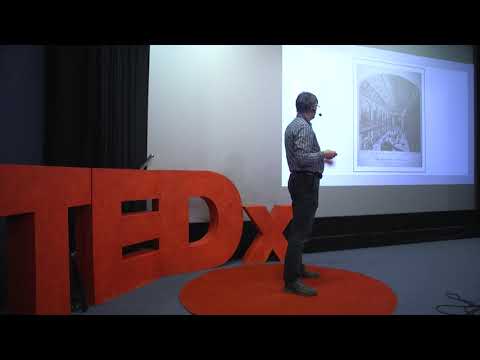
this is the Royal Polytechnic
institution the Royal Polytechnic
institution was established in Regent
Street in London in 1836 in 1836 it
acquires its Royal Charter a couple of
years later and you go to places like
this you pair your shilling at the door
which suggests you amongst other things
that this was a feature those strictly
for the middle classes since the
shilling is a fair amount of money in
the 1830s in the 1840s and you go to the
Royal Polytechnic institution to witness
wonders you go to see the ingredients
out of which the future is going to be
made these these are these are canals
inside you’ll see kind of model
steamboats chugging up and down just at
our end here there’s a big pool of water
what you’re staying there is the diving
bell if you pay an extra penny you can
descend to the bottom of the pool of
water in the diving belt there’s a diver
wandering around in the in the in the
pool as well and around
around the main gallery now you’d see
electrical machines you’d see
Telegraph’s you’d see you’d see the
stuff out of which the future was going
to be made you go to places like this in
order to see that to think that you
yourself a part of this kind of drive
towards the future and of course by the
1840s in the 1850s the future seems to
be taking place outside of places like
the Royal Polytechnic institution as
well but at the the patent for the first
electromagnetic Telegraph mrs. satty is
a awarded to Charles Wheatstone and
William Fothergill Cooke in 1837 I mean
just stars the throne is taking hands
and imagine the difference that makes to
communication well it takes a little
while after 1837 for it to actually take
off but think of the difference that
makes to communication if you want to
send somebody the message in 1835 that
message can only travel as fast as you
can travel pretty much whether you’re on
foot on horseback horseback in a coach
and a train that’s how fast the
information that’s how fast the message
can travel as well
once you have Telegraph networks and by
the end of the 1840s the beginning of
the 1850s Telegraph networks are
spreading across the British Isles in
1851 the first underwater cable connects
England with France so it’s spreading
across across Europe Telegraph networks
is spreading across usually mainly the
east coast of North America and you can
now communicate more or less
instantaneously after various failed
attempts in 1866 they succeed in laying
a telegraph cable across the Atlantic
and of course this is what’s being this
is what’s being portrayed here yeah
there we have
the British lion there we have the
American Eagle connecting the to the
British Empire and the growing American
Empire or the United States and
literally you can see this in there
literally making the world a smaller
place a smaller more manageable more
controllable place I mean that’s an
intrinsic part of the the rhetoric of
the Telegraph I mean threat really
threat to the 19th century telegraphy is
the great leveler telegraphy means that
ever it will everybody will know
everything that met that message it will
pass seamlessly from one part of the
world to the other in reality of course
it means that the telegraph telegraph
means that it’s now far easier for the
imperial government in london to keep a
closer eye on what’s going on in various
parts of the world and indeed
maintaining what they call the all red
line there’s Telegraph cables that only
travel or only pass through yet
countries and areas under Imperial
control there’s a very very key kind of
British diplomatic requirement Bremner
telegraphy fantasies as well known if
you can send information down the wire
and after 1876 and Alexander Graham’s
Bell invention of the telephone
you can send voices down the wire as
well why can’t you sense
why can’t you send vision why can’t you
see send pictures why can’t you send
sight through the wire as well
remarkably quickly actually after Graham
Bell’s invention of 1876 people start
talking excitedly about another new
invention that’s about to emerge usually
call the telescope that’s called the
telephone Oh scope in this example here
and that electro scope the telephone
scope is indeed going to be a way of
transmitting pictures of transmitting
vision of transmitting sight by
electricity see this has punched his
Almanac from 1879 again I’m sure that
you can’t read
writing here since I can barely read it
so design here’s every evening before
before going to bed
patron major familias set up the
electric camera obscura on the
mantelpiece that’s that there and
connect by wire to their children in the
Antipodes so there they are mater and
Pater sitting by the fireside and there
they’re talking to and they’re seeing
their children cavorting playing tennis
courting if you can see really even
smaller prints down there them the
mother is asking the system who the who
the nice young lady is that the brother
is talking to so this is a bit of the
future being generated by Vic’s like the
excitement of the telephone this is in
punch slightly satirical again but if
you read if you look at the technical
journals around this period as well
you’ll see very very detailed technical
accounts technical drawings of what the
telescope is going to look like how it’s
going to work the details of its
operations which is quite remarkable
really because there never was any such
thing as electricity but electroscope a
is if you like a piece of Victorian
technological fantasy it was always on
the verge of being invented but never
and the telescope there’s never quite
invented in the end was going to go on
show in places like this actually not
quite like this it was promised to be on
show at the greater Paris Universal
Exposition of 1900 it wasn’t this is a
few years earlier this is 1893 1994 in
Chicago this is the Chicago World’s Fair
the Columbian Exposition and it shows
you in a way just how how much more
complicated and how how much how much
bigger and how more grandiose the future
had become by the end
the Victorian period this set of
speakers a direct descendant of places
like the Royal Polytechnic institution
now a half a century or so earlier but
now whilst the Royal Polytechnic
institution is a small building on
Regent Street this is a City this is the
White City this is built on the shores
of the lake in Chicago it’s an entire
ground
tonight’s place this devoted to
displaying the future people come here
and they’re thousands there are tens
there hundreds of hours of their
Millions
to see what the future is going to be
like it was particularly given the
funfair is an avarice with this week
when you shouldn’t you should cast an
eye over there in the distance that is
the ferris wheel not a ferris wheel that
is the ferris wheel now that’s the very
first values to call there’s a kid big
wheel and it was invented to be put on
show at after at the Columbian
Exposition in Chicago to Trump in a way
Eiffel Tower the Eiffel Tower should be
in it which which had been designed to
be built for a previous exhibition in in
Paris so it’s in play in places like
these the other the Victorian future as
being male as being made active you know
places like this Sancho the artifacts
the machines the displays the spectacles
they’re on show here and of course it’s
not just in exhibitions not in galleries
of practical science or in kind of
Telegraph networks that’s not the only
sort of place that Victorian future is
being made there’s a flourishing of
scientific romance what were you an
alcohol science fiction really in the
1880s and the and the 1890s we’ve all
heard of HG Wells this is when Wells is
making his futures making his sort of
time machines and his War of the Worlds
add to them bits and bits and pieces of
1890s technology and culture this is a
piece of it this is from from George
Griffiths
Angell of the revolution it’s a
fantastic piece of writing we can find a
copy of the angel of revolution then you
should absolutely read it
it’s about airships it’s about war in
the air factors about anarchists
fighting our touch of war in the air
before the great powers do and therefore
destroying the great powers roaming see
what’s going on this is we’re just a
couple of years before the Dreadnought
yeah that new generation of huge British
warships has invented you know but this
is what we’ve got here we’ve got dreaded
we’ve got dreadnoughts in the air now
this is you know taking that kind of
latest technology a victorian naval
warfare and putting it up a few thousand
feet up in the air and adding a
judicious dose of electricity and that’s
what the future is going to is going to
look like can you see a lot of this at
the end of the 19th century as you do
today I mean you see factual and
fictional account what the future is
going to look like coming together
feeding back and forth one from the
other
which of course is where somebody like
this gentleman finds Israel this is
Nikola Tesla Tesla made a name for
himself in the 1890s really more than
anything else as a storytelling inventor
as a creator of spectacle this is at
least a very created spectacle here
since nor even Tesla would sit there
really this is a double exposure but
it’s a kind of explicit promise of what
the future might be likeness of
electricity as I said literally
everywhere now to finish off this
matters to me of course because I’m a
historian of Victorian science and
inventions so I’m interested in
Victorian futures but there’s more to it
than that as I started out by saying
it’s it’s at the beginning of the
Victorian period the people start
thinking about the future in the
that we think about the future now we
still think about our future in the same
way that the Victorians did we still
invent our futures we talk about our
futures we speculate about our futures
in the same sort of way that the
Victorians did when some like Elon Musk
it talks about his plans to colonize
Mars or to build amazing underground
yeah
high-speed transport networks it all
seems very familiar to us and to some of
us it seems quite compelling as well
because he’s going about creating his
future if you like in a very very
confirm Ilia way he’s using some very
well used ingredients when he tells us
his stories about future Mars and future
California transport because he’s still
writing his future if you like according
to a Victorian rule that this is how
we’re very very used to thinking about
the future the Victorians thought that
social progress and technological
progress pretty much went hand-in-hand
now so the technological progress just
simply is the social progress and we
tend to think like that very often as
well and like the Victorians we tend to
think of the future something that’s
made by individuals but is this made by
invention
now the Victorians celebrate great
inventions they invented they celebrate
Edison Tesla’s nemesis they celebrate
Tesla they celebrate James Watts they
celebrate Brunel and we do the same
thing now when we when we think of
invention we we think about inventors
now so we celebrate Tim berners-lee we
celebrate Elon not so we celebrate
individual inventors oh I just finished
with a suggestion that maybe it’s time
that we stop doing that as the
Victorians get further and further away
from us in the past but maybe it’s time
to start rethinking the rule book that
we have
for thinking about the future in
particular that maybe rather than
thinking that the future is going to be
created for us by great heroic
individuals we might think that well
actually if if the future is made by
individuals and that rather makes the
future the property of those individuals
if we want to a future that actually
belongs to all of us then maybe what we
need to do is think of the future
something that we can all make and that
therefore we all have some kind of
responsibility for thank you [Applause]
Please follow and like us: