
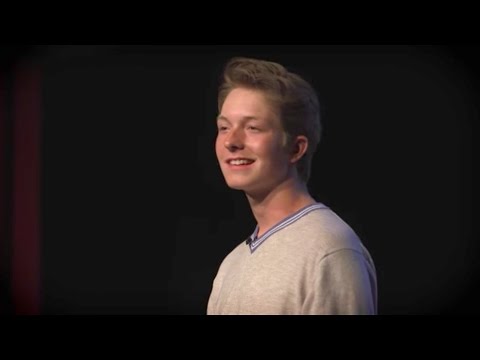
I’m 17 and I’m not special I have
however been able to achieve some
special things the past year and a half
has been a bit of a blur for me myself
and my co-founders have taken a science
fair project and turn that into a funded
company creating assistive technology to
solve the unsolvable problem of
paralysis and that’s all due to one
thing a mindset a mindset of naive
curiosity a year and a half ago I went
to a movie the theory of everything a
biopic about Stephen Hawking and he’s
someone who I’ve always admired I grew
up watching the Science Channel and he
was one of those titans of physics that
everyone talks about and through this
movie I saw a different side of him I
saw how his disability had affected his
life and that’s stuck with me when I
went home that night I was frustrated
this man who had pondered some of the
universe’s biggest questions was
inhibited by what seemed to me to be a
simple problem his brain couldn’t talk
to his muscles and that’s what happens
with anyone who’s paralyzed be it ALS or
MS stroke or spinal cord injury their
brain can’t talk to their muscles their
brains still working fine and the
muscles the motors of their body they’re
still running but there’s some loose
wires in between that don’t let that
signal be passed along now I figured
electricians have been fixing the
problem of loose wires for centuries so
why couldn’t someone do it with the
human body and so I went home that night
and I drew up some designs of what this
device might look like and I had no idea
that night but solving that problem
would become my passion now a year prior
when I was a sophomore in high school I
was in this chemistry class and I was
really bored I don’t know why but for
some reason things just didn’t click
with me and I spent most of my time
daydreaming and doodling which was
frustrating because I know I love
science
and I’ve always loved science so I
decided to start an independent study I
went online to Khan Academy and I
learned about anatomy and physiology I
learned about the nervous system and
about the muscular system and it was all
just because I was curious I didn’t
really know what I would ever use that
information for but I just wanted to
learn and so a year later my junior year
when I was in this engineering class
after I had that stroke of inspiration
from the movie I drew upon those tools I
was in this engineering class called
design tech at Centaurus high school a
public high school and the goal of the
class was to take some idea you had and
develop a working prototype and these
are some notes that I took from that
independent study so the goal of the
class was to develop a working prototype
and then you write this big paper on it
and so I just got to work I didn’t
really know what I was doing I didn’t
know how I was going to tackle this
problem but I just took it one piece at
a time
I figured there must be some way to get
some of these muscles to move and I
found something it’s called a tens unit
and it uses electro muscular stimulation
through electrodes that you just place
on the skin and you can get somebody to
bend their fingers close their hand bend
their elbow and then I figured there
must be a way to allow somebody with
paralysis to control this and I’d never
written a line of code I’ve never done
any electrical engineering but I thought
what about voice control that’s the sign
that might be doable and so I bought a
microcontroller online and a little
microphone and I turned to the internet
and I asked my teachers and when they
didn’t have the answer I just googled it
and I figured out how to build the
system where somebody would be able to
say a voice command and move their
muscles I developed these prototypes by
marrying these two technologies together
and I saw success by the time the
science fair came around after about
four months of devel
and I had a working prototype i sat down
with somebody who had had a brain injury
they had a brain tumor and they weren’t
able to close their hand effectively I
sat down with him I put these electrodes
on him and he said a command he said
open and it opened his hand for him and
I saw his face light up I saw how that
affected him and that was really where I
got the passion and the drive to keep
solving this problem for more people now
looking back on that and I always knew
in the back of my head I was probably
not in the position to solve this
problem a problem like paralysis is
supposed to be solved by a big research
company with some huge R&D budget or by
a research institution with some of the
best Ivy League Minds working on solving
the problem and I didn’t have either of
those things I was working out of our
high school engineering lab and I had a
budget of about $100 but I had a passion
I had a drive to do it
I was curious I I thought there must be
some way to solve this problem and when
I came to a bump in the road or
something that looked like it was going
to be crazy expensive I just went a
different way I followed my curiosity
and it led me to a solution and I was
able to see success creating this
prototype for less than a hundred
dollars and getting someone who was
partially paralyzed to move under their
own power and it was all because of that
naive curiosity I think often times
people think that their circumstances
are inhibitory but that’s
counterproductive because having less
resources leads to a more innovative
solution you don’t get to take the
routes that most people are you got to
find your own shortcuts you got to pave
your own path and that’s how you’ve come
up with this novel solution now while
all this was going on I was watching the
show or called Silicon Valley and it’s
about this guy this nerdy guy in a
sweater who has some hairbrained idea
and starts a company and becomes a
successful CEO and I figured well I’m a
nerdy guy in a sweater
I have a harebrained idea so why don’t I
give it a shot and I did I got together
myself and my four friends my three
friends and they were crazy enough to
tackle this problem with me and they
were smart enough to fill my gaps in
knowledge and help me along and I just
went online and I googled what do you do
when you start a company and I found
some stuff and I found this website to
connect startups with funding and I
filled out half of the application for
this thing called the boomtown
accelerator I didn’t really know what it
was but I kind of left half of it blank
and them win and started tinkering with
the prototype well two league weeks
later I got a call from the director of
the health tech accelerator at boomtown
they had had a company drop out last
minute and they needed someone to come
in and he started off the calls saying
that things probably weren’t gonna work
out and it was probably too late but I
pitched him the idea and I pitched him
our company which at the time the
company was for high schoolers a science
fair project and a logo but I guess I
made that sound pretty good because he
asked us to come in on that Monday and I
said of course and then I realized that
that Monday was the first day of our
finals week and I thought even better so
we came in and we started working for
eight hours a day taking these business
classes learning more and more about how
to develop a startup and we met with
experts in their fields people who had
spent years in FDA regulation in product
development in marketing and we drew
upon their device and developed our
company we spent the entire summer three
months working on this and it all
culminated to our graduation a demo day
where I gave a pitch in front of a
thousand people at the Boulder Theatre
and we ended the night with a standing
ovation we received the investment from
boomtown it was surreal and it was crazy
thinking back on it I mean we were
meeting with people who had more
experience in
they’re filled then years we’d been
alive and at the time I was kind of
scared of that I thought that this
inexperience was going to hinder us but
I’ve come to realize that that’s not the
case
inexperience allows for new perspectives
in established fields the people who are
trying to tackle this problem of
paralysis are going through the same
pathways they go to medical school to go
to engineering school and they learn how
to think about these problems and then
they go and work for a biomedical
company and because they have those
similar pathways they oftentimes have
similar solutions right now there’s two
leading solutions in solving the problem
of paralysis
the first is exoskeletons which are a
flashy sci-fi solution but have so far
proved to be not commercially viable and
clunky for the user the other solution
is implantable devices having an
expensive surgery and has proved not to
be accessible for most of the users now
we were not experienced we had no idea
what we were doing we weren’t taught to
think the certain way we approach the
problem from our own angle we started
from scratch with our knowledge base and
only learned what we needed to learn as
we went along and it worked out for us
that inexperience led us to this new
perspective if you think about this tech
industry and this technological age that
we’re in right now innovation and
industries are revolutionized by
outsiders by kids who are tinkering in
their garage and they don’t know what
they’re doing but they’re able to
approach the problem in new ways and
because of that they’re able to flip the
industry on its head
and so I ended that demo day pitch
talking about our plans for the future
and our plans for the future were to
develop a brain control system and
implement that into our device so
someone wouldn’t have to say a voice
command but they would simply think
about moving their muscles and it would
work for them at the time I said that I
didn’t really know what I was talking
about
I knew it was possible and I knew we
could get there I had no idea how and
that’s kind of scary but I leaned into
it over about the course of a month
myself and our CTO Nate looked at this
problem and we did research we googled
things and we found different ways we
connected with an entrepreneur who had
used brain control in his 3d printed
prosthetics and we implemented that
technology into our device and within a
month we had it working this is Betty
we’ve worked with her more recently and
she had a stroke about eight years ago
she’s a very independent person she’s
recovered very well she lives alone but
she’s lost the control in her left arm
she doesn’t have the ability to make
those fine move or motor movements or
even coarse muscle movements with her
arm and so we went to her home and we
sat down with her and over the course of
about 15 minutes we trained in a couple
different brain commands and we hoped
the device up to her we put place the
electrodes on her muscles and then she
thought she thought about closing her
hand and the device was able to do that
she was able to open and close her hand
like she hadn’t been able to do in eight
years prior and it took about 15 minutes
to set up this entire prototype cost us
less than a thousand dollars to build
with the full brain control implemented
and that’s what we’re currently
developing right now and working on
improving and making it even better for
our users
now I think oftentimes people think that
if there’s not an answer for your
question out there then there’s no
reason for you to try and answer it
right because there’s people with more
money and there’s smarter people out
there who are trying to solve it but
they’re not that’s the thing with these
big problems and these big questions
that we have they’re not being answered
and by being an outsider by being
someone who is naively curious by not
looking at that big picture and just
taking it one step at that’s at a time
you’ll be able to tackle the problem in
a new way you’ll be able to see
solutions that others haven’t if I
wasn’t naive if I looked at the full
scope of work that was ahead of us when
I first started out on this journey I
probably would have given up it’s it’s a
lot but I didn’t I just looked at what
was next
ahead I looked at the next problem we
needed to tackle and that naivety and
that curiosity to find solutions and ask
questions that others hadn’t before is
leading us to solve an unsolvable problem