
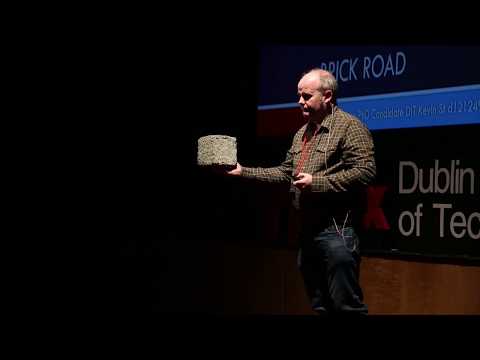
so imagine a world where you can grow
your own home now some of you might be
familiar with the work that’s been done
in the laboratory in the Netherlands
where they’re growing what they call
cultured meat or you might also be aware
of the little bit of work that they’re
doing there on insect burgers mmm
but did you know that you can apply that
principle to the homes and the buildings
that we live in with this brick I bet
you didn’t now what I want to say to you
is we’re living in a time of increased
challenges we have a population that is
growing at an enormous rate believe it
or not we have unprecedented wealth in
the world on a global scale and the UN
says that maybe in 150 years time we
could have 125 times the population we
currently have now just think about that
we’re not very good at the moment US
housing the people that we already have
mean I was walking in this morning and
we were coming up by the canal there was
people there living in a tent I mean
this is the 21st century and we’re a
so-called advanced country here so
trying to face this challenge is quite a
big one
and there are a couple of different
schools of thought on this some people
say that over time man will innovate he
always innovate to solve whatever
problem he faces and solved them with
technology other people say no we’ve got
to tighten our belts we’ve got to cut
back I say that we can do both and we
can do both with this brick now you may
have remembered these incredible scenes
from a couple of months ago in London
when that Terra block went on fire and
what some of you obviously I’m a
building physics narrator I kind of know
about this but what some of you
realizes that one of the reasons why
that fire was so bad why it spread so
rapidly was because insulation had been
put on the building and it hadn’t been
thought through properly and it allowed
the fire to spread so actually a project
that was meant to improve the lives of
people turned out to be a bit of a
disaster in some respects so that’s the
scale of the challenge that we’re facing
we have increased population we have
also a demand for increased standards we
want better homes we want more
energy-efficient homes we want more
comfort everybody all over the world
wants that and some people think that
this is the solution a plastic wendy
house okay so i am exaggerating a little
bit
I mean Wendy might insulate her house
not quite as well as what engineers are
proposing now but I am serious one of
the main things we have in Europe now is
a standard it’s a law actually it’s
called the energy performance and
buildings directive and what it says is
that every country must set a minimum
standard of energy performance for every
new building and you have to realise
that those standards are very very
demanding and a lot of people think that
building what’s called a passive house
is the way to do it and it’s a brilliant
design there’s no doubt about it
it’s a concept where a series of
equations works out what the energy
demand of your home is and you’ve got to
figure out how to make your home to that
series of equations
however things can go wrong
because now what you’re doing is you’re
literally wrapping your home in a
plastic bag and we all know that if you
do that and you don’t ventilate it
properly then you get magic mushrooms
okay try it sometime trust me
so I want to talk to you a little bit
about hem crease and why I think it
could be the solution so first of all
I’m going to tell you a little bit about
it it’s a material that is made from the
inner core which is also called a shiv
of the hemp plant and it’s the
industrial hemp variety not the other
stuff it does look kind of the same all
right I’ll give you that and for years
people in the plastics industry were
able to get the cultivation of this very
severely restricted in the USA but it’s
making a huge comeback and I’ll tell you
a little bit more about that presently
but first I want to tell you that homes
that are built using natural materials
like this cave home here in Spain keeps
you cool inside even when it’s 40
degrees outside or maybe this home here
in Germany’s type of a passive house it
has lots of windows and the bricks were
made locally right this type of science
is how we always used to build for
example this is my grandfather’s home I
visited there about two or three weeks
ago I was amazed to find that it was an
earth house I mean it that never
occurred to me before of course it was
it was built maybe 150 years ago and
it’s still standing and it’s still as
dry as a bone
so what are the advantages of this well
number one it’s completely sustainable
you can literally grow it in your garden
and it’s one of the fastest growing
plants in the world it requires very
little fertilizer inputs also it makes a
very light but thermally insulating
material we add a little bit of lime to
it where we can also add clay we can add
a little bit of cement as well if we
want to get it to set quicker and in our
work here we decided to make bricks
because one of the limitations with
working with lime is that it’s very hard
to get
to set when it’s below -5 degrees or
sorry 5 degrees so we figured that if we
could make bricks in advance people if
we told people how to do that and we
standardized the whole process people
could literally build grow and develop
their own home while of they were
sleeping now
I also wanted to talk to you a little
bit about why I decided to follow this
road and how I came to follow what I’m
calling this yellow brick road through
pardon my pun so a number of years ago I
was an IT consultant
it was probably 15 20 years ago yeah I’m
trying pretend an older member and a
friend of mine said to me you know he
was living he had a family home down in
the West about and he said to me you
know what there’s laws of wall down here
and the sheep are just thrown it away
and you know we did a little bit of
research on it and we realized it you
know
wall is a very valuable commodity and
it’s an excellent material for
insulating so what we decided to do was
to set up a company to manufacture
insulation from sheep’s wool now about
eight years later we sold that to
investors in the UK we stayed with them
for a little while
and our goal was to be the world’s
leading natural insulation company so we
built a factory in Wales and you know we
were driving around in fancy cars for a
little while and you know after a while
it something began to dawn on me that
this wasn’t really the path that I
wanted to be on so we parted company and
in 2009 I found myself unemployed and
not really sure at a crossroads you
could even say and not really sure what
the next thing was so I went back to
college I retrained I became a kind of
an
engineer and then a couple of years
later I was down in Cary and I do this
course in hemp building now I was amazed
to find that I just drove down this kind
of road in the middle of nowhere and
like I was on the side of a mountain I I
didn’t know what to expect to be honest
and the last bit of the road was only
partly paved and I got up there and I
said like I mean even in the right place
but in there I found people from
Singapore from Longford from Dublin from
the USA there was a number of people
from Poland at the center of it was an
English guy named Steve Allen and he’s
been living in Ireland for 30 years and
he’s a pioneer of hemp building and he’s
wrote a couple of books and from that
remote carry hillside he has inspired
what you might call a movement or I
don’t know something an event happening
but it’s an awakening of interest in
building with hemp and you know when I
delved into it a little bit more I found
that you know he wasn’t even the first
he was he had taken up the baton from
people in France who had developed this
idea as a way of conserving old
buildings and a few years later I found
myself doing a PhD and in my PhD now I’m
trying to standardize this stuff because
you can’t imagine this with any new
technology that emerges where you have
people from all walks of life who are
trying to how would you say make
something happen but for themselves it’s
very difficult then to kind of get that
to penetrate to a larger group of people
you need to be a specialist to do it and
all this kind of thing but I think that
this is such an opportunity I mean this
material can help us to save so much
energy so many carbon emissions all the
plastic houses I showed you earlier you
can imagine what they’re made of they’re
made of petrochemicals they’re made of
concrete which is a very high pollutant
so I had to learn one little lesson from
all of the work that I had done up to
that point in time I had to absorb it I
had tried to be a leader in my field and
I found myself on a path that I wasn’t
really comfortable with I had to step
back from that path and look at it life
from a different perspective perspective
where you come along and you build on
what other people have pioneered and you
try and add a little bit to it and then
hopefully you create a set of guidelines
are a little bit of information or a
little bit of help that somebody else
can come along and take and run and
build their own home and grow their own
home it’s all really what I want to say
to you is what I learnt about leading is
that first you have to learn how to
follow thank you
[Applause]
Please follow and like us: