
some of you may have heard that some of
you maybe that’s the first time st.
Helena Island has a specific location in
the world it’s in the Atlantic Ocean
about halfway across it it’s right in
the middle between Rio de Janeiro and
the Divya in southwestern Africa he
might go its historical significance in
that it’s the place where Napoleon was
exiled after his final defeat in Europe
the supporters spent the remainder of
his life and a few days ago I realized
the importance of this place to me in my
life even though I’ve never been there
before and it has a lot to do with what
happened while Napoleon lived there you
see Napoleon late in his life had
visitors on this island
and once that visitor wrote down their
conversations
after Napoleon died he published it into
a best-seller in France what an
opportunistic guy but when you think
about what he wrote there was one
particular idea that was infamous and
this was the idea that Napoleon had
about history the exchange goes
something like this at the time of the
events during the heat of conflicting
passions history cannot exist at a later
period all parties are agreed respecting
it so then what is the truth of history
that it is a fable agreed upon I’ve
heard this lesson before in fact when I
was young younger than you I spent my
summers in southeastern Kansas which is
also kind of like being on the edge of
the world there’s nothing out there
that’s where my family came from
originally and I heard Napoleon through
the lens of my great aunt julia fiercely
independent fiery one with a mind like
of Dimond ferocious reader she always
said Luke history isn’t agreed upon Pact
allies that’s what the poll and said I
didn’t really get that until later sure
and it becomes my life and that’s the
thing the notion of agreement is what
stood out in my mind connected to this
agreement implies in detention agreement
implies distortion so we were truly
studying history it occurred to be
pretty quick that it didn’t matter what
history I was studying it didn’t really
matter why I was studying history either
what mattered was how I thought about
history and so that’s gonna be the
subject of my talk today its historical
thinking I’m gonna talk about it as a
necessary but unnatural act and I’ll
unpack what I mean by that so I’m not in
a history classroom I’m a psychology
teacher too when we seek to understand
we always start with what we know
and that’s ourselves the basic
principles of psychology tell us that to
an extent when we want to claim what it
is that we know what knowledge we have
our understanding of the world we look
inside of ourselves we look to our
memories we consider what emotions we
have at that time we consider what sort
of beliefs and traditions have been
ingrained in our mind and then we speak
with the authority of what we know well
the intriguing thing about what we know
is it’s a bit problematic because unless
you take the active step to critically
assess and think about what it is that
you know I’m talking about metacognition
you might end up in a pattern
the world just revolves around you and
your thoughts history can help us
understand this so here’s how I would
define history history is not the past
spoiler alert history is in fact that
debate about the past and it’s that last
word in there that sets me apart from
napoleon whereas he said it’s an
agreement
I’m in total disagreement with that but
what is the importance of this debate
why do I bring it up are we meant to
learn history to debate its contents for
the sake of writing really stellar
essays are we meant to learn and debate
history from the standpoint of if I’m
assigned the affirmative position I can
crush the dissent I don’t think so in
the pursuit of historical truth we
happen upon a path that leads us outward
historical truth teaches us to grow
early on in my college career I happen
across the definition offered up by
Latin actually the original word for
history it’s Latin derivation remains to
lead outward it’s kind of a novel
concept when you think about it you were
asked as students and all of us have
been asked at some point in our life
with learning to consider many different
fields but the fact that there’s one
entirely devoted to moving away from the
confines of what you know what’s inside
and instead trying to apply yourself to
thinking that goes beyond the confines
of your mind what I’m talking about here
is history is in effect a process of
empathy so let’s think about empathy for
a second there’s an age-old tradition to
teach the notion of empathy
that means oh you should think about
things you should understand things from
the shoes of another person
it’s an approachable thing to illustrate
empathy that way it’s a rather ambitious
prospect if the nature of your knowledge
is everything inside of you than to
suggest that you need to remove yourself
entirely from what you believe and think
and almost quite literally stand in the
shoes of another person and try and
attempt their understanding that’s
really unnatural that’s really difficult
to do it’s easier said than done so it
comes that debate again the debate means
you have to think about things not just
from your vantage point but others as
well but here’s the thing about the
debate it’s an ongoing thing that’s
really lacking in participation despite
how important it is I would argue that
taking part in this debate is something
that encourages you to grow to think
about how you might approach the world
differently so let’s enter into a
particular debate shall we I’m going to
share with you a quote from history and
the quote that I’m gonna share projected
up on the board
we’ll talk about who its author is and
needs behind it in a moment but as I
read it I want you to think about it who
could potentially have said this I have
no purpose to introduce political and
social equality between the white and
black races there is a physical
difference between the two which is my
judgment will probably forever forbid
they’re living together in perfect
equality powerful statement we’re
talking about race we’re talking about
social justice we’re talking about
equality and we’re talking about
somebody who has a very strict opinion
on prejudice let me give you a few
minutes see if you can figure it out
first the speaker is male the speaker is
American and the speaker is president
Abraham Lincoln hang on a second
Abraham Lincoln we’re talking about the
guy known as the great Emancipator the
guy known for ending slavery clearly we
have some kind of conflict going on here
if you stop and think about what’s going
on in your head you might leave to do a
series of questions what do I know about
Abraham Lincoln what do I know about its
life what do I know about the time that
he came from and by extension well what
do I know about race what do I know
about racism prejudice what do I think
where my opinions on that when you seek
to understand you look inward first well
in order to truly give this the best
possible information and the best
credence that we can to these words to
try and understand how they happened we
have to ask a really difficult question
was Abraham Lincoln a racist so to
answer that question let’s dig in
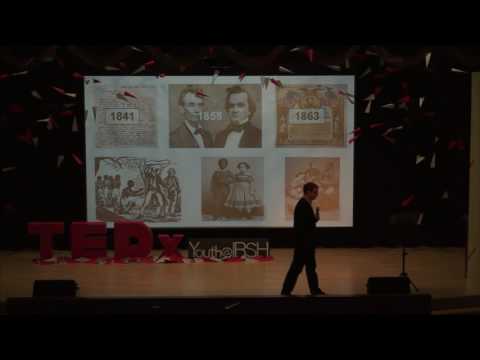
so got a lot going on up here let’s talk
about it across the top of my slide
represents actions thoughts writings
moments from Lincoln’s life if we’re
truly going to understand the thoughts
and deeds of someone we have to look at
what they did they historical
documentation of all these things in the
far corner we have letters written from
early on in his life before he got into
politics in 1858 we have a discussion
that happened on a political trail which
is where a quote originally comes from
but five years removed from the quote
Lincoln’s president and Lincoln with
stroke of the pen is changing the lives
of millions of non-white Americans
granting them freedom for the first time
in their lives across the bottom the
context of Lincoln’s world if we’re
going to talk about standing in the
shoes of another person and truly
understand
empathy we have to understand where
those shoes were located so first of all
1858 well as I stated before he’s on the
campaign trail this happened during a
series of senatorial debate that
happened in the state of Illinois before
Lincoln was president he attempted to
become a senator he ultimately didn’t
win that election but while he was on
the campaign trail his opponent a guy
named Stephen Douglas he didn’t Lincoln
entered him to what are now famous a
famous series of debates known as the
Lincoln Douglas debate during this time
Stephen Douglas was a fierce speaker
absolutely Titan of speaking and when he
was out there talking to you primarily
talking about white superiority and how
folks who weren’t white didn’t really
have many rights and didn’t deserve gun
and he often characterized Lincoln as
the polar opposite of him suggesting
that Lincoln cared too much perhaps
about black people and yet think back to
her quote Lincoln and his response would
say no it’s the political and social
equality for people who are not white he
would say that there’s a physical
difference between them and that
equality is a dream that would never
happen did you say that because he’s out
on the campaign trail speaking to a
large white audience of voters trying to
win the vote well let’s add on to that
quote you have to think about other
things he said to further on in that
speech Lincoln’s remarks suggested that
a black man was not his equal in terms
of morality and intellect so not only is
there a physical disparity but he’s
never gonna be as smart as me and he’ll
never be as good as me powerful words
coming from Lincoln but we take this
with a grain of salt because by the end
of his
he does say however that blacks and
whites deserve equal entitlement to
things like life liberty and the pursuit
of happiness
so these comments are cryptic is he
racist or not thinking about what he
said it it’s hard to say but what is
only one moment in time let’s go back to
1841 Lincoln’s a younger man he’s
travelling through his home state of
Kentucky and while he’s traveling he’s
riding on a boat and why he’s on this
boat he’s writing a letter to one of his
best friends a woman named Mary speed
while he was on the boat Abraham Lincoln
encountered a collection of recently
purchased slaves they were all chained
together and hanging out on the deck
they were on route to a plantation where
they would live out the rest of their
lives and slaves Lincoln sat there and
talked about the harsh reality and its
letter talked the harsh reality of what
would face them in their lives of
slavery but then he also made sure to
note that they were sitting there
telling stories they were playing games
they were laughing and he uttered this
really infamous line he said how true is
it that God renders the worst of human
conditions tolerable worst of human
conditions clearly that slavery worst
implies some kind of negative thought
about it but tolerable we’re going to
tolerate it hmm no clear answer there
either if we think about the world in
which Lincoln lidded stopped me this
sounds familiar he’s standing in a
society that is rigidly divided on the
notion of civil rights on the notions of
race who deserves what and both sides
are fervently involved in the argument
against one another
they truly believe what they say it’s
relevant to modern times in some cases
the pro-slavery folks considering our
picture to the left they believe that
the physical
was a real thing that a person who is
white was not the same species as a
person who was not white and they also
argued that hey we can invoke religion
and use religion as a tool for saying
that we write a famous quote that was
published in the book lauding the crisis
of slavery said that God hath made us
white people to rule and the Negro to
serve they fervently believed it but as
much passion as there was for slavery on
the opposite side Frederick Douglass in
a photo campaign right around the time
of mastication 1863 published a series
of photos in which he tried to educate
the american society at that time on
what slavery was about and why it was
wrong and how good emancipation was the
photos to the bottom right are from
those picture exhibits in 1863 they’re
photos of slaves or recently emancipated
slaves I should say I’m not talking
about the two black gentlemen in those
photos the white children were the
children who appear white were also
slaves if that doesn’t jive with you if
that doesn’t make a great deal of sense
it pulls back the veil and reveals what
they meant by physical difference there
was this harsh social rule and
understanding notice the one-drop rule
the idea that if you had a non-white
relative in your immediate or extended
family that you had in theory one drop
of non-white blood in your blood and
therefore you were not white and as a
muscly can a racist it’s a heck of a
debate to enter into it we’ve looked at
all this evidence we’ve analyzed it in
was talked about context really making
an effort to think from the vantage
point of Lincoln’s life at that time and
the actions of negatives to be presented
can I say right now here in front of you
with absolute certainty that Lincoln’s
races the answer is no I can’t I don’t
know the answer but that’s the thing
about history it’s doesn’t matter what
you learn doesn’t matter why you’re
learning it what matters is how you
think about it even though I don’t have
an answer for you the idea is the
process that gothis here is what matters
that’s what’s most important think about
it for a second in the moments that
we’ve been talking about this we
challenged your preconceived notions
about what you might have understood
about this topic before we got in death
we wrestled with a lot of different
information and try to make sense of it
to answer a divisive question and in the
process it led you to a deeper
understanding not just a Lincoln but of
a lot of things that’s an important
lesson more to the point we were able to
talk about Lincoln as a human yesterday
or even 15 minutes ago if I ask you do
Lincoln was you probably would have
thought oh you know if he’s a part of
that narrative that ended greed he
didn’t like it
and his story squeaky-clean by talking
about history in this sense and really
digging in and trying to consider what’s
out there versus what we know we
humanize individuals like Lincoln we
show this hubris his flaws and as a
result it doesn’t just teach you history
it teaches you something about what you
so here’s the thing about this and I
find myself again st. Helena Island kind
of reflecting on where I have always
been when it comes to thinking about
history doesn’t matter what I learned
doesn’t matter why I learn it matters is
how I think about it
history is a debate one that demands
your participation in a world where
information is at your fingertips in a
matter of seconds you can google
anything and have an answer but what
cost does that comment easy information
raises serious concerns for me about
literacy and our ability to critically
assess what we’re seeing and what we’re
experiencing so the importance of an
unnatural act of taking on empathy and
trying to think beyond the confines of
what we know and believe that’s the
importance of thinking about history I
would say that’s something the world
needs more of and all honesty how else
can we expect to grow it’s not by looking beyond the obvious