
well today we’re gonna start by learning
just a little bit our very much
unappreciated sense of touch now the
five senses sight hearing smell taste
and touch if you were to ask yourselves
which sense would you never ever ever
definitely want to live without most
people would say something like hearing
or sight but have you ever really
thought what it would be like to live
without the sense of touch all right
in order to do this let’s all do a
little experiment together okay it’s
hard for me to send a microphone and
clear but it’s all raise your hands and
without looking trying to touch your
fingertips above your head place up
awesome it’s a good price but you can do
it right well you can do it with our
theme and this is all face business
sometimes the sense of touch is
unbelievably complicated and an inherent
part of our daily lives it is comprised
of sensors a lot of different sensors
that sense things like temperature and
pain grows to forces and vibrations and
the way we interpret those signals
membrane in the hostages in when you
raise your hand up you felt the forces
in your muscles that stretch of your
skin and finally skin-to-skin contact
all of which guided you to be able to
accomplish this task without even
looking when we’re out in the cold and
we’re trying to button up our jacket or
zip it up it’s really awkward right well
funnily enough this is not because your
muscles are cold it’s because the coal
knocks out some of the mechanoreceptors
for touch sensors in your skin
which give you contact information
making it really hard to manipulate
anything with your fingers so the sense
of touch is really important because it
is the sensor allows us to move around
and interact with our environment
without really having to think about it
the science and technology with haptics
studies the sense of touch and how to
use it to be able to interact
devices in a more profound way this type
of haptic technology will work by
recording a user’s motion for example
for a robotic device which is in right
there and then transmits that motion to
a virtual world in this example the
virtual world is just going to be a
personal shopper and then in turn the
virtual world trans means back to the
device what should happen when the
cursor touches that teapot so for this
example we can think okay what should we
solve it so if the cursor touches it the
user should feel a force and not be able
to penetrate that teapot and then they
have to devise a little robot that you
see there has mores which are able to
transmit that force back to the user so
what’s really cool is that the user can
be moving around and healthy device and
then feeling a teapot even though
there’s no miscibility about there now
this doesn’t have to be just about
virtual worlds though if we substitute
the virtual support for our one arm now
what happens is that you can be
controlling a proba through these have
deep device and feeling for the Rowan’s
view and since the way we control our
own bodies is also by feeling is much
more natural and easier way to control
the device one very cool application of
controlling remote devices is in
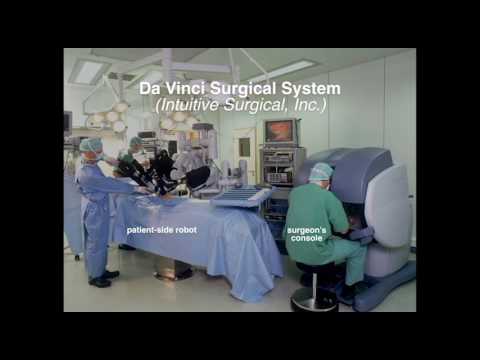
progress distance surgery now this robot
shown here is a clinically available
surgical robot called The Da Vinci
Surgical System and the way it works is
that a doctor was here at console and
look through a monitor at what the robot
is doing and then control the global
consumers in this type of procedure the
robot cannot act autonomously there’s
there has to be a surgeon in the loop
because it’s just too complicated and
the robot is can’t advance up and then
just before it gets for me that’s just
foam it was me in my lab some tissue and
and so these robots are ours
surgeon to be able to perform surgeries
much less amazingly and more accurately
so what we can get deep inside a patient
without cutting big holes we are going
to be closing them and in a surgeon in
drunk and we’ll wave your dolphin
tolling aerobic if I can get the sense
of touch feedback it is however really
hard to give that sense of touch
feedback it’s hard to give a sense of to
the present so you feel as if you’re
directly manipulating a patient and
offer a robot and a lot of the projects
in my lab the one I work not the one
working in Stanford work on healing
exactly this problem well well now that
we’ve learned about the sense of touch
and how amazing it is I want to talk
about the application that makes me most
excited which is education so we don’t
even address when you’re reading
something you will have about a 10
percent retention rate when you’re
hearing something about 26 percent
retention rate when you’re seeing
something about 30 percent retention
rate when you’re seeing and hearing
something about 50 percent attention
rate when you’re explaining something
about 70 percent retention rate but what
about what you feel well turns out that
learning movie and haptics is really
interconnected in the brain when
crazy-cool example of these is that
neuroscientist and education researchers
have shown that when we’re doing our
math calculation in your brain would
actually see a representation of your
fingers even when you’re not using your
fears to count which is why we’re trying
to understand the relationship between
haptics and learning we hypothesize that
virtual environment by media students
learning concepts that are very
difficult to practice by just seeing an
equation and this is why we created this
still happy program it’s called happy
and in the way it works is just a one
degree of freedom device when you move
it around you can feel different forces
and not program needs and virtual
environments it’s open source so all of
the instructions on how to build it are
online make sure you practice you can
manufacture it yourself you see how get
a student can interact with the computer
and feel different physical simulations
in this code these people’s relationship
right here a student can interact with
concepts about sprites the ideas and you
use the mouse to create different types
of Springs such as single spring springs
in series in Springs in parallel and you
can change this thicknesses all those
Springs and then it in happy
you can feel we just created another
really cool application of haptics for
learning is in making to abstract
concepts together so in this program
right here we’re trying to link the
concepts of trigonometry the graph and
even in the relationship with healing
circle and so a student will be able to
add many different trigonometric
functions change their amplitude and
frequency and it so happens for the
function and feel the changing of us
just name
we have seen some promising results in
students learning how to graph these
functions after they have felt as well
as understand the relationship with the
unit circle we have used hacking in
different virtual environments ranging
from massive open courses middle school
classes undergraduate and graduate
courses very positive results are our
dream is to find new ways of teaching
science so that everybody can understand
we would really like
if you could have any future on our
interactive classrooms and be able to
distribute quality education to the most
remote corners of
[Applause]
Please follow and like us: