
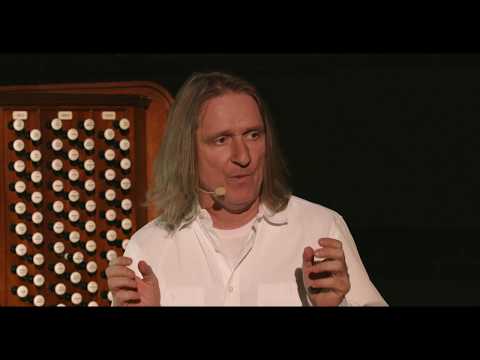
hi I’m Christopher
defeat east of
and unlike some of my
that went on before me I actually have
the luxury of recognizing some faces
instead of staring into the dark space I
actually bought a cell phone from
somebody earlier so it’s great to be
sitting amongst you I’m sitting at the
console of the 1930
eeehm Skinner pipe organ which has been
an integral part of Royce Hall since it
was built and I’m very thrilled to be
awarded the gravitas of concluding this
day of ideas with a festive piece by
Johann Sebastian Bach
before I do so I would like to talk a
little bit about how this piece makes me
feel I think most of you will have heard
that there’s numerous studies that
demonstrate that music has a positive
effect on the brain both listening and
playing and I contend that playing the
organ has an especially positive effect
on the brain because as organist we use
our left hand and left foot thus
stimulating the right hemisphere of the
brain we also use our right hand and
right foot thus stimulating the left
hemisphere of the brain so when we’re
playing with all limbs we’re hitting the
brain at all kinds of different spots
and sometimes when I wake up in the
morning I’m not really a morning person
so I’m groggy and drowsy and I stumble
through the instrument at my home and
after only playing a little bit of music
my juices start flowing and I start
remembering what I’m supposed to do that
day and I’m starting to have some ideas
for new projects so I’m so appreciative
of having been given this gift of
playing playing organ with all of my
lips and there’s one genre of music that
I especially like because it’s
especially conducive to using all four
limbs and that’s the fugue a fugue is a
classical genre that starts with one
line of music then a second line is
added a third maybe a fourth fifth sixth
and all of those lines have to operate
pretty independently so having four
limbs comes in very handy
and the master of that genre was Johann
Sebastian Bach who lived in the Baroque
era and in my opinion he wrote the most
beautiful Fuchs a whole bunch of them
and I’m going to play one of them what
also fascinates me about these pieces is
that they remind me of planets and stars
in space because these bouncing notes
and pitches they have relationships to
each other just like stars and planets
have relationships to each other for
example pictures are frequencies the
first pitch in the piece I’m about to
play is a D and it has a frequency of
about 293 Hertz and then the next pitch
after that is a G which has about 392 in
music that’s called a fourth the
interval of a fourth and the second
pitch is about 1.3 three times higher
than the first that’s just the first two
notes but all of the notes in the piece
have these relationships so it’s like a
whole bunch of stars and planets that
are on the scoresheet
another very important relationship in
music is time just like space and time
is very important for stars and planets
so the composer prescribes certain
rhythms
there’s eighth notes and their sixteenth
notes which are twice as fast so I have
to follow that but within that grid I
get to make some personal choices I can
delay a beat a little bit I can make a
note a little bit longer I can make a
little bit shorter so I get to be a
co-creator of the universe of music and
I could go on and on about this but I do
want to leave you with this piece and
I’m striving to to create with the help
of mr. Bach a positive upbeat effect in
your brains when I first learned this
piece I was a child in Germany and my
first teacher a wonderfully musical man
by the name of Haman Sheva told me this
was a champagne fugue and by that he
meant it has the same effect as a glass
of high-quality dry champagne without
any negative alcohol effects
this piece also has a bouncing
propulsive rhythm which I feel
simultaneously is rooted in gravity and
defies gravity thank you so much he has
yawns abbas embarked few Kinji major
[Applause]
[Music]
[Music]
you
[Music]
[Applause]
[Music]
[Applause]
okay
[Applause]
Please follow and like us: