
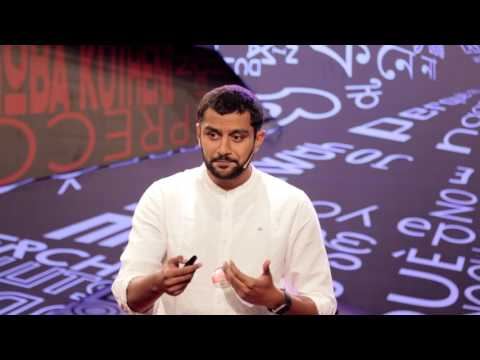
[Music]
you
good afternoon so when we look our
around us to ourselves today one thing
is incredibly apparent the technology
will change everything and it’s going to
affect even the most mundane parts of
your life including I would reckon
within the year drones might be
delivering toothpaste at your home but
there’s an area of the world a problem
and in my mind one of the biggest
problems that we see where all of this
technology and all of this innovation
has hardly made a dent and that’s the
dream of being able to provide high
quality affordable education to millions
and millions of students in school and
there’s no country where this problem is
bigger than our own
we have 250 million students in our
schools and our education system by most
records is amongst the worst performing
in the world and about six years ago my
co-founder and I started a journey to
try to solve this problem and when we
looked carefully at what we saw before
us the one statistic really jumped out
at us our public schools are short 1
million teachers that’s the teacher
shortage and in a country India size you
know a million teachers 10 lakh that
seems something you could you could fill
if you hired aggressively but let me
rephrase the problem for you what we
genuinely believe is in today’s context
we are actually short of 1 million
superheroes when I walk into a classroom
as a teacher this is what I am expected
to do I am supposed to be an
encyclopedia of knowledge
I’m supposed to be engaging and charming
and be able to deliver an exciting
lesson that my kids lap up at the same
time I am supposed to be almost a parent
to all of these children I’m supposed to
be able to understand how they’re
feeling why they’re motivated inspire
them educate them this is not an easy
job and I would reckon this is amongst
the hardest jobs there is and when you
start to look at this problem as saying
we need to find not one actually I would
reckon about two or three million
superheroes for this country it starts
to look very daunting and when we try to
break this problem down we imagined it
as a two-part problem one part of it is
the academics can you go to class know
your subject matter and can you deliver
it in an engaging way the other is the
human element of teaching which is can
you work with children understand them
coach them mentor them and we really
felt that given our backgrounds in
technologies we could really attack that
first problem you know we could really
make it easy for someone with almost no
academic expertise to go and deliver
good academics to children I like all
good engineers we designed an experiment
so we started working in a government
school system called the Nevada with the
Allies so these schools are rural
schools and they are magnet schools as
they say which means that the smartest
rural kids get admitted to these
programs the government pays for
boarding lodging academics and they’re
very good high-performing schools and we
picked 25 kids in these schools in class
11 and we said let’s try to teach these
students without a subject expert in
class so what did we do we took some
high quality video content about seven
eight minutes long we interst it with
some collaborative activities where the
kids could sort of answer questions and
debate and discuss and really you sort
of fight it out we designed assignments
and tests and on the weekends we tied up
with volunteers at IIT Madras who would
come down and mentor these kids and
answer that outs
and all of this was run by a facilitator
who incidentally we used to be in HR at
Infosys
before she took the job and this went on
for two years and then our kids went and
wrote the iit-jee now for those of you
who aren’t familiar with the je it’s the
entrance exam to most engineering
colleges in the country and widely
regarded as amongst the hardest tests
for math and science on the planet now
when the results came back we were
shocked 90% of that class cleared the je
right which men at most of these
children went on to either the IITs or
the NIT s and we really thought we’d
found the Holy Grail right yes this is
an incredible story right we we have
found a way to deliver academics without
an academic expert these kids are able
to learn incredibly well you know we
could scale this within a few years this
could scale across the country we were
really excited we were even more excited
about the fact that when we compared
their outcomes to students who went to
more traditional coaching programs or
tutoring programs they actually did
better that’s the yellow grey yellow
line on the curve that you see so like
all good entrepreneurs we raised some
money hired a team quit our jobs and
drove right in and for a couple of years
everything was fantastic you know we
started a few more batches they also did
incredibly well and let me sort of
started hitting B of the prime time or
big time and we started getting these
big implementation projects that we were
wanting to do and that’s when the wheels
came off
one of the first implementations are
large implementations we did it was in a
major Municipal Corporation system in a
big Indian city and as a matter of fact
we sort of went in there we were going
to teach about a thousand 1,200 children
conducted a baseline test the data came
back and we found that only 40% of
students in class nine could solve this
problem
and roughly only about 40% could read a
full paragraph and understand it in
their own mother tongue and this is not
a problem that you know is only in
government school systems we also
started working with many many more
private schools and we went and
conducted tests you know basic math
ability tests in private schools and
founded about 40% of the kids there were
below grade level that they were not at
the mathematical level they should have
been and this was only the first problem
we saw but what it meant a very
important thing for a model what it
meant was sort of the high scale you
know technology driven product driven
model that we had envisioned would not
really work right because you could
design a product for kids who were at
one grade level with a facilitator who
didn’t know any math but the moment you
have children who are two grades behind
three grades behind one grade behind you
needed someone who knew math right so we
had to suddenly switch from having no
subject expert to a subject expert in
the classroom and that was okay
that’s the solvable problem but what we
started to realize is as the scale of
our work increased and we got more
diverse children you know these
facilitators we were hiring who were 22
23 fresh out of college really excited
and passionate really started to crumble
because you know in public school
settings or government school settings
kids came in with issues like child
abuse physical abuse missing parents
malnutrition in private school settings
these issues didn’t exist but there were
others the complete irrelevance of our
curriculum which means nothing to most
kids unbelievable amounts of parental
pressure no match between what they
really want to do and what they’ve been
asked to do and 22 year olds in
classrooms really struggle to deal with
this and you know my co-founder and I
remember this very distinctly sort of
sitting down and trying to understand
what should we do because the dream of
the big bold idea right the idea that
would scale dramatically and rapidly was
really starting to not look that way and
as we talk to people we started to
realize this is a very familiar pattern
in education
2012 was I believe the year of the MOOC
what these are are massively open online
courses so professors from Harvard and
Stanford teaching courses online that
millions of students would sign up to
and the MOOCs like many education
products before them were hailed as the
savior as like I said the Holy Grail all
these kids in India you know who didn’t
have good college would study from
professors at Harvard and everything
would be what fine and then a year or
two later the data started coming in and
and people found that there was firstly
only about a four percent completion
rate and worse that only the kids of the
four percent that were actually
completing more than eighty percent had
either already previously taken that
course or at least belong to the
education elite which meant that they
went to good colleges already had had
good schooling were not poor and what
many of these companies did then was
pivot away from this problem and say hey
this you know solving education at scale
for everyone just doesn’t seem like
something we can solve let’s pick
something smaller let’s pick something
simpler you know let’s go out and solve
a problem that we as technologists know
how to solve and I think we had that
choice too right
we could have pivoted but we just
couldn’t and the reason was because at
that point in time we were actually
teaching these children in classrooms
and it really struck us at that point in
time that the reason there has been such
little progress in education is because
of this fundamental fear of failure that
people like us have we are brought up
and I was certainly brought up to
believe that I would my brilliance my
intelligence my ability to use data and
technology was going to make me
incredibly successful and then you find
yourself with the problem staring you in
the face which you know that there is a
part to solve but you’ve just never
prepared to do that you’ve never
prepared to run a twenty thousand person
company where you are largely hiring and
training teachers and at that point in
time you really feel like you’re you
know driving uphill with this tremendous
load on your back and the question is
you really want to do that right you
would really want to commit to something
that might take 20 years to do
that will consume most of your
professional life and we’re because
education has about one year cycles you
may go at it for ten years and still
realize it doesn’t work
anything at that point in time I it was
not because of any other reason but the
fact that we had hundreds of kids who
dependent on us that we said no we’ll
try and do this and we dramatically
changed how we operated so our focus
suddenly became finding teachers
training teachers creating pay
structures reward models performance
appraisal career trajectories for
teachers and none of this is super
exciting right four years I think I
think for the last two years much of my
job has been looking at KPI is figuring
out you know what’s a two-year career
track through your career track five
your career track speaking at events in
campuses trying to encourage young
people to join the teaching profession
for life not for a year or two it’s also
dramatically changed how we review
technology instead of thinking of
technology as the solution we started to
think of it as something that that’s a
scaffold that’s that sort of a
protective blanket around the teacher
that something that supports the teacher
so all of a sudden things like invoicing
systems you know testing systems
back-end data analytics and tell
teachers what to do start to become more
important then cool apps that we could
give kids and the third problem we
really had to solve was to train all the
teachers that we were hiring to be
familiar with technology which we
embrace it and to act like many many
product managers had figured out what
they wanted tell it to us so we could
slowly iterate and the most exasperating
thing often has been that every single
Italian takes months at best sometimes
years because that’s just how education
works but things started to turn a
corner then I think a year or two into
committing to do this sort of a slow
hard ride uphill we started to see
incredible outcomes so today we employ
almost 200 teachers across the country
what’s more exciting is that we employ
these teachers in 25 different cities or
locations many of them are very small
towns or even villages what’s perhaps
even more exciting is that many of these
people have our teachers have really
committed to spending multiple years of
their lives in these small towns either
building education businesses or
transforming government school systems
and the results have started to come
last year one of our students was
accepted on a full scholarship to the
Massachusetts Institute of Technology
this is the best engineering college on
the planet when he came to us he barely
spoke English but he had this tremendous
Drive we’ve had one student who is now
studying computer science at IIT Madras
he got got close to a 300 top 300 rank
on the iit-jee but more importantly
we’ve already sent hundreds and hundreds
of kids to the IITs and annuities and
not just from big cities like you know
Bombay and Delhi and Pune but also from
small town small villages and I think
this is giving us a lot of confidence
that this might take another you know
five years seven years ten years to get
the model right but once we get there
once we figure that out it’s not going
to be that hard to scale and perhaps
more importantly it’s not going to be
that hard for there to be hundreds of
people who believe that the answer is
somewhere on in the confluence of
Technology and actually good operations
so the message I really want to leave
with you is that you know this year like
many other years before maybe some of
you many people you know will step into
this field will step in trying to use
what they are good at to solve the
problems in education and my sincere
hope is that when they hit this folk in
this in the road they have the courage
to really look at this steep difficult
part to climb and say why not why not
teach
thank you
you
[Music]
you
you
you
good afternoon so when we look our
around us to ourselves today one thing
is incredibly apparent the technology
will change everything and it’s going to
affect even the most mundane parts of
your life including I would reckon
within the year drones might be
delivering toothpaste at your home but
there’s an area of the world a problem
and in my mind one of the biggest
problems that we see where all of this
technology and all of this innovation
has hardly made a dent and that’s the
dream of being able to provide high
quality affordable education to millions
and millions of students in school and
there’s no country where this problem is
bigger than our own
we have 250 million students in our
schools and our education system by most
records is amongst the worst performing
in the world and about six years ago my
co-founder and I started a journey to
try to solve this problem and when we
looked carefully at what we saw before
us the one statistic really jumped out
at us our public schools are short 1
million teachers that’s the teacher
shortage and in a country India size you
know a million teachers 10 lakh that
seems something you could you could fill
if you hired aggressively but let me
rephrase the problem for you what we
genuinely believe is in today’s context
we are actually short of 1 million
superheroes when I walk into a classroom
as a teacher this is what I am expected
to do I am supposed to be an
encyclopedia of knowledge
I’m supposed to be engaging and charming
and be able to deliver an exciting
lesson that my kids lap up at the same
time I am supposed to be almost a parent
to all of these children I’m supposed to
be able to understand how they’re
feeling why they’re motivated inspire
them educate them this is not an easy
job and I would reckon this is amongst
the hardest jobs there is and when you
start to look at this problem as saying
we need to find not one actually I would
reckon about two or three million
superheroes for this country it starts
to look very daunting and when we try to
break this problem down we imagined it
as a two-part problem one part of it is
the academics can you go to class know
your subject matter and can you deliver
it in an engaging way the other is the
human element of teaching which is can
you work with children understand them
coach them mentor them and we really
felt that given our backgrounds in
technologies we could really attack that
first problem you know we could really
make it easy for someone with almost no
academic expertise to go and deliver
good academics to children I like all
good engineers we designed an experiment
so we started working in a government
school system called the Nevada with the
Allies so these schools are rural
schools and they are magnet schools as
they say which means that the smartest
rural kids get admitted to these
programs the government pays for
boarding lodging academics and they’re
very good high-performing schools and we
picked 25 kids in these schools in class
11 and we said let’s try to teach these
students without a subject expert in
class so what did we do we took some
high quality video content about seven
eight minutes long we interst it with
some collaborative activities where the
kids could sort of answer questions and
debate and discuss and really you sort
of fight it out we designed assignments
and tests and on the weekends we tied up
with volunteers at IIT Madras who would
come down and mentor these kids and
answer that outs
and all of this was run by a facilitator
who incidentally we used to be in HR at
Infosys
before she took the job and this went on
for two years and then our kids went and
wrote the iit-jee now for those of you
who aren’t familiar with the je it’s the
entrance exam to most engineering
colleges in the country and widely
regarded as amongst the hardest tests
for math and science on the planet now
when the results came back we were
shocked 90% of that class cleared the je
right which men at most of these
children went on to either the IITs or
the NIT s and we really thought we’d
found the Holy Grail right yes this is
an incredible story right we we have
found a way to deliver academics without
an academic expert these kids are able
to learn incredibly well you know we
could scale this within a few years this
could scale across the country we were
really excited we were even more excited
about the fact that when we compared
their outcomes to students who went to
more traditional coaching programs or
tutoring programs they actually did
better that’s the yellow grey yellow
line on the curve that you see so like
all good entrepreneurs we raised some
money hired a team quit our jobs and
drove right in and for a couple of years
everything was fantastic you know we
started a few more batches they also did
incredibly well and let me sort of
started hitting B of the prime time or
big time and we started getting these
big implementation projects that we were
wanting to do and that’s when the wheels
came off
one of the first implementations are
large implementations we did it was in a
major Municipal Corporation system in a
big Indian city and as a matter of fact
we sort of went in there we were going
to teach about a thousand 1,200 children
conducted a baseline test the data came
back and we found that only 40% of
students in class nine could solve this
problem
and roughly only about 40% could read a
full paragraph and understand it in
their own mother tongue and this is not
a problem that you know is only in
government school systems we also
started working with many many more
private schools and we went and
conducted tests you know basic math
ability tests in private schools and
founded about 40% of the kids there were
below grade level that they were not at
the mathematical level they should have
been and this was only the first problem
we saw but what it meant a very
important thing for a model what it
meant was sort of the high scale you
know technology driven product driven
model that we had envisioned would not
really work right because you could
design a product for kids who were at
one grade level with a facilitator who
didn’t know any math but the moment you
have children who are two grades behind
three grades behind one grade behind you
needed someone who knew math right so we
had to suddenly switch from having no
subject expert to a subject expert in
the classroom and that was okay
that’s the solvable problem but what we
started to realize is as the scale of
our work increased and we got more
diverse children you know these
facilitators we were hiring who were 22
23 fresh out of college really excited
and passionate really started to crumble
because you know in public school
settings or government school settings
kids came in with issues like child
abuse physical abuse missing parents
malnutrition in private school settings
these issues didn’t exist but there were
others the complete irrelevance of our
curriculum which means nothing to most
kids unbelievable amounts of parental
pressure no match between what they
really want to do and what they’ve been
asked to do and 22 year olds in
classrooms really struggle to deal with
this and you know my co-founder and I
remember this very distinctly sort of
sitting down and trying to understand
what should we do because the dream of
the big bold idea right the idea that
would scale dramatically and rapidly was
really starting to not look that way and
as we talk to people we started to
realize this is a very familiar pattern
in education
2012 was I believe the year of the MOOC
what these are are massively open online
courses so professors from Harvard and
Stanford teaching courses online that
millions of students would sign up to
and the MOOCs like many education
products before them were hailed as the
savior as like I said the Holy Grail all
these kids in India you know who didn’t
have good college would study from
professors at Harvard and everything
would be what fine and then a year or
two later the data started coming in and
and people found that there was firstly
only about a four percent completion
rate and worse that only the kids of the
four percent that were actually
completing more than eighty percent had
either already previously taken that
course or at least belong to the
education elite which meant that they
went to good colleges already had had
good schooling were not poor and what
many of these companies did then was
pivot away from this problem and say hey
this you know solving education at scale
for everyone just doesn’t seem like
something we can solve let’s pick
something smaller let’s pick something
simpler you know let’s go out and solve
a problem that we as technologists know
how to solve and I think we had that
choice too right
we could have pivoted but we just
couldn’t and the reason was because at
that point in time we were actually
teaching these children in classrooms
and it really struck us at that point in
time that the reason there has been such
little progress in education is because
of this fundamental fear of failure that
people like us have we are brought up
and I was certainly brought up to
believe that I would my brilliance my
intelligence my ability to use data and
technology was going to make me
incredibly successful and then you find
yourself with the problem staring you in
the face which you know that there is a
part to solve but you’ve just never
prepared to do that you’ve never
prepared to run a twenty thousand person
company where you are largely hiring and
training teachers and at that point in
time you really feel like you’re you
know driving uphill with this tremendous
load on your back and the question is
you really want to do that right you
would really want to commit to something
that might take 20 years to do
that will consume most of your
professional life and we’re because
education has about one year cycles you
may go at it for ten years and still
realize it doesn’t work
anything at that point in time I it was
not because of any other reason but the
fact that we had hundreds of kids who
dependent on us that we said no we’ll
try and do this and we dramatically
changed how we operated so our focus
suddenly became finding teachers
training teachers creating pay
structures reward models performance
appraisal career trajectories for
teachers and none of this is super
exciting right four years I think I
think for the last two years much of my
job has been looking at KPI is figuring
out you know what’s a two-year career
track through your career track five
your career track speaking at events in
campuses trying to encourage young
people to join the teaching profession
for life not for a year or two it’s also
dramatically changed how we review
technology instead of thinking of
technology as the solution we started to
think of it as something that that’s a
scaffold that’s that sort of a
protective blanket around the teacher
that something that supports the teacher
so all of a sudden things like invoicing
systems you know testing systems
back-end data analytics and tell
teachers what to do start to become more
important then cool apps that we could
give kids and the third problem we
really had to solve was to train all the
teachers that we were hiring to be
familiar with technology which we
embrace it and to act like many many
product managers had figured out what
they wanted tell it to us so we could
slowly iterate and the most exasperating
thing often has been that every single
Italian takes months at best sometimes
years because that’s just how education
works but things started to turn a
corner then I think a year or two into
committing to do this sort of a slow
hard ride uphill we started to see
incredible outcomes so today we employ
almost 200 teachers across the country
what’s more exciting is that we employ
these teachers in 25 different cities or
locations many of them are very small
towns or even villages what’s perhaps
even more exciting is that many of these
people have our teachers have really
committed to spending multiple years of
their lives in these small towns either
building education businesses or
transforming government school systems
and the results have started to come
last year one of our students was
accepted on a full scholarship to the
Massachusetts Institute of Technology
this is the best engineering college on
the planet when he came to us he barely
spoke English but he had this tremendous
Drive we’ve had one student who is now
studying computer science at IIT Madras
he got got close to a 300 top 300 rank
on the iit-jee but more importantly
we’ve already sent hundreds and hundreds
of kids to the IITs and annuities and
not just from big cities like you know
Bombay and Delhi and Pune but also from
small town small villages and I think
this is giving us a lot of confidence
that this might take another you know
five years seven years ten years to get
the model right but once we get there
once we figure that out it’s not going
to be that hard to scale and perhaps
more importantly it’s not going to be
that hard for there to be hundreds of
people who believe that the answer is
somewhere on in the confluence of
Technology and actually good operations
so the message I really want to leave
with you is that you know this year like
many other years before maybe some of
you many people you know will step into
this field will step in trying to use
what they are good at to solve the
problems in education and my sincere
hope is that when they hit this folk in
this in the road they have the courage
to really look at this steep difficult
part to climb and say why not why not
teach
thank you
you
[Music]
you
you
Please follow and like us: