
[Music]
[Music]
I’d like to start with some words from
the late Doug Tompkins what happens when
you get to a cliff and take one step
forward or do 180-degree turn and take
one step forward which way you go on
which one is progress
well surely here in Minnesota in light
country we have no cliffs but we do in
fact I’m an engineer as Brian introduced
me so let’s look at some data according
to the CDC with the advances in
microbial resistance where you are
looking at the end of antibiotics period
and there’s a lead pipe cinch also with
the CDC that maybe we shouldn’t have put
in all that lead pipe in the past
according to the CDC
3,000 areas have more lead in their
water than Flint Michigan does and of
course we moved out here to Bemidji for
climate and we certainly haven’t seen
peak climate if you graph up that what
the data from the National Weather
Service it becomes clear that if you
look out in the mid century even we here
in Burma she might not see temperatures
below zero by mid-century the final
thing is something I’ll call the rule of
50 if you look in the newspaper and you
see an obituary and it’s less than 50
words and the age of the deceased is
less than 50 years then you might be
looking at a victim of suicide
alcoholism or drug overdose you may be
looking at a victim of despair then with
our data I started with antibiotics and
water and antibiotics and water and
weather because these are all things
that I knew as a kid and I thought we
could take for granted forever and if we
can’t take them for granted then we may
be coming to a cliff cliff for all of us
if we’re going to proceed if we’re going
to thrive we need cliff skills let’s get
some
we live in a world with where three
things predominate there are three
things we offer this world energy brains
and money energy and brains of the
fundamental things we contribute to each
other in this world money is merely a
token that we use to keep score and
these currencies have very different
paths ahead we were leaving an age of
cheap abundant energy back at the middle
of the last century
you only had to burn about one barrel of
oil to get a hundred barrels into the
economy of course we went after the best
sources first and we’ve had a great
hundred year run but we’re now coming up
on what Charles Hall called the energy
return on investment threshold that’s
the minimum production efficiency that a
modern society needs to take care of
itself to maintain itself and we’ve
certainly left the seemingly endless
supplies of cheap energy that made many
of our advances possible behind at the
same time we’re entering into an age of
cheap abundant information cheap
abundant brains Ken Jennings defeat on
Jeopardy to IBM’s Watson would have been
almost unthinkable even a generation ago
and some of the older folks among us
here might remember danger Will Robinson
with modern robots and the advances we
make in them every day those robots
don’t need to worry about Will Robinson
anymore they don’t need Will Robinson
and this is all great energy and brains
are good and you might wonder though
what is the money we hire now seven
years into a Fed Funds rate of zero a
magnificent unparalleled age of cheap
available money but no one knows quite
where this train is heading so let’s sum
up with industrialization we replaced we
replaced labor with cheap energy but if
we leave the age of cheap energy it’s
not clear how we’ll move forward
similarly globalization then replaced
onshore labor with cheaper offshore
labor
capital has mobility but labour doesn’t
and so this was actually a great path
forward but here too the low-hanging
fruit has been picked so where do we go
now to see what we’re going in the
future we need to look to the past
in legend John Henry was a steel-driving
man but John Henry lost his battle with
the engine and were head and
subsequently
we have headed to a world where people
no longer provide primary mechanical
energy to business because every John
Henry has lost his battle with the
engine similarly Ken Jennings lost his
battle against IBM’s Watson and we may
be looking at an age where people no
longer provide routine decision-making
to business now the final piece of the
puzzle is actually a legal case about a
hundred years ago in Dodge versus Ford
Motor Company we embraced the goal the
corporate goal of maximizing shareholder
value and as long as maximizing
shareholder value remains the goal then
every John Henry and every Ken Jennings
is going to lose to the income statement
advances that come from a succession of
smarter and cheaper machines so where do
we go now do we take one step forward or
do 180 degree turn and take one step
forward here are some places where we
can make progress in the world ahead
localism beats globalism globalism has
been a 30-year race to the bottom on
wages and it’s not clear how good global
supply chains are going to be in a world
where we leave cheap energy second
friends beat friend requests harsh
winters make good neighbors if you think
you might lose power in the next
blizzard then you really might want to
know already who your friends are
third up smarter beats harder machine
learning will take all of the routine
job
but humans can do things people can do
things that machine’s cannot our
forebears came here before Thinsulate
before gore-tex and they thrived and we
will thrive and finally maybe not more
but better we can thrive with the unique
things we make for each other and
provide to our world so where do we go
now to the future from the past the
amazing thing is that we have been here
before
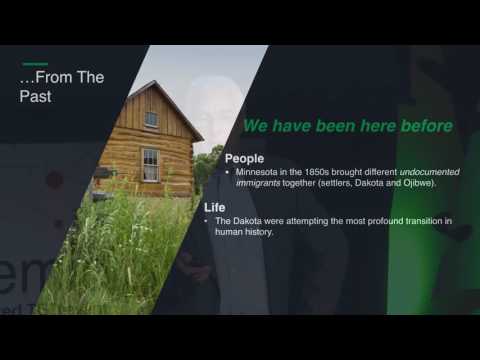
Minnesotans came here and could have
invented diversity with settlers Dakota
and Ojibwe back before the tournament
diversity even existed the Dakota at the
time were attempting the hardest
transition in human history the
transition from hunter-gatherer society
to agriculture before there was ever a
diet book on it and the subprime
mortgage crisis would be no news to 1850
zero Minnesotans who already knew plenty
about failed currencies and bad banks
the catalyst for the transition we can
actually put a finger on the single
event that led to the world we live in
today
the 1862 Dakota uprising was a terrible
and tragic event in our history in 1862
information failed the Dakota were new
to agriculture
they weren’t skilled farmers yet and
they had a failed crop the year before
also in 1862 money failed the Civil War
was a conflict that the Union couldn’t
afford and President Lincoln tried to
paper over the deficits with a paper
currency greenbacks
but that a code didn’t trust and they
wouldn’t accept so in 1862 the previous
poor harvest and late payments led to
starvation and starvation led to war and
that war led us to the world were in
today but maybe in ways you wouldn’t
expect one of the cadavers from the
executions that follow the Dakota
uprising was taken by a local physician
William Morel Mayo who used it to train
his
Suns will and Charlie you may have heard
of the clinic down in Rochester that
will and Charlie Mayo founded similarly
with the skirmishes that followed the
uprising the Dakota were forced West
this open homesteads including the
homestead where William McKnight was
born in 1887 he joined Minnesota mining
and manufacturing in 1907 and in the
60-year career that followed he created
in 3m the innovating marvel that we know
today the troubles of 1862 were a
terrible time but in the crucible of
difficult times good people bond
together and they create a better world
that their children then can bring out
to the world but what about us today our
financial system collapsed in 2008 and
as I speak to you we are 13 years of war
but here these need to be the spark in
us in good people to try to create a
better world that we live in tomorrow we
are fortunate to live in the Giga zone
Paul Bunyan Communications is a
cooperative one of a number of
cooperative that provide technology and
essential services to us every day with
those cooperatives have moved as broadly
and as quickly if they were publicly
traded corporations I don’t know but as
we are entering into an age of
information abundance I’m fortunate we
are fortunate to live in the Giga zone
as we need something different we can
borrow from the past not to relive it
but to use it or something better so we
can find our future in that past and
there’s a lot of good things to find
today’s Paleo diet wouldn’t be any news
to the Dakota who came from hunter
gathering you don’t even have to stop
there market gardens in France in the
mid 18th century kept the world’s third
largest city supplied in fresh produce
and they did it both winter and summer
and they did it before the Green
Revolution with no GMOs no artificial
fertilizers or pesticides
so food is good but again you might be
thinking John where’s the money the
local solution for money is the local
currency
I’ll call Bemidji box with our
University our forests our lakes wealth
comes to Bemidji but if that wealth
shops in a chain store and pays with a
credit card that wealth flows right back
out of a migi local currency can give
purchasers a discount and keep the
wealth that comes to Bemidji in Bemidji
a more general solution for money can be
found next door to us in North Dakota
with the country’s only public state-run
public bank Israel the Bank of North
Dakota runs surpluses and fracking boom
or fracking bust unemployment rates in
North Dakota have been half the national
average for the past ten years so food
is good and we’ve got some work to do on
money but what about medicine I mean
that CDC said it’s the end of
antibiotics period or is it here the
21st century solution to the problem was
found by a Viking studies expert dr.
Christina Lee in the wonderful charming
9th century pages of Bald’s leech book
which reads take crop leek and garlic
and pound it together with Bullock’s
gall and wine and sit it in a brass pot
for nine days I’ll leave out the bubble
bubble toil and trouble but when dr.
fray Harrison tried it they found it to
be every bit as effective as the best of
our modern antibiotics our predecessors
didn’t have our science but they were
empiricists and they were inventors they
were creative if we can discover their
wisdom we can adapt it to our time and
create a better future with it
now at the top of this talk I mentioned
something I called the rule of 50 and
here in flyover country
might seem unbelievable to think that
anything is difficult as the social
challenges of despair and addiction
could be overcome with a single term as
trite as innovation but Enrico Moretti
in his book the new geography of jobs
explains how just such a transition can
be done innovation creates wealth wealth
generation creates opportunities and
creates hope about a year ago ink
magazine named for Bemidji companies –
its ink 5000 list of thriving companies
so great innovators have already come to
Bemidji we’re entering the age of
information abundance and we have
providers as you have heard that provide
that information to us in abundance but
even the best bandwidth won’t help if
you don’t do something with it as we are
Minnesotans I am working on something
I’ll call social media for shy people
the data is the scope of it is local not
global the data is private and
blockchain and a hyper card like
interface makes it possible for regular
people to create interactions and
explore the world around them
entrepreneurship is really important to
us here in Bemidji the launch pad gives
us a place to all get together to move
our dreams forward and we have a strong
entrepreneurial community to help turn
ideas into reality and finally Bemidji
State University Northwest Technical
College and Concordia language villages
all bring innovators and kids in from
around the world the rule of 50 is a
challenge for every community and we
need to plot our path forward our past
isn’t perfect and it’s easy to look at
our predecessors doctors with leeches
with scorn and derision but it’s a
mistake if we do that we are of course
better adapted better evolved to
conditions than they were
but what if the conditions we evolve to
no longer exist in that case in a world
where industrialization replaced many
hands with cheap energy and
globalization replaced onto our hands
with offshore hands in that case the
future then lies in a past that we can
create to fit the conditions we live in
today so what happens when you get to a
cliff do you take a step forward or do
one or duty to return and take one step
forward we can move forward by embracing
the past here in Bemidji
we are local if we can’t get blueberries
flown up from Chile we’ll grow the Mir
ourselves we are community if you are
not in community then 30 below winters
might not appeal to you but when it gets
cold we go ice fishing we are smart our
university colleges and schools are the
center of our community and our goals
are not more but better so let’s make
that turn and take that step the thing I
love most about Bemidji in northern
Minnesota is our community and meals
money and medicine are just a sampling
of the wonderful things in our past that
we can rediscover and bring into our
future
many people vacation in Bemidji we live
here we can move forward by looking to
our past in this way we will thrive
thank you
[Applause]
[Music]
[Music]
I’d like to start with some words from
the late Doug Tompkins what happens when
you get to a cliff and take one step
forward or do 180-degree turn and take
one step forward which way you go on
which one is progress
well surely here in Minnesota in light
country we have no cliffs but we do in
fact I’m an engineer as Brian introduced
me so let’s look at some data according
to the CDC with the advances in
microbial resistance where you are
looking at the end of antibiotics period
and there’s a lead pipe cinch also with
the CDC that maybe we shouldn’t have put
in all that lead pipe in the past
according to the CDC
3,000 areas have more lead in their
water than Flint Michigan does and of
course we moved out here to Bemidji for
climate and we certainly haven’t seen
peak climate if you graph up that what
the data from the National Weather
Service it becomes clear that if you
look out in the mid century even we here
in Burma she might not see temperatures
below zero by mid-century the final
thing is something I’ll call the rule of
50 if you look in the newspaper and you
see an obituary and it’s less than 50
words and the age of the deceased is
less than 50 years then you might be
looking at a victim of suicide
alcoholism or drug overdose you may be
looking at a victim of despair then with
our data I started with antibiotics and
water and antibiotics and water and
weather because these are all things
that I knew as a kid and I thought we
could take for granted forever and if we
can’t take them for granted then we may
be coming to a cliff cliff for all of us
if we’re going to proceed if we’re going
to thrive we need cliff skills let’s get
some
we live in a world with where three
things predominate there are three
things we offer this world energy brains
and money energy and brains of the
fundamental things we contribute to each
other in this world money is merely a
token that we use to keep score and
these currencies have very different
paths ahead we were leaving an age of
cheap abundant energy back at the middle
of the last century
you only had to burn about one barrel of
oil to get a hundred barrels into the
economy of course we went after the best
sources first and we’ve had a great
hundred year run but we’re now coming up
on what Charles Hall called the energy
return on investment threshold that’s
the minimum production efficiency that a
modern society needs to take care of
itself to maintain itself and we’ve
certainly left the seemingly endless
supplies of cheap energy that made many
of our advances possible behind at the
same time we’re entering into an age of
cheap abundant information cheap
abundant brains Ken Jennings defeat on
Jeopardy to IBM’s Watson would have been
almost unthinkable even a generation ago
and some of the older folks among us
here might remember danger Will Robinson
with modern robots and the advances we
make in them every day those robots
don’t need to worry about Will Robinson
anymore they don’t need Will Robinson
and this is all great energy and brains
are good and you might wonder though
what is the money we hire now seven
years into a Fed Funds rate of zero a
magnificent unparalleled age of cheap
available money but no one knows quite
where this train is heading so let’s sum
up with industrialization we replaced we
replaced labor with cheap energy but if
we leave the age of cheap energy it’s
not clear how we’ll move forward
similarly globalization then replaced
onshore labor with cheaper offshore
labor
capital has mobility but labour doesn’t
and so this was actually a great path
forward but here too the low-hanging
fruit has been picked so where do we go
now to see what we’re going in the
future we need to look to the past
in legend John Henry was a steel-driving
man but John Henry lost his battle with
the engine and were head and
subsequently
we have headed to a world where people
no longer provide primary mechanical
energy to business because every John
Henry has lost his battle with the
engine similarly Ken Jennings lost his
battle against IBM’s Watson and we may
be looking at an age where people no
longer provide routine decision-making
to business now the final piece of the
puzzle is actually a legal case about a
hundred years ago in Dodge versus Ford
Motor Company we embraced the goal the
corporate goal of maximizing shareholder
value and as long as maximizing
shareholder value remains the goal then
every John Henry and every Ken Jennings
is going to lose to the income statement
advances that come from a succession of
smarter and cheaper machines so where do
we go now do we take one step forward or
do 180 degree turn and take one step
forward here are some places where we
can make progress in the world ahead
localism beats globalism globalism has
been a 30-year race to the bottom on
wages and it’s not clear how good global
supply chains are going to be in a world
where we leave cheap energy second
friends beat friend requests harsh
winters make good neighbors if you think
you might lose power in the next
blizzard then you really might want to
know already who your friends are
third up smarter beats harder machine
learning will take all of the routine
job
but humans can do things people can do
things that machine’s cannot our
forebears came here before Thinsulate
before gore-tex and they thrived and we
will thrive and finally maybe not more
but better we can thrive with the unique
things we make for each other and
provide to our world so where do we go
now to the future from the past the
amazing thing is that we have been here
before
Minnesotans came here and could have
invented diversity with settlers Dakota
and Ojibwe back before the tournament
diversity even existed the Dakota at the
time were attempting the hardest
transition in human history the
transition from hunter-gatherer society
to agriculture before there was ever a
diet book on it and the subprime
mortgage crisis would be no news to 1850
zero Minnesotans who already knew plenty
about failed currencies and bad banks
the catalyst for the transition we can
actually put a finger on the single
event that led to the world we live in
today
the 1862 Dakota uprising was a terrible
and tragic event in our history in 1862
information failed the Dakota were new
to agriculture
they weren’t skilled farmers yet and
they had a failed crop the year before
also in 1862 money failed the Civil War
was a conflict that the Union couldn’t
afford and President Lincoln tried to
paper over the deficits with a paper
currency greenbacks
but that a code didn’t trust and they
wouldn’t accept so in 1862 the previous
poor harvest and late payments led to
starvation and starvation led to war and
that war led us to the world were in
today but maybe in ways you wouldn’t
expect one of the cadavers from the
executions that follow the Dakota
uprising was taken by a local physician
William Morel Mayo who used it to train
his
Suns will and Charlie you may have heard
of the clinic down in Rochester that
will and Charlie Mayo founded similarly
with the skirmishes that followed the
uprising the Dakota were forced West
this open homesteads including the
homestead where William McKnight was
born in 1887 he joined Minnesota mining
and manufacturing in 1907 and in the
60-year career that followed he created
in 3m the innovating marvel that we know
today the troubles of 1862 were a
terrible time but in the crucible of
difficult times good people bond
together and they create a better world
that their children then can bring out
to the world but what about us today our
financial system collapsed in 2008 and
as I speak to you we are 13 years of war
but here these need to be the spark in
us in good people to try to create a
better world that we live in tomorrow we
are fortunate to live in the Giga zone
Paul Bunyan Communications is a
cooperative one of a number of
cooperative that provide technology and
essential services to us every day with
those cooperatives have moved as broadly
and as quickly if they were publicly
traded corporations I don’t know but as
we are entering into an age of
information abundance I’m fortunate we
are fortunate to live in the Giga zone
as we need something different we can
borrow from the past not to relive it
but to use it or something better so we
can find our future in that past and
there’s a lot of good things to find
today’s Paleo diet wouldn’t be any news
to the Dakota who came from hunter
gathering you don’t even have to stop
there market gardens in France in the
mid 18th century kept the world’s third
largest city supplied in fresh produce
and they did it both winter and summer
and they did it before the Green
Revolution with no GMOs no artificial
fertilizers or pesticides
so food is good but again you might be
thinking John where’s the money the
local solution for money is the local
currency
I’ll call Bemidji box with our
University our forests our lakes wealth
comes to Bemidji but if that wealth
shops in a chain store and pays with a
credit card that wealth flows right back
out of a migi local currency can give
purchasers a discount and keep the
wealth that comes to Bemidji in Bemidji
a more general solution for money can be
found next door to us in North Dakota
with the country’s only public state-run
public bank Israel the Bank of North
Dakota runs surpluses and fracking boom
or fracking bust unemployment rates in
North Dakota have been half the national
average for the past ten years so food
is good and we’ve got some work to do on
money but what about medicine I mean
that CDC said it’s the end of
antibiotics period or is it here the
21st century solution to the problem was
found by a Viking studies expert dr.
Christina Lee in the wonderful charming
9th century pages of Bald’s leech book
which reads take crop leek and garlic
and pound it together with Bullock’s
gall and wine and sit it in a brass pot
for nine days I’ll leave out the bubble
bubble toil and trouble but when dr.
fray Harrison tried it they found it to
be every bit as effective as the best of
our modern antibiotics our predecessors
didn’t have our science but they were
empiricists and they were inventors they
were creative if we can discover their
wisdom we can adapt it to our time and
create a better future with it
now at the top of this talk I mentioned
something I called the rule of 50 and
here in flyover country
might seem unbelievable to think that
anything is difficult as the social
challenges of despair and addiction
could be overcome with a single term as
trite as innovation but Enrico Moretti
in his book the new geography of jobs
explains how just such a transition can
be done innovation creates wealth wealth
generation creates opportunities and
creates hope about a year ago ink
magazine named for Bemidji companies –
its ink 5000 list of thriving companies
so great innovators have already come to
Bemidji we’re entering the age of
information abundance and we have
providers as you have heard that provide
that information to us in abundance but
even the best bandwidth won’t help if
you don’t do something with it as we are
Minnesotans I am working on something
I’ll call social media for shy people
the data is the scope of it is local not
global the data is private and
blockchain and a hyper card like
interface makes it possible for regular
people to create interactions and
explore the world around them
entrepreneurship is really important to
us here in Bemidji the launch pad gives
us a place to all get together to move
our dreams forward and we have a strong
entrepreneurial community to help turn
ideas into reality and finally Bemidji
State University Northwest Technical
College and Concordia language villages
all bring innovators and kids in from
around the world the rule of 50 is a
challenge for every community and we
need to plot our path forward our past
isn’t perfect and it’s easy to look at
our predecessors doctors with leeches
with scorn and derision but it’s a
mistake if we do that we are of course
better adapted better evolved to
conditions than they were
but what if the conditions we evolve to
no longer exist in that case in a world
where industrialization replaced many
hands with cheap energy and
globalization replaced onto our hands
with offshore hands in that case the
future then lies in a past that we can
create to fit the conditions we live in
today so what happens when you get to a
cliff do you take a step forward or do
one or duty to return and take one step
forward we can move forward by embracing
the past here in Bemidji
we are local if we can’t get blueberries
flown up from Chile we’ll grow the Mir
ourselves we are community if you are
not in community then 30 below winters
might not appeal to you but when it gets
cold we go ice fishing we are smart our
university colleges and schools are the
center of our community and our goals
are not more but better so let’s make
that turn and take that step the thing I
love most about Bemidji in northern
Minnesota is our community and meals
money and medicine are just a sampling
of the wonderful things in our past that
we can rediscover and bring into our
future
many people vacation in Bemidji we live
here we can move forward by looking to
our past in this way we will thrive
thank you
[Applause]
[Music]
Please follow and like us: