
delicious foods that feed us these
incredible creatures feed our world by
pollinating most flowering plants these
plants in turn are feeding insects birds
mammals countless other creatures rather
than thinking of bees as flying stinging
machines we need to move away from that
and appreciate the huge contribution
they make not only to the food on our
plates but to our entire world bees help
us and most everything else to have food
on our tables in a lot of places in the
world today we are leaving bees a plate
with less a table with less and less
food we can keep bees fed and keep
countless other animals fed and keep
food on our tables by putting food back
on the table for bees colleagues and I
have been studying bees in North Dakota
in the northern Great Plains to figure
out how they’re doing in farm lands and
how to support them we were interested
in what’s happening in North Dakota
because North Dakota traditionally has
been a great place for bees it’s one of
the top
honey producing states in the entire US
one out of every four honeybee colonies
in the entire country is brought to
North Dakota in the summertime this is
over six hundred thousand colonies and
each of these colonies has tens of
thousands of bees honeybees are brought
by beekeepers
to North Dakota not only to produce
honey but also so their colonies can
grow strong because these colonies are
then brought by beekeepers across the
rest of the country to pollinate crops
that help put for
une on our tables North Dakota has also
been a great place for other bees the
honeybee but while well known by many is
just one of twenty thousand different
kinds of bees in the world and North
Dakota has been home to over 300
different kinds of bees these bees
aren’t managed by people they’re what
they’re living in the wild they are also
very important pollinators of crops and
wild flowers all of these bees honeybees
and wild bees need food to eat and all
bees get their food from flowers wild
bees also need a place to live they all
make nests some in the ground summer in
plant stems a lot of them are needing
areas that are safe from disturbances
like mowing or tilling a lot has changed
in the landscape in North Dakota over
the last 200 years before European
settlers were here was mostly Prairie
which was dominated by native grasses
and flowers the indigenous people here
did practice agriculture but it’s on a
fairly small scale there was still many
flowers and many places for bees to make
nests basically most of North Dakota was
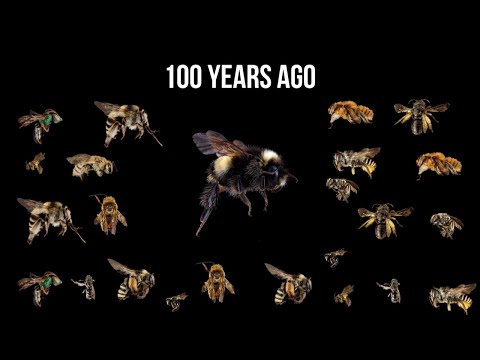
great bee habitat 100 years ago European
settlers had already converted most of
that Prairie into farmland 63% of North
Dakota was already farmland a hundred
years ago a diverse range of crops was
grown in these farmlands many of which
were providing food for bees there were
few pesticides being used on these crops
things were basically still pretty good
for bees the European settlers also
brought honeybees with them before this
time there were not any honeybees here
honeybees are not native to North
America the beekeepers a hundred years
ago were focused most
on honey production they weren’t
bringing their colonies all across the
country for pollination they had smaller
local operations we know something about
the wild bees that were here a hundred
years ago thanks to the work of oay
Stevens Oh a Stevens was a botanist and
a bee researcher that was based at North
Dakota State University and he found
many different species of bees in North
Dakota an important thing about the
collections that he found here for bees
is that there were even numbers between
the different species of bees there was
no one kind of bee that was dominating
the community you may have heard
biologists talking about the importance
of biodiversity when we’re talking about
diversity we’re talking about that
evenness among the species that
indicates a stable community so these
diverse communities are telling us that
it’s a healthier community one common
bee a hundred years ago was the yellow
banded bumble bee this bumble bee and
other species of bumble bees are
becoming a cause for concern as
populations have dropped over recent
decades bee collections like that of Oh
a Stevens are our only window to the
past to know what things were like for
bees his collection is currently housed
at the American Museum of Natural
History in New York City it’s thanks to
the important work that this museum has
done and also the scientists there that
have ensured that these specimens are
properly identified in database that
give us this information this window to
the Past to even know what things were
like then so we can see how things have
changed
we know that the farmland has changed a
lot over the last 100 years in North
Dakota for one thing there is a lot more
of it over ninety percent of the land in
North Dakota is now farm Lee
and be food is becoming more scarce and
pesticide use is becoming more frequent
driven by price increases due to their
uses biofuels there’s been a dramatic
increase in the amount of corn and soy
that are being grown in the state this
boat neither sow nor corn provide bees
with much food things are getting harder
for bees we can see this clearly in
what’s happening with honey bees honey
bees are having increased health
problems we know that these problems are
due to a combination of different
factors there’s interactions between
pathogens parasites pesticides and poor
nutrition it’s harder for beekeepers to
keep honey bee colonies alive from one
year to the next honey bees are
different than other bees in that
they’re managed that kind of like
livestock
so although we are losing honeybee
colonies beekeepers can breed them and
create more colonies to replace them you
don’t need to worry about the honey bee
going extinct but these current losses
are not economically sustainable for the
beekeepers we need these beekeepers to
be able to stay in business and have
enough colonies to bring around to
pollinate the crops that we need things
are getting hard for wild bees too we
know they’re affected by some of the
same factors as the honeybees but for
most places we don’t really know what’s
going on with all these wild bees this
is one of the reasons why I came to
North Dakota because this was one of the
places where we we knew we had
information from a hundred years ago but
we didn’t know it was happening there
now when I first came to North Dakota to
start looking for bees and I saw not
many flowers not many places to nest I
thought that it didn’t really look like
it would be a great place for bees
I was surprised to find that there are
still many wild bees that are using
these farmlands a key difference between
what I saw now and what Oh a Stephen saw
a hundred years ago is that the
community of bees is less diverse
although I found many different species
there were a few species that were
dominating the community these species
are doing pretty well with scraps of
habitat that are left other species are
not finding what they need like the
yellow banded bumblebee a hundred years
ago in the collections of Oh a Stevens
this bee was one out of every 25 bees
that he captured during my recent
surveys one out of every two thousand
bees was a yellow banded bumblebee
unlike honeybees when wild bees decline
conservationist Aldo Leopold pointed out
one of the many important reasons to
preserve biodiversity to keep every cog
and wheel is the first precaution of
intelligent tinkering we need to
preserve these species while they’re
still here
and the good news is that a lot of these
species are still there but we do need
to act quickly as their numbers are
drastically lower than what they used to
be we do have options things we can do
to help keep bees alive and healthy and
this is where we get to also beautify
the world around us planting flowers is
one of the best things we can do and we
need to keep these flowers free of
pesticides this will help not only bees
but it will also help butterflies frogs
birds it will help improve our soil
water quality we can do this we could
all go home and do this in our gardens
we can do this at schools we can do this
at our businesses and this helps but if
we only do this we’re going to end up
with most of these flowers where most
people live and looking at population
density in the u.s. you can see that
there’s broad areas of the country where
there’s not so many people to make a
bigger impact we need to also be
thinking about putting these flowers
where bees need them that we’re in our
farmlands across the country these bees
are looking at less and less available
foods I’m a bee scientist and in case
you haven’t been able to tell I’m very
passionate about what I do
talking with farmers I know that they’re
very passionate about what they do and
they know the value of sustainability
they also need to make decisions that
are based on economics they already have
so much risk in their businesses we
can’t ask them to add more risk to their
business plans avoiding risk from pest
damage is one of the reasons why
pesticide use has become so much more
common farmers need tools to reduce
pesticide use and we do have these that
that we can share more there are pest
monitoring tools they can have more
sustainable choices from agricultural
companies and importantly have more
connections to scientifically based
management decisions the best solutions
for helping bees and our farm lands are
going to be to find ways that we can
support both the farmers and the bees my
colleagues and I found some things that
were in the landscapes in North Dakota
that are already support
B’s and these are things that are
already there in the farmland there are
some crops that can feed bees some of
the common ones are canola sunflower and
alfalfa there’s also new research that’s
looking at biofuel crops that can also
provide forage for bees possibly
providing alternatives to soy in corn
there are set-aside programs like the
Conservation Reserve Program these
programs economically compensate farmers
for setting aside habitat for wildlife
and some of these programs are focused
specifically on setting this habitat
trees can make a big difference they’re
not all that common in North Dakota
having rows of fields but rows of trees
between the fields can help provide
nesting for wild bees if these are
planted with trees and shrubs that also
flower they can also provide food for
all bees enhancements like these that
I’ve been mentioning can be supported by
both state and federal programs and
they’re shaped by local and federal
legislation one of the biggest players
in this is the federal farm bill so it
is important for you to plant flowers
wherever you can but let’s make sure
that this food for bees is getting to
where it’s needed which is where bees
are which should be just about
everywhere make sure that our farm bill
has measures that help farmers support
bees work with local and regional
growers create solutions for pollinators
where pollinators live keep food on the
world’s table by making sure we keep
food on the table for bees thank you
[Applause] [Music]