
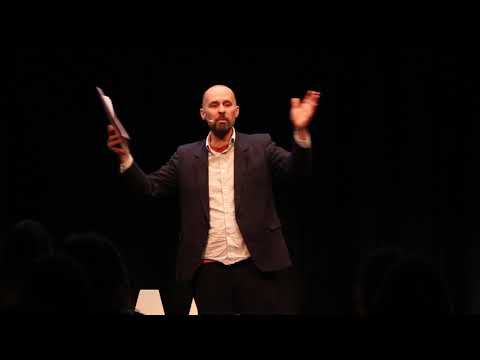
this talk is about creativity there is a
TED talk by Ken Robinson it’s called do
schools kill creativity over the last
five years I think I’ve probably watched
it about 20 times I think it’s actually
the most watched TED talk of all time
and in it Ken Robinson identifies that
creativity should be as important as
literacy in our schools he also argues
that creativity is our best hope to meet
a future which we cannot foresee when I
was asked to do this TED talk I couldn’t
think of anything better to say than
what Ken said I do think that Ken
Robinson would make a great prime
minister I would actually like to
publicly declare my love for Ken
Robinson um the best bit of advice you
might get from my talk if you haven’t
watched his talk is to watch his talk do
you know that when you get asked to do a
TED talk you get sent 11 of the best TED
Talks to watch
I think someone at Ted HQ must have
thought you know it’s a really good way
to settle the nerves of future speakers
somebody could have thought let’s send
them you know 11 of the biggest blunders
in Ted history because that might kind
of relax them or give them a bit of
confidence but no you basically get sent
a set of rules about how to make your
talk completely perfect by the time I’d
watched 11 incredible TED Talks I just
thought I don’t have anything to say and
why on earth did I agree to do this
anyway but the other thing it made me
realize is that actually I’ve never
actually watched a TED talk from start
to finish a part from Ken Robinson’s one
it’s not because the speakers aren’t
incredible or the ideas aren’t amazing
but I just sometimes find myself getting
a bit overwhelmed by the sheer wealth of
good ideas at latest count I think there
are 93 thousand TED talks and TEDx talks
online
that’s ninety-three thousand good ideas
worth spreading to make the world a
better place is anybody else wondering
why the world isn’t a better place why
more of the world’s problems haven’t
been fixed or solved or things haven’t
changed more even when I think about
King Ken and his awesome talk I look at
the education system in the UK and see
it going in exactly the opposite
direction to what Ken suggests with
creativity becoming less valued by our
school system rather than more why when
there is such a beautifully expressed
incredible argument there that’s been
watched nearly 50 million times why does
our school system and those who design
it not seem to be changing I think part
of the issue is that giving talks
including Ted is part of what I would
describe as a wider watching and
listening culture I imagine that Ted
utopia is a place where good ideas get
spread to everyone but how many of these
good ideas actually get implemented by
those of us who listen to them how many
of us actually change the way we think
or more importantly how we act because
of what we hear or read I think there’s
an unquestioned principle in our society
that people learn most by listening and
reading but do we this assumption means
that our society systematically
privileges listening and reading as our
preferred approach to learning our
education system is largely based on
this approach with children
predominantly expected to sit and listen
our companies actually also operate on
this approach with most work carried out
by some form of instruction and our
governments also work like this with
public policy developed through the
analysis of data and reports but the
strange thing is is that I think most of
us as individual human beings do not
change to the point where we take action
unless
we undergo an experience try asking your
friends when their lives have been
changed I think it’s less common for
people to tell you about a talk that
they’ve listened to or a book that
they’ve read than an experience they’ve
had my meeting somebody by going
somewhere by trying something new why is
this I think it’s because when we
practically try something we take more
of a personal risk that when we listen
or read when we experience something we
do not just sort of intellectually
involve ourselves but we emotionally
physically and socially involve
ourselves and in this more visceral
state we are more likely to open
ourselves up to the possibility of
change we’re more likely to carry that
experience Falls to learn through doing
but somehow the systems we’ve developed
in our schools our organizations and our
governments privileged listening and
reading above a culture of learning
through doing but could a culture of
learning through doing be any better I
think it’s interesting to look at times
when a family or a community or a
country go through some kind of crisis
because it’s often in these moments that
people are extraordinary my guess is
that this is not just because people
have a primal instinct to want to put
things right in a crisis it’s also
because difficult situations compel us
to take action to do and the result is
is that we take more risks and we do all
kinds of things practically that we
probably would not have attempted had it
not been for the crisis you can see this
kind of doing and risk-taking happening
on a massive scale during and after
World War two for example because of the
challenges during the conflict the
emergency medical service was
established and run by government to
help provide free medical care to people
in bomb blasted communities this helped
people including government ministers
experience the benefits of this health
care system for all and after the wall
free health care for
all was established as the norm the NHS
and because people believed it was a
good thing because they’d experienced it
and as a result a new idea was not just
created but delivered on a massive scale
a health system which has since been
envied around the world can you imagine
such an extraordinary idea that changes
the lives of millions of people that
changes the fabric of our country being
developed and delivered through our
current systems which are not about
learning through doing I’m not
suggesting that we have to experience
some kind of trauma in order to get
stuff done simply that we practically
test more ideas and I’m also not saying
anything that anybody in this room
doesn’t already know because when we
were small like about this big we all
knew this because this is how we live
most of the useful things we learnt when
we were a toddler that we do today is
speaking moving or walking eating being
able to represent something through
scribbling and so on and so on we learnt
through doing we didn’t read a book
about reading and as a consequence learn
how to read at the heart of our learning
experience as a toddler was doing things
instinctively and often failing to
achieve the thing we were trying to do
but through learning by trying stuff we
would continue to refine the way we did
something I believe we display a very
pure form of human creativity when we
are that young we’re prepared to try
anything in order to explore and learn
new stuff but as we get older more of
our adult systems kick into action which
tends to make us fearful of making
mistakes this suppresses our creative
instincts even the idea of our own
creativity becomes confused to the point
where I think people tend to think about
creativity as a skill that you learn
like painting or singing for me
creativity just means that you’re
prepared to take a risk to try and make
something and do something when you’re
not quite sure what will happen next and
our creativity is
it’s on tap like the right to life and
the right to be free we all have the
right to be creative but instead of
Exeter’s exercising and enjoying our
creativity we’ve learned to sit in
auditoriums like this instead of TED
Talks perhaps we should have TED actions
in which we come together to test our
ideas in which we all get to do stuff to
learn through doing so the idea I want
to share with you today is not an idea
it’s just a practical suggestion and a
process we should all spend less time
listening to so many of other people’s
ideas and spend more time trying and
doing stuff rather than think through
passively listening let’s think through
a creative process of doing so how do we
take a more practical approach without
any crisis or trauma forcing us to our
listening and watching culture has
become so ingrained that sometimes we
just need a bit of help to actually just
do stuff I’ll share with you a process I
have used in my work as a producer to
support other people’s ideas to develop
and it can apply in lots of different
context it’s called scratch it’s simply
a creative process to develop and
deliver ideas and this is how it works
firstly someone has an idea say it’s you
you start by defining your idea it could
be a massive idea or it could be just
quite a small modest idea and then you
plan
you practically plan how to test your
idea and as part of this stage you would
assess the risks of carrying out your
idea and the resources you will need
making sure that you save some of those
resources for your second annual third
and your fourth test and then you would
carry out a test of your idea you would
personally take a creative risk by doing
a version of your idea live before you
really know what it is and other people
would get to experience it then you
would gather feedback to find out how
people react to your idea what did they
experience
and then you analyze what their feedback
means you decipher it and what that
means for the future of your idea and
then ideally you would take time to go
away and do something else for a bit so
that you can come back to your idea with
a little bit more perspective and then
you revisit your idea and you further
develop it and plan a new test and so on
iteratively developing a practical idea
it’s not the creative process it’s just
a creative process and before you think
I’ve got this is scratch is some new
jargon or idea arrived got to get my
head round remember this is not
something new to you remember that you
use this approach or a simplified
version of this approach literally
millions of times in the first few years
of your life as a toddler as you learn
stuff as you changed because of the
responses you got from people and
through your willingness to take
creative risks in your early years you
probably learnt more stuff and changed
more quickly than you have for the rest
of your life put together with each loop
you develop a new iteration of what you
are creating be prepared just one health
warning receiving feedback is almost
always frustrating on some level
feedback rarely says wow what an amazing
idea that’s so clever gosh you’re so
smart
instead feedback is usually really
annoying on some level because other
people see things that you can’t or they
just seem to be looking at something
else entirely
but either way their feedback provides
you with more information to help you
reflect on your idea it’s likely to
disrupt your thinking but that’s the
point
it helps you see your idea through
somebody else’s eyes it helps you see it
through them lots of people fell into
the development of this talk and I would
like to thank them for their feedback
even though it was quite annoying so
when I was growing up I consistently
felt inadequate in a system which graded
intelligence like a product I felt I had
a missing chip like millions of other
children around the country I struggled
to absorb large quantities of
information and regurgitate it to order
the system didn’t only
you feel insufficient it meant I felt
bored and despite a current generation
of wonderful teachers the current system
is doing the same to hundreds of
thousands of young people every year but
imagine if our schools adopted creative
learning principles that looks something
more like this learning could be a
practical adventure rather than force
children into subject specific
disciplines a practical approach could
help young people to develop more ways
to think not just analytically but
laterally and divergently not just
critically but entrepreneurial II and
strategically every day could be about
doing and learning rather than thinking
about how not to be wrong and every day
could increase our sense of our
involvement as young people our purpose
and our agency what if we went the whole
hog and used a creative process like
this in the way that art government
operates how would that look rather than
a group of policy researchers evaluating
data in order to change the lives of
people they have never met and probably
never will every day could be about
practically testing policy ideas by
working with members of the public to
feedback and to help shape those policy
ideas and at a time when divisions
between different communities ideologies
and approaches threatened to dangerously
divide us I would argue that more than
ever we need to creatively and
practically work together to understand
each other and to invent our future
together rather than one group of people
present another group of people with
solutions because it is through the very
process of doing the creative process of
making it up as we go along from which
we have so much to gain individually and
collectively
of course there’s huge value in
listening and reading and watching but
we must seek to balance this with doing
and testing and creatively learning so
my simple practical suggestion is to
watch less and do more
and as we finish this TED talk let’s
turn it into a TED action I’m gonna ask
you you’ve already met each other but to
turn to the person next to you and share
with them an idea an idea that you would
like to test whether it’s in your work
life your family life your home life and
just do that for 30 seconds and then the
other person can share their thought and
their idea that they would like to test
you have one minute and it starts now
okay ladies and gents thank you very
much thank you for taking part in that
experiment I encourage you to pursue
those ideas and maybe if you if you’ve
just heard somebody’s a good idea and
that’s really excited you then maybe get
their number in the break and phone them
up in three weeks time and check they’ve
done it thanks very much
[Applause]
Please follow and like us: