
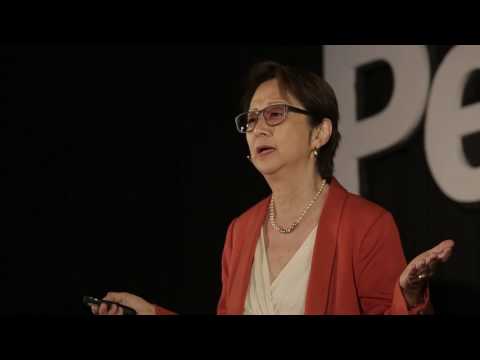
well good morning everybody back in 2010
I visited Burundi a war-torn country in
East Africa and at that point the rebels
had just signed a peace agreement with
the government and I was there to talk
to these young people some of them
believe it or not as young as 16 and
they were the foot soldiers they were
the rebels they were the combatants in
the civil war that went on for many many
years after the women who signed they
agreed to lay down their arms and Here I
am talking to them trying to convince
them to join the program that the United
Nations and the government had had run
to try to reintegrate them back into a
society right because obviously you know
you cannot have a situation with young
men walking around with guns a k47 some
of them and expect the peace to be
sustainable obviously so in fact you
know this picture may sound strange but
this is a very common picture in my work
the first thing we do when we come to a
country that has come out of civil war
is to do this program that we call DDR
meaning that we demobilize disarm and
try to reintegrate these combatants
right very important because we if you
don’t achieve that you’ll never have a
sustainable peace because it will just
relax back into war as you can imagine
right there four countries no jobs no no
future so this is a very common sight so
you may actually ask me what is this how
is this relevant to you here we are
sitting in comfortable peaceful Penang
you know how is this relevant to you so
I hope that by at the end of my talk I
will be able to convince you that that
this this phenomenon of failed States
concerns us all including
you so what are these failed States fail
States just think think Somalia Syria
Yemen right those are fast becoming
failed States the last two these are
countries where the government has lost
control very limited role over vast
amounts of the country where security
cannot be guaranteed for anyone right
there’s no security the economy is in
shambles so we’re talking about broken
countries these are broken countries not
functioning but I’d like to make a
distinction between what in my field
recall failed States versus fragile
states the fragile states are the ones
that some 30 or 40 around the world you
know who are trying who are in and out
of war for decades but they’re trying to
recover but they’re still fragile and
that’s why they called fragile States
because any little thing can push them
over the abyss again and these are
called fragile states but not as bad as
the failed States that I described
earlier but the main point here is that
these states provide perfect havens
havens for terrorists and drug lords
right if you were a terrorist the
perfect environment for you to function
in is a failed state it’s no government
no security you can do as you wish right
and that’s why this is so important
today for all of us to try to understand
this phenomenon of failed state and what
the consequences are globalization you
know we all know about globalization in
trade in goods and money unfortunately
today globalization affects terrorism as
well terrorists are globalizing and so
are drug lords
so I’d like to talk to you about the
characteristics of a failed state very
briefly obviously is a long complicated
issue but number one all these countries
without exception of poor countries
there are the bottom the bottom of this
no matter what rankings you’re looking
at and usually what happens is there’s
an internal or an external shop that
pushes them into civil war right so
internal shop can be for instance the
Arab Spring the Arab Spring brought
about what none of us expected chaos and
war in so many of these places as well
as external shops commodity prices of
their main products plummeting suddenly
there’s no more economy and before you
know it civil war strikes and I’m not
saying civil war is there but for
instance one country to look at to look
out for is Venezuela today which is
really suffering as a result of an
external shock and then you have you
also have poor governance unfortunately
all these countries not only poor but
the gap they are unfortunate enough to
have governments that do not govern that
do not understand what governing is
about so as you can imagine government
neglects as citizens you know doesn’t
bring about development doesn’t bring
basic services like education and health
and certainly doesn’t provide security
the police are corrupt ineffective in
these countries usually and so it’s
justice there’s no justice to talk off
justice is for the elites not for the
mass masses of people so this is one of
the characteristics I don’t I think you
can see this picture this I don’t know
if you know this lady she is the first
African woman president
her name is presence Ellen Sirleaf
Johnson of Liberia in West Africa she
inherited the country unfortunately so
typical of many of these countries where
everything happens only in the capital
city once you leave the capital city
there’s nothing to think of there’s no
police hardly any police no development
you know schools are left to their own
and in fact people outside outside these
capital cities where the elites live
they’re very resentful of government so
in fact when government shows up people
get very angry and usually you know
conflicts may break out so she inherited
this kind of a country and here we were
talking about what the United Nations
could do to help her in her efforts to
decentralize and in this particular case
decentralize justice rule of law how we
can start bringing about courts
functioning courts in this area to try
so many cases that are that have been
sort of sitting this is a totally
different country altogether this is
Guatemala a country in Latin America in
Central America
this is a country you know if I can
describe it very briefly with a very
small European elite very small European
elite and a vast a massive majority of
very poor indigenous people you know
mainly indigenous people they’re rebel
groups as a result you know many
revolutions here and there there’s
organized crime here and there that’s
impunity so people get away with murder
literally so you can imagine all these
are ingredients for a civil war to rage
on and on and on for decades that’s what
makes these civil wars go on for so long
and here we were discussing I was
discussing with the president and the
cabinet what we can do to again to
strengthen rule of law and to bring
about you know at least a semblance of
justice now obviously we don’t just talk
to the highest levels of government we
also talk to various levels of gamma in
this picture I’m sitting here with
community leaders in the rural area of
Afghanistan to talk about the plight of
the internally displaced people of which
there are many in Afghanistan as you can
imagine this this is to make the point
that you know we we must have
discussions we must consult all kinds of
stakeholders not just the highest levels
of government
civil society local leaders local
community leaders you know this is what
constitutes what we call stakeholders
unfortunately a lot of international
community and international aid you know
the thing dealing with the government is
sufficient but they do that to their
peril because any development program
and certainly any program to bring about
peace that doesn’t involve a local
population the civil society and local
leaders is going to fail that I can tell
you with my experience is going to fail
so very important to touch base with
them so I’ve told you about poverty I’ve
told you about ferg of the poor
governance and a very important third
element third characteristic of these
countries as a large population of idle
fully educated youth you know
unfortunately in these conflict prone
countries the young population makes up
a majority 70% in most cases are people
under 25 but unfortunately there’s
little education so they’re poorly
educated or in the case of Liberia
because of the years of civil war no
education at all not missed out for
decades so no education despair no hope
for the future sitting around idle what
do you expect what do you expect with
poor governance they see it happening
all that corruption all those elites
driving around in big cars what do you
expect then obviously they become easy
recruits anyone wanting to start an
insurgency where there’s a revolution
against some group whether it’s against
ethnic group whether it’s just to steal
from their gold mines or the diamond
mines it’s actually very easy to recruit
your foot soldiers your your malicious
in these kinds of settings so so that’s
what happens and you saw that in the
first picture all these young young boys
were actually recruited number two in
this day and age I’m afraid to say when
you have this kind of situation is ripe
ripe for radicalized radicalization we
have seen it time and again in so many
countries not just the Middle East
elsewhere as well radicalization and
today this is more more
important and more dangerous than ever
to have this kind of situation and then
and then we have a third consequence of
idle young people brain drain right and
how can the country ever develop when
you’re young people especially the ones
with some education run away how can you
possibly have development and that’s
what we see you see that’s what you see
in evening news everyday people in
desperation leaving in this the rubber
dinghies across the Mediterranean at the
rest of their lives by the way for your
information do you know how much a
ticket you know to get a seat on this
rubber boat across the Mediterranean is
two thousand US dollars two thousand US
dollars so we’re not talking about the
poorest of the poor we’re talking about
people with some means usually with some
education and in fact a lot of them you
know are business people some are even
professionals fleeing the country how
can a country ever develop when you have
that situation okay
this picture to show you it need not
always end in despair I need not this is
a country in another country in West
Africa Guinea Guinea is potentially a
very rich country but yet it’s been
wrecked by by civil war by conflicts for
many many years but here the United
Nations started a program for the youth
with UNICEF I’m sure you know about
UNICEF and this is you know these people
these young people you see smiling some
of them were actually involved in some
kind of insurgency movement not all but
some of them were and this program was
to train them in acrobatics in
entertainment so that they can eke out
some living for themselves you know some
of them work in the tourism industry of
you know move to neighboring countries
where tourism is more robust and they
able to find jobs but but they have a
sense in life and that’s right they’re
smiling you know and they’re not smiling
for the camera they have a sense in life
they feel that they’re appreciated and
and that’s what’s you know peace
building is all about so lastly another
characteristic of these conflict prone
countries these failed States
ethnic problems ethnic divides you know
that’s I was so happy to hear early on
this this issue was is being tackled we
have grievances suspicion lack of trust
between 1/8 Nick group and another
between one religious group and another
even in geographical regions
you know they distrust each other you
can not build a nation that way you know
there’s no national identity which is so
important if you want to stop conflicts
national identity is very important so
unfortunately in these conflict prone
states most of them suffer from this
this this situation of of grievances
against each other a sense of exclusion
and the some despair this is a picture
of me with the leader of Myanmar Anson
su Chi those of you who have been to
that beautiful country you’ve been to
Rangoon you know you see what’s what’s
the problem around goodness a normal
capital city well once you leave
jung-geun and you go to the outer
provinces especially to the provinces on
the east Shan province touching province
I don’t know if you know this but civil
war has been raging there for decades in
these provinces and these are definitely
ethnic groups these are tribal groups
that the the central government doesn’t
even know about doesn’t care about
neglects them completely and in fact
when they show up in these regions is
only to harass them or to steal their
minerals you know so people see
government officials military people
arriving with great suspicion and that
usually sparks a conflict so in fact the
conflict is between you know the tribal
groups and the military and in this in
this in this in this regions and here we
were discussing how we can bring about
some development to this region you know
some infrastructure development so that
these people understand that peace peace
time can bring some good things you know
a peace courts have been signed with
many of these groups at that time so you
know what saves countries you know is
that always hopeless you know is always
descending to hell a situation no not
necessarily you know if you know if
you’re serious about one thing
especially there many other factors but
one especially in
securin building if you work with a good
international partner if the UN is able
to play its role well and we can build
institutions right we start the building
blocks for foreign nation start building
institutions whatever the institution’s
may be but a lot of times we start with
security security a rule of law the most
important if your police are not
effective they have they’re corrupt
if they cannot control situations of
conflict then it’s going to escalate and
you before you know it it’s a civil war
so building the security institutions
the rules the courts of law you know the
justice rule of law is very important
and we find a lot of times that once we
get that right then of course then you
continue with education with agriculture
etc so many other institutions that you
have to build but that’s a key though is
to be able to stop the conflict before
it escalates because believe you me the
problem with these countries is they
they sign piece of quartz and within the
year before the euros out its back to
war it’s back to conflict so these
characteristics I’ve described that
they’re not so they’re not so surprising
right at the pretty common sense what do
you expect you know if you’re gonna have
idle young men around with no education
with guns you can have war you could
have war and and what kills me is that
when I go to this country’s I I just
can’t understand how the leaders leaders
of these countries don’t see that you
know they only see patting their own
pockets they don’t see that they have to
invest in this youth for the future so
so I think it’s not it’s not so so
mysterious what goes on in these
countries but the fact of the matter and
that’s the point I want to make to you
today it’s that the world is a more
dangerous place today
surely you must admit then a decade or
so ago is a more dangerous place a day
for reasons that you know and when you
have these failed States they provide
breathing ground
they provide havens for terrorism they
provide havens for terrorism and for
drug lords so we must be extra extra
you know we cannot be complacent or
dismissive we cannot say this doesn’t
affect us because we’re in tranquil
little Penang no with globalization of
everything including terrorism is gonna
affect us all one way or another one day
so it’s really incumbent upon all of you
you know you bright young educated
people you know to heed this and to pay
attention to have some interest and
maybe some of you may actually enter
careers that might actually help in this
area help mitigate these problems so
with that thank you so much for
listening I hope I’ve convinced you
thank you very much
[Applause]
[Music]
Please follow and like us: