
you
[Music]
I very sincerely believe that we all who
are gathered here who are living in this
era are extremely blessed we are very
fortunate why because we are not only
witnessing we are also part of a great
technological revolution that is taking
over the world say technology keeps on
changing we all know that every day
changes and it sort of keeps on evolving
from one thing to another thing things
keep getting better but only very rarely
we see technology taking a frog leap
that changes the way it has been
happening over the past multiple decades
I mean for example that went of the PC
which brought the computing power from
the mainframes of the world from the
data center on to the common man’s desk
the advent of the mobile phone which
changed the way tech communication had
been happening for the multiple
centuries I would say and the advent of
the Internet these are will change the
way we live we have been living and one
such extremely fascinating and wonderful
technological change that we are
witnessing today and we are getting part
of it is the change that we are
witnessing in artificial intelligence so
what all things artificial regions can
do today I mean it can play go I mean
which is a very big I mean very
complicated Chinese game much more
complex than chess and it’s started
meeting human beings and now let’s let
like it easily beats human beings it can
learn to paint say for example if I take
a picture of this gathering here and I I
have a picture of say
Ravi Varma which are da Vinci and I want
this this photograph to be painted in
the style of that particular artist a
machine can do that the next one is
fascinating it can compose music it can
learn to work it can learn motor skills
it can write captions it can translate
it can identify objects it can identify
if if somebody becomes naughty and fave
and and
my my picturing in internet somewhere it
can give me a trigger it can do face
recognition and it can drive cars all
right so I mean all this we have never
heard about it the past in the recent
past right but now the world is abuzz
with it I’m sure you will agree with me
if I say that none of the computer
technologies which have we have been
hearing has created so much of buzz and
so much of ripples in the world as
artificial intelligence is doing today
so what’s happening let’s chat about
that for the next 13 minutes for 15
minutes all right
artificial regions is nothing new you’ll
be very surprised to look at this chair
it has been there from 1950s and machine
learning which is a methodology to
achieve artificial religions has been
there for several decades now so I mean
what is artificial is what is machine
learning to put it in very simple terms
as their as the term as the asset is
self-explanatory
it is like you are coming out with
methodologies of making the machine
think and act like human beings simple
right and then keep deep learning okay
so deep learning is a methodology of
achieving artificial intelligence it is
a subset of machine learning it’s a
methodology to achieve machine learning
techniques so how does it work I always
explain the concept of deep learning
with one simple illustration I always
use this illustration and it really
resonates well with with the reasoner’s
how does a eight month old or let’s say
a 10 month old child understand that
rapa Liz an apple that’s because the
father or the mother gives the object
called apple to the child and attached a
label to it he’s he a judo this is Apple
and Nature has created our brains in
such fantastic manner that the child is
able to look at at the object its brain
gets trained about the object okay the
brain extracts the features that are
hidden there in the Apple and also
associates that label called a PP le
Apple to that object that is
what it does right now if we are trying
to do exactly the same thing and right
Mich algorithms that enable the machine
to look at objects look at data and pick
out commonalities and patterns that are
hidden inside the data and when a
similar data not the same data when a
similar data is presented to the machine
on a subsequent day it is able able to
correlate to the training it her
undergone the previous time and hence
infer and hints understand that the new
object is also as an apple that is what
is deep learning okay now there’s an
intricacy involved in this the child was
the complexity is this the child was
trained with at red apple which which
was maybe this size and which had a
different acai some shape whereas 5 days
later you present to the child a green
apple which is much smaller in size and
shape is also slightly different and
maybe the stock is also attached to the
Apple and maybe some a couple of Leafs
are also there attached to the stock but
still the child can identify the new
object also as an apple though it had
undergone trading using this different
data set right thank God machines are
not so intelligent okay you cannot train
a machine with own image or maybe a
child needs few I mean maybe not one
Apple maybe five four five times a
little pickup machines need large amount
of data and you and you what do you do
when the approach of deep learning what
exactly do you create algorithms that
enable the machine to look at data learn
from data and take intelligent
actionable decisions right very
important words intelligent
actionable decisions which can hence be
used for automating things okay here we
are talking about software writing
software here we are talking about
automation of automation okay now that
is what is deep learning okay and deep
learning works on the principle of
something called as artificial neural
networks okay and it is in a way we are
trying to mimic the way human brain
works
okay and it’s not a trivial task I can
stand here and say we’re trying to mimic
the human brain I can say that it’s
absolutely non-trivial task to do
I mean you a small trivia here the brain
I mean I think it’s about two percentage
of the body weight is the brain but it
consumes at at rest it consumes about
twenty percentage of the metabolic rate
is constrained by the brain and it’s an
extremely extremely complex part and the
way signals move from one to another the
way memory works the way learning
happens the way we dream I mean many
things it’s it’s extremely complex and
it’s not possible to I mean it is not a
trivial task I stand corrected it’s not
a trivial task to to imitate it and make
a machine do what you are supposed to do
who’d believe that right so how does the
planning work so as I said earlier it
works on a principle called as
artificial neural networks wherein there
are multiple layers of abstraction of
features and and as I see progress they
put the network as you can see on the on
the screen better will be the results
the basic level features like maybe the
the edges and the surface are extracted
and then higher-level features like say
for example if you’re trying to
recognize the face the nose and the and
eyes are extracted and then the entire
face is extracted and hence it goes in
in a sequential manner from a layer to a
layer and and deeper the layer deeper
the network layer better will be the
accuracy of the results I’ll start here
and I’ll stop here I can go on on this
for three hours I don’t want to get in
there I don’t have the time to do that
now
so how did this happen how this magic
happen what are the triggers to for this
to happen I mean this sounds at least
now we have understood what is deepening
what happened over the past let’s say
five years seven years which which has
led to the rebirth of this technology
called as deep learning there are three
major drivers number one data became
available in huge quantities there is a
deluge of data from two different
channels the first one is what we call
as the social media just pick one one
example here look at the third example
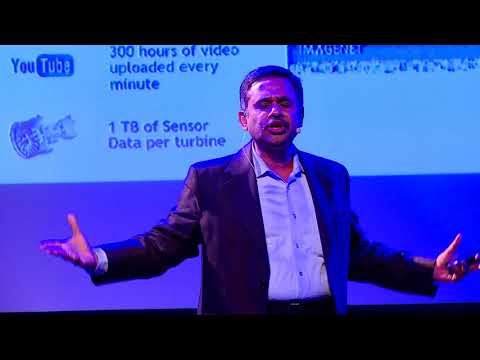
YouTube
300 hours of video get uploaded every
minute in other words it’s 50 hours of
video every second 50 hours of video has
gone into the internet looks like people
don’t have any job other than uploading
videos onto internet and look at the
last example what we call as the
Internet of Things everything is fitted
with sensors today from milking cows to
rockets the fly into the space
everything is fitted with sensors and
they create huge huge huge amounts of
data now so how do I do with this data I
mean so much of data so may may come out
with a machine learning technology
that’s the second trigger may come out
with a machine learning technology that
can use make use of the data learn from
the data and help me to make decisions
now this post Dynamo enormous challenge
there’s a lot of data a huge number of
the era that needs to be processed and
obviously the the the complexity of the
network that needs to go into processing
the data the algorithms that need to be
written or extremely extremely complex
how do you manage this for that you need
brutal processing power which was not
possible by the conventional processors
that we have had and that is where the
GPUs came into play the graphics
processing unit which which is a
parallel processor and which can handle
because of the inherent architecture
with which it is built it can handle
enormously a more big amounts of data
and extremely complex models with ease
and so the availability of the
processing power then thanks to the new
technologies that are evolving I mean
from Nvidia in which I am fortunate to
work for though so these are the three
triggers that led to the rebirth of deep
learning so I said deep learning can do
almost everything but how reliable it is
okay so this is I I would encourage you
to look at the first box so the bottom
chopped the black line shows the levels
of accuracy that were achieved by the
conventional machine learning techniques
which is stalled at around 75 76
percentage and then came deep learning
and deep learning today can go up to for
this particular problem
I’m not telling the deep learning this
this level of
applicable for all deepening problems
for the particular problem that I’m
talking about an image recognition
problem it can go up to ninety six point
three level three percentage of accuracy
so it’s ninety six point three good or
bad maybe ninety nine is good maybe
ninety five is good how do I say over
ninety six point three is good or bad
because it is good because the human
levels of accuracy for that particular
problem is below ninety six point three
so for this problem machines can achieve
a better level of accuracy than human
beings
so hundred percent it is reliable now
we’re all deplaning these can be applied
almost everywhere to be honest well for
example as I talk in English if you want
to hear this in Spanish or Tamil or
Telugu or Canada anything
it is possible through deep learning
okay and medicinal biology a big huge
area in which deep learning is getting
applied take the case of radiologists
first look at a monochrome monitor from
morning 9:00 a.m. to 6 p.m. for six days
a week it’s it’s extremely strenuous and
and and I mean maybe maybe not enough
radiologists are available the world
now this faff getting replaced by by
machines which instead of radiologists
machines are trained to die to look at
medical images identify the aberrations
and lesions that are that are aware that
are visible in a in an image and hence
identify diagnose a disease and then
they are not going to replace
radiologists either the diagnosis made
by the Machine will be presented to the
radiologists and radiologists the human
radiologist will either accept or reject
the diagnosis made by the Machine it’s
wonderful and this game for very big
implications particularly for developing
countries maybe not enough radiologists
are available everywhere so how do i how
do i complement the the efforts of the
knowledge of our of a trained
radiologists and a machine to work
together for the betterment of the human
kind that is what it can do security and
defense although smart city projects
that we are talking about everything
that we are talking about it’s all
thanks to deep learning if let’s say a
child goes missing and the child was
spotted walking in the platform of a
railway station 150 kilometers away if
yeah
diligent a camera can look at capture
the picture of the child and it can
compare the other the the the photo of
the child which is available today
dabangg and hence identify it is the
same child and create a trigger and tell
that hey you need to go and pick up this
child at this point okay all these
things are possible thanks to deep
learning the the smart cities that we
are all talking about all of them are
becoming better and better in terms of
the technology
thanks to deep learning now Cancer
Research is an extremely important thing
in which deep learning is getting
applied a lot okay and multiple things
like discovering their cancers genetic
signatures predicting cancerous protein
formation see what I’m talking about
doing a post-mortem after the thing as
has happened we’re talking about
predictions intelligent predictions
automatic pathological reports to find
cancer biomarkers etcetera all these
things are becoming possible thanks to
deep learning so the eye of the needle
is 2 million nanometers in in terms of
the size and a semiconductor defect he’s
10 nanometers I mean look at the numbers
ten nanometers doesn’t ring a bell but
even compare it with the size of an eye
of a needle you’ll be able to understand
and a 10 nanometer defect in a
semiconductor can be picked up through
deep learning technologies intelligent
recommendations chatbots presenting to
you recommendations that suit your needs
your tastes predicting what you will buy
when you walk into your store
understanding which shelf your eyeballs
are residing a lot and hence ensuring
that that that gets the right product
all these things are more possible
thanks to deep learning and retail area
is becoming a buzz with multiple
applications using deep learning now is
it all only technology no it is also
used for multiple social good also take
the case of this using satellite imagery
it is possible to map the way poverty
has spread over a particular area for in
developing countries thanks to deep
learning you can recognize the a
geological disaster that is
about happened that is impending oh it’s
again picked up from a satellite imagery
a deforestation effort that is happening
say for example thousands of satellites
are or or or roaming all around the
earth and if the small patch of forest
has smoke coming out of it before this
book engulfs the entire area and becomes
a natural disaster deep learning
technologies can enable a preventive
maintenance preventive action to be
taken to to call that so deep learning
has got lot of social implications as
well and in terms of technology there
are amazing machines that are that are
being gone for example there are
purpose-built a super computers which
can handle this complexity of data this
complexity of computation the one I mean
there are there are systems that can
handle up to 960 there are flops of
operation this is this is like 40 cutoff
flops
short of a petaflop and people who are
working the high-performance computing
area would resonate they would would
find this fascinating these are like
amazing things so it is not only the
technology which is evolving it is also
there the brutal computation that is
needed to handle this technology that is
also evolving at a pattern at an amazing
speed so to conclude a is the path for
tomorrow and it is time to get started
there I know there are a lot of worries
about will it take away jobs or all if
you ask me that question if I say no
then I’m a liar and I will never say
that but then we have two choices
the first choice is to whine about it
get worried about it get scared about it
and stay away from it the second choice
is to understand it embrace it we go
along with it and we take it along with
us and hence be on the bandwagon
Please follow and like us: