
that were revealed to me on the way of
becoming an architect and the truth that
was found in the process and I hope that
will resonate with fellow colleagues and
people of different profession but first
I would like to start with what I call
breaking walls of perception each one of
us has its own unique point of view and
it’s that that defines us and when more
than two points of view align we start
to talk about common sense but how
logical is that common sense in the way
of securing a position I was told that
my background was fantastic but I was
lacking experience so at that point it
occurred to me how can I get experience
if I cannot secure a positions to begin
with and I knew at that point I had to
break free from that logic I had to
unfollow that sense of thinking and I
had to break that perception so I
started focusing on the things that I
enjoy doing the most designing and
making things but focus is a very
difficult thing to do especially
nowadays 95% of people struggle to focus
and if we think how we used to live 20
and 30 years ago and how we live today
we understand that through technology we
have the ability to move from the
industrial age to the age of information
and the amount of information that we
receive is so vast that we are unable to
understand and decipher that information
as a person growing up I was told that I
always have to cross check my sources
and in that sense it wasn’t only about
the type of information that I was
receiving it wasn’t about the amount of
information but it was also about the
speed the speed by which that
information was reaching out to us and
it’s that speed that is so high that it
makes it even more difficult to start to
evaluate understand and eventually make
a decision based on that information
that it makes it feel like a helpless
laborer to my truth technology education
design were always interweaving and they
also had a little bit of shock I started
my architectural education on
the onset of shifting from one design
tool to the next I knew how to draw by
hand and I started to use the computer
and that was a revealing moment for me
because I was able to draw a skyscraper
in a matter of days when it used to take
a matter of weeks and I could also have
design changes included of course that
was a personal choice I chose to develop
myself to master a skill and in that
sense I progressed I didn’t wait for the
tutorial day I was teaching myself at
any point I had the option to do so and
I started to feel like I was an awesome
architect already of course I wanted to
apply the gained knowledge and a person
named learn of the da Vinci once said I
am impressed with the urgency of doing
knowing is not enough we must apply be
willing is not enough we must do and in
a way that I would like to understand
the world I started working before even
graduating and that led me to the next
revelation real-world deadlines of
course that didn’t stop me there the
passion for architecture drove me to
advance myself and I started studying in
one of the top schools of architecture
at the architectural Association and at
that point with my five years diploma
and experience at hand I finally began
feeling that I’m that architect the
awesome architect reality struck back
and I realized I had many things to
learn and in that sense I I also
realized that these crucial to go
through a process of designing and as
the design was sophisticated at the same
time it was essential to interact with
other awesome architects and while my
design was very different from the
design I used to do in my first year now
I was using code it was more important
that I interact and I talk to other
amazing architects and this is not the
truth that is given to you this cannot
be taken by you this has to be earned
and this is a universal truth we fight
against it we try to deny it but this is
how it works and we cannot start to
dance if we don’t start to work first
unless if we are Shakira or Michael
Jackson
my next adventure began when I started
working for with zaha hadid
at that point I was already looking at
architecture in the same way that neo is
looking at the built environment in the
movie The Matrix the sophistication in
the design was matching with everything
that I was teaching myself by then and
this is a render of the nanjing towers
in China for the Youth Olympics it has
105 thousand five hundred square meters
of conference center two towers coupling
at two hundred and fifty eight point
five hundred square meters and hundred
thousand square meters of basement areas
at the same time there is a plaza that
is terminating on the riverfront and
these are lenders and these are real
photos of the project now there’s
another building opera theatre house in
Rabat and this is a project for the King
of Morocco the 120 million dollar
project includes an 1,800 seat theatre a
7000 outdoor amphitheater additional
rehearsal spaces and the 350 people
restaurant now then this also has
different design features it has to
represent its design features and at the
same time be very functional and follow
building regulations of the country the
interior of the theater is different is
crystalline and it’s inspired by the
Moroccan makalah’s at that point each
line of the design depicted to me that I
had to understand that they represent
columns slabs and maybe even beams now
no matter how sophisticated that design
was the point to understand and remember
is that I was already applying the
things that I knew in an international
team in the team of different people
with different background and whoever
has held the position in an office or
had any work they realized that they go
through different moments and moments of
adversity and in the places that I teach
in London and in Oxford there are
mechanisms in place to help people deal
with stress and there is a the
the point to understand here that that
point comes to us by nature and it comes
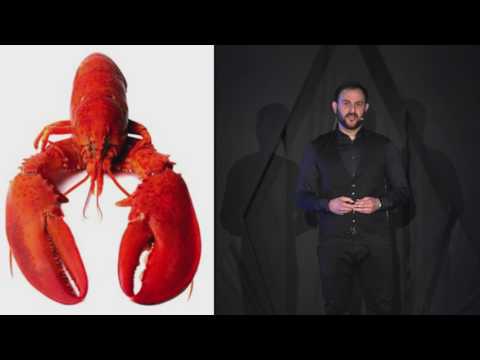
to us in the form of a lobster recently
understood how lobsters grow lobster
from the family of malok ostraka is an
animal that has a tough skin and a mushy
soft internal body
now the word Malikov circa for those who
speak Greek is misleading because it
doesn’t have a soft exterior it’s only
soft at the beginning of the molting
process it’s a very rigid and it doesn’t
expand so when the lobster needs to grow
it has to go away hide away from
predators and start to cast off that
shell then the new shell is generated
the shell has the same features as the
previous one it can even regenerate lost
limbs and that process continues every
time it needs to grow now the point to
understand is that the driving force for
the lobster to grow is the feeling of
being uncomfortable if lobsters had
doctors to prescribe medication every
time they feel uncomfortable they would
never grow every time they would feel
bad they will go to the doctor they
would get an aspirin or a bubbling
painkiller they would feel fine and they
would never cast off the previous
smaller shell now the important thing to
remember here is that moments of
adversity are also signals for growth
and if we can understand those moments
we can also grow through those moments
together now the way that nature
inspires me and to realize that interest
like this also becomes a reference point
for me for the work for the experimental
work that I do in the programs that I
run here in Greece in different cities
of of Greece and it has enabled me to
also see architecture in a different
perspective and has long been the work
of many theoreticians to try and
decipher how nature creates the
abundance of shapes and forms that we
see from growing plants to emerging
islands in the ocean and things to the
advances of of technology we are able to
move and create a sophisticated design
in the computer into one-to-one scale of
course there needs to be a certain
purpose we need to understand what is
the purpose for creating something
different for creating something new and
if the purpose is superficial if it is
ephemeral then if there is no plan then
it’s very easy to fall into a vices
cycle where the value of our work is
mixed and we misunderstand what we do
and why we do it and especially when we
do things through moments of adversity
and through a special growth and we can
grow through that process ourselves now
I would like to show you some details of
the work of the experimental work and
this is a photo of an unusual concrete
pavilion Kalli pod now this is not a
Photoshop image this is not edited is a
real photo and the interesting thing
about this is that it was put together
in less than a week with the people of
international students that just met
each other and they went through a
process of looking at nature as a
reference point now to give you a hint
on what that work looks at as a research
background I will have to talk to you
about school of fish swimming or a flock
of birds flying or a herd of sheep
traveling around while the movement can
be mesmerizing it hides a certain
purpose it has a specific way that
happens they try to come together not
too close to each other and they have a
specific direction now these are the
basic flocking rules that were coined by
Greg Reynolds in 1987 other moments of
inspiration by nature can be networks of
bundling and branching and this has been
the case also for Cali pod now the
purpose here is not to recreate a moving
animal or is not to make a plant the
purpose here is to understand how that
way happens and to connect that way with
design features where we don’t
understand we don’t know exactly how the
final outcome will be but we know what
the final structure will do and that has
been a thrilling moment for me because
it wasn’t just about how things were
looking it wasn’t about how things were
operating
but it was both and every proposal grew
from that process of course here again
the trick is choice how do you choose
how do you choose from a plethora of
different options you might know what
you want so for instance you might know
how much sunlight you want to have but
there are different options of opening
configurations that then give you that
level of of sunlight so every time we go
to the market every time we go to the
market to pick up tomato we grab it we
smell it we squeeze it and in that
process we try to understand how that
tomato feels and looks like because we
know that will be a parameter of how
tasty our Greek salad will feel like
yeah and in that sense we go through a
process of evaluation every great chef
usually a mother knows which tomato is
the best similarly to Architecture we go
through a process of evaluation so we
make many different iterations and this
is the case for the programs that I run
with the students who come in make
different design proposals and we go
through many different design proposals
based on the brief and we try to do that
through a simulation through using
specific code and at the same time
creating prototypes at smaller scales
until the moment where we evaluate how
these objects can be realized by using
advanced technological tools and at the
same time understand how they behave
structurally how they stand and in the
case of of Cali pod we had to understand
how the forces of gravity were affecting
that shell eventually a choice was
picked and that was gone to the next
stage where it was created into
one-to-one scale we had to go from the
three dimensional geometry on the
computer to a two dimensional plan that
will give us the formwork in order to
start creating that pavilion and what we
managed to do is to cut out these pieces
out of a piece of fabric the piece of
fabric was then used as the formwork for
casting concrete
and we gathered earth that was the
scaffolding for a structure we created
an earth scaffolding we laid on top the
fabric formwork and the casting process
began we use the special concrete mix
with fiberglass additives and that
enabled us to move away from
conventional ways of reinforcement we
didn’t have to use rebar eventually this
process continued by removing the earth
scaffolding the earth scaffolding was
then out in the surroundings and the
final outcome was revealed and this was
done again in a matter of less than a
week the final structure is 2.1 metres
high four point four meters wide and it
was done by a group of people who just
met each other now I will show you one
more example of experimental advanced
architecture and we try to challenge
ourselves through these processes and we
try to see how we can change things and
move beyond the things that we already
know in this project we vex we wanted to
challenge the way that we use formal but
also different design tools and
fabrication tools such as the robotic
arm as you will see in this process we
began by creating protocols of
information and communication with a
tool that is usually found in the
automotive industry the robotic arm and
we had to sort of customize the way that
it was moving and it was used in order
to start bending that reinforcement to
match the design purpose that we wanted
to achieve the revealing moment here was
that we were able to very quickly
generate a series of customized bends
for the rebar that will eventually give
us a very specific design that was not
random but it had a purpose and through
that process everyone so I started
seeing a different perspective for
architecture in the built environment
and by understanding materiality and how
polypropylene
was used for formwork we began having
unexpected results such as a polished
concrete surface that was done on this
on the go without having to go through a
second step of editing the the structure
now in this way the fourth notion of
mass production is met with the process
of mass customization however there’s
always the need for a purpose we need
purpose to guide us and to drive us if
we don’t do that if we don’t have
purpose then we fall easily into
illusions perhaps the biggest truth here
was that architecture for me is a way of
life a way of thinking and as long as it
is passion then we can overcome many
moments of struggle and there have been
many moments of negative feelings for
instance in the first here I’m showing
how the mass customization can be met
with the 3d 3d personal machines but to
go through the moments of negative
feelings in the first project there was
a moment where part of the hair
scaffolding collapsed under our feet and
we had to make a decision on that point
to continue not stop at the same time
when we started to talk about
communicate with the robot it felt like
we’re talking to wall there was no
response zero but we didn’t stop and we
realize at that point that we have to
put ourselves into place and and
surround ourselves with people that
understand what it means to have
persistence and perseverance and at this
point I didn’t come here to talk to you
about how we’re going to move ahead how
this will progress I came here to show
you a world with possibilities a world
without boundaries and in that world in
order to have your place you have to try
you have to begin and remain active we
have to have you with me and in this
sense I would like to tell you how
grateful and privileged I am to have
told you my truth such as it is and how
we go from here
it’s a choice I leave to you thank you [Applause]