
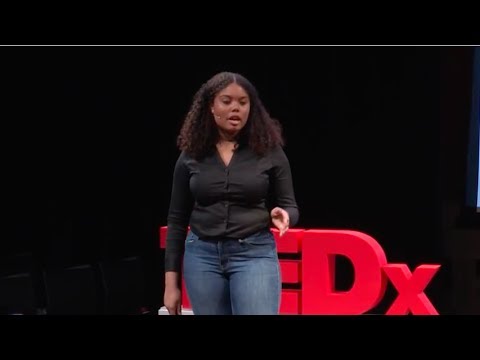
[Applause]
my love me cure me love me back my love
my money hunting but most of all my love
my browning I’m sure you’re all very
proficient in our Jamaican dialect on
that I didn’t need to translate that for
you but just in case that was a very
popular Jamaican song that says I love
my car I love my bike I love my money
but most of all I love my browning
browning a term of endearment used in
Jamaica to describe those of a lighter
skin tone the first time I was called
browning was when I was three years old
see in Jamaica many middle-class
families have housekeepers who generally
didn’t have much educational opportunity
but are very dedicated to caring for the
children of a family so my housekeeper
and I would go on walks and she’d look
at me and say Amanda you are the most
beautiful child in the community because
you are brown and she tell me and my mom
that because I was brown I was deserving
of the best possible care she could give
me and as I got older this concept was
never really at the forefront of my mind
I would hear the term browning being
used in our music from men in the
streets and women in hair salons and by
the time the summer of 2015
rolled around I got my first job at a
Jamaican restaurant a vegan restaurant
actually called me hungry in Kingston my
co-workers we’re tall with dark
chocolate skin and intricate long locks
because they practice Rastafarians in so
on my first day I eagerly introduced
myself hi I’m Amanda but very quickly my
name became I’m sure you can guess
Browning
see one day my coworkers were in the
kitchen making a meal for delivery and I
hear that I’m having a conversation
under their breath but I distinctly
remember this one line listen you can’t
sit around a browning man those words
became stamped on my mind you can’t say
that around the Browning and this
continued to happen every time I went on
another one of my summer jobs
I was nameless my identity rested solely
upon the fact that I was lighter skinned
than the majority of Jamaicans common
thing in an interview on his book
outliers Malcolm Gladwell explains my
mother is a brown skinned Jamaican there
are a whole series of advantages rooted
deeply in the peculiar history of
Jamaica that accrue to people who are of
mixed race he tells us that because of
British colonialism if you were the
offspring of a slave and a landowner you
were freed from slavery because the
British were still outnumbered this
helps to explain why being mixed or
brown in Jamaica does come with a set of
privileges but here’s the thing I never
felt privileged growing up I actually
felt ostracized but because of the
history of colonialism in Jamaica I was
seen as wealthier educated refined you
can’t say that around the brown name
suggests that when I was in the room
there was an instinct to move closer
toward a perceived standard and at the
end of that summer I moved to New York
it was October 2015 and my new school’s
acapella group was singing for the
Prince of Serbia Atlas Cirque in
Manhattan so as we’re waiting to sing
one of my friends taps me on my shoulder
and he says so Amanda what is it like
being the only African American in the
room it was my second month in America
so I look around
I’m trying to figure out exactly which
african-american Amanda he was referring
to
I’m not African or American I’m Jimmy
good but of course this was before
shading in the african-american bubble
on most forms and applications became my
only option
before I was asked to speak on every
discussion about race before I was told
I was different from regular African
Americans before I was told I didn’t
know my history when I didn’t know a
piece of african-american literature see
from that day on race began dominating a
lot of my conversations and being an
african-american woman became an
identity that I had to embody but I
didn’t have a choice people assume my
race for me as soon as I stepped off the
plane at JFK my reality completely
shifted so here’s a picture of Amanda
Taylor in Jamaica here’s a picture of
Amanda Taylor in New York obviously the
same person so why does my experience
differ so greatly in one place versus
another colorism or the practice of
discrimination where those with lighter
skin are treated more favorably than
those with darker skin persists in many
different communities all over the world
a 2009 report from global industry
analysts declared skin lightening a ten
billion dollar industry in 2012 India
alone used 258 tons of this lightening
cream one study found that in Lagos
Nigeria over 77 percent of residents use
this bleaching cream so on clearly what
is a massive scale there is an
adjustment of self to fit a perceived
standard regardless of the detrimental
effects that this may have so where does
they stem from norms see in a lot of
situations norms are useful every
concepts we have
there’s a reference point a norm see we
rank our intelligence our bodily
dimensions our sex drive along this
invisible line from below to above
average in the workplace adults measure
their salaries based on what the average
person in their field earns doctors
measure their patient’s health based on
the average height and weight curves and
this is totally appropriate I mean if
you have a low sex drive it might mean
that your body isn’t producing enough
testosterone and if you’re morbidly
obese that might mean that you’re at
risk for heart disease sometimes we need
norms so I’m going to show you a chart
just warning you all it’s very
scientific very technical so if it gets
too difficult to spare with me
so WTB Dubois does a great job at
explaining these concepts he the idea is
that whiteness is okay it just skips
ahead we’re gonna go back so this chart
there are points of relativity on this
chart and the closer you are to that
point of relativity or the closer point
of relativity that you are is the closer
you are to the norm and so there are
rarely any concepts that we have that
don’t try to establish a norm and so
when I skipped ahead this is the idea
that I was getting at that this desire
to establish a norm and fit ourselves to
this norm doesn’t just disappear when
talking about race see I live in a
country where 97% of the population is
either of partial or total African
descent and only 0.2 percent of this
population is made up of white people
yet 400,000 people of only 2.7 million
still bleach their skin so now I’m going
to show you another chart and as I was
saying WTB Dubois does a great job at
explaining this concept he explains that
because you know whiteness is is almost
invisible in the sense that it lingers
in places where white people no longer
are and so in the absence of white
people I was the closest point of
relativity I was the closest physical
embodiment of this Eurocentric norm then
I moved to America and relative to the
norm I moved very quickly down the
social hierarchy suddenly no one cared
if you could or couldn’t say that around
the Browning see as a black woman in
America privilege is not a word one
would associate with me but as a brown
girl in Jamaica I have to admit
privilege is definitely a word I can use
to describe my experience and in both
places Eurocentrism remains the norm in
America and Jamaica this norm structures
our perception of reality and limits
human experience and we see this through
all generations and centuries norms are
unquestioned they hold true even when
they’re ridiculous I mean there was a
time where we thought that the earth was
flat and in the Middle Ages in Europe
people feared going to hell so deeply
that they could feel the flames licking
their feet now today many people believe
their preconceived notions about race in
the same way we adamantly believed the
earth was flat
look I had my own Flat Earth
realizations when I went back home to
Jamaica I had to constantly remind
myself that speaking our dialect patois
did not limit a person’s fluency of
expression that wearing an afro in an
office did not indicate any more or less
professionalism that there is beauty in
wide hips and full lips when I went home
I had a new awareness I had to
constantly remind myself and check
myself I had to say to myself that those
tiny assumptions that we make about
people have a ripple
effect and I became more active in the
face of injustice when I was able to
realize where my point of relativity was
in different situations and no matter
who you identify as there is a lot of
moral power to be gained by recognizing
yours thank you
you
Please follow and like us: