
Translator: Sebastian Betti Reviewer: TED Translators admin
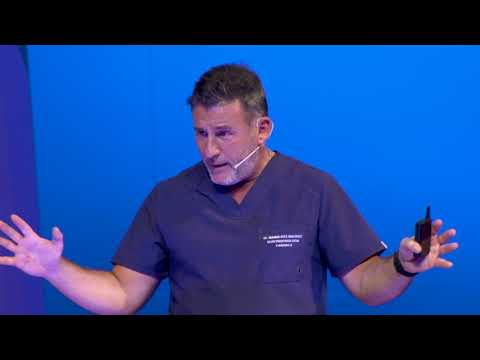
Mario Fitz: We are going to learn how to do cardiopulmonary resuscitation.
But I need help.
One is you sure. I need another one.
Diego Golombeck: Gerry, are you out there?
(Applause)
[No Gerry will be damaged in the next demonstration]
I’m going to need you to circulate to the center of the red circle
and you collapse with a sudden death without hurting yourself, please.
Diego Golombeck, Mario Fitz: You can.
An applause please.
(Applause)
Mario Fitz: Gerry, are you okay?
Gerry does not answer me.
And he is not breathing either.
Please, call 107 and I asked for an ambulance. Quickly, please.
Well, as everyone knows, nothing happened to Gerry.
Not to hurt him
let’s continue with the practice in a doll and we will give him a round of applause
to Gerry for this great fall he had.
(Applause)
I’m going to do cardiac compressions to maintain circulation.
And I’m going to ask you Diego
that if there is a defibrillator in this place
you can bring it to me please.
Diego Golombeck: There’s a lot in the theater, wait for me to bring you one.
Mario Fitz: Thanks.
We’re going to turn on the defibrillator and we’re going to do what he says.
“Break package and remove electrodes”.
We break the packages and extract the electrodes.
“Break package and remove electrodes”.
“Unwrap an electrode from the plastic liner”.
“Unwrap an electrode from the plastic liner”
“Do not touch the patient.”
“Analyzing rhythm”.
“Do not touch the patient.”
“Analyzing rhythm”.
“Download notice”.
“Loading”.
“Stand back.”
“The download will be applied in 3, 2, 1”.
“Applied discharge”.
In this case it can happen, as we did fast,
let him open his eyes, and obviously ask “what happened to me?”
The answer is not “you died, stay calm.”
The answer to reassure him and put him always with the patches placed
in the rescue position to wait for the ambulance.
This is what we have to do: put it on its side
Wait for the ambulance, quiet.
Well, now, while he waits for the ambulance, I want to tell you
is that in Argentina there is a sudden death every 15 minutes.
So, we have to think that when this sudden death occurs
It happens in this way.
Anywhere, in people who felt good
who were previously healthy and who seemed to have nothing.
It is 200 times more frequent to die like this from the heart
to die in a fire.
Think now the amount of fire extinguishers that are everywhere
and, however, what few defibrillators we see.
This kind of unexpected deaths
in most cases they are caused by an arrhythmia.
This arrhythmia causes the heart, which was beating normally, to stop beating
and begin to tremble, causing death.
The only possible treatment is to start with cardiac compressions
to maintain circulation and use a defibrillator so that the heart
stop shaking, reset, and start again and beat normally.
If we manage to do the cardiac compressions and the utilization
of the defibrillator within the first three minutes, the possibility that
That victim arrives alive at the hospital is very high, is 80%.
Now, if we do not do anything, almost none will arrive alive at the hospital.
This is why both cardiac compressions and the use
of the defibrillator are part of the chain of life.
They are the two central links.
Now this chain of life, which has four steps, has three steps that are
outside the hospital, you are the ones who will activate them because nobody leaves
with a doctor in your pocket in case something happens.
If something happens to you, the one that revives you and the one that helps you is the one next to you;
That is why the first link is to ask for help at 107.
If you see that someone who was normal falls,
You call it and it does not answer and it does not breathe,
It is a serious situation.
Call the ambulance at 107 or the local emergency number.
Immediately we have to start with the cardiac compressions that are done
in the center of the chest, in the center of the chest, fast, strong
and without fear to be effective.
You have to compress the thorax and sink it almost 5 cm
so that circulation can work.
That is the second step.
The third step is to ask for a defibrillator.
Here in the Colon there is.
If they bring it to me I use it and I follow the indications
of the defibrillator that speaks in Spanish and tells me what I have to do.
And it will never shoot
if this person did not have that arrhythmia that causes the tremor of the heart.
Therefore, we remain calm because it will not work
if that victim does not have a sudden death.
Now if we are in a place where there is no defibrillator,
we continue with the cardiac compressions until it arrives
the ambulance, which is the fourth step.
But the ambulance will arrive alone in both and in the first step
they called her
That is why it is very important to call the ambulance first.
This is so important that today we are going to practice it together here.
So I’m going to ask you to order everyone to stand up, please.
We are going to -without hitting the one in front-
stretch your arms like that – well stretched –
and let’s put the skillful hand down and the less skillful hand up.
We are going to interlace the fingers and we are going to break the wrist, like to stretch well
the elbows and leave the wrist well exposed.
We are going to go down and with the shoulders we are going to throw the weight of the body
without bending the elbows.
What are we going to do now?
You gave them a little bag when they entered.
Inside that bag there is a foam heart.
Let’s get that heart out and put it on the seat.
When we are all ready,
let’s practice cardiopulmonary resuscitation
with the arms and hands technique that I just showed you
to the beat of a song by the Bee Gees that will mark us one hundred per minute.
The rhythm is going to mark a song.
So, if you are all ready with your hearts, when I say three tablets
at one, at two and three.
(Music)
(End of music)
Very well. A round of applause for all these rescuers.
(Applause)
Now we order ourselves, we sit down again, please,
I have two more things to tell you.
The first: the Bee Gees gave us this theme
so we can know what the pace at which it is necessary to do it.
Because this music has the tempo at one hundred per minute, which is necessary
to do the compressions correctly.
It means that if at some point you’re going to do heart compressions
thinking this song they will be able to do it a hundred per minute.
Just think about it, do not sing it.
It’s wrong, okay?
The second recommendation is that you, before doing the cardiac compressions,
They must have been witnesses.
They must have seen that that person fell inexplicably.
They must have called her.
Do not answer, do not breathe, have called 107.
And just then start with compressions.
Do not come out now with your hands like this to reanimate everything on the floor
because there are people who are also sunbathing.
(Laughter)
Well, as soon as you get to this red circle you see a lot of people.
Now I’m leaving and I do not see more people. I see resuscitators.
I see a lot of hands that surely at some point
They are going to transform a situation of death into a life situation.
I’m happy to have lived this with you.
Thank you so much everyone.
(Applause)
Please follow and like us: