
you
[Applause]
hi there my name is Katrina I’m a
pediatrician specialized in
endocrinology and diabetes and for one
year I worked with Berlin’s refugee
Health Unit I’m a doctor and a patient
when I was a kid my immune system had
one of my vital organs down and I was
diagnosed with type 1 diabetes type 1
diabetes means multiple blood sugar
tests and insulin injections everyday
and regular visits at a specialist
doctor and the pharmacy in daily life it
is quite difficult to keep your blood
sugar levels in range
whatever you do impacts it what you eat
when you’re sick
physical activity whether you’re nervous
or excited
everything can potentially make your
blood sugar go up or down too little
insulin will result in a high blood
sugar and too much insulin will result
on a low blood sugar both can be
life-threatening acute events in this
room 100 people at least 20 more of us
have a chronic condition I’m sure there
are people sitting here amongst us who
are affected or have a friend or a
family member if you want to show
yourself feel free to do so
I’m here today to talk about a neglected
group of refugees those with chronic
conditions there are missing people
while some arrived most don’t amongst
the people migrating across borders
there is the same occurrence of chronic
disease as in any population refugees
face many challenges every day even if
they do not need medical service but for
those who do finding access to medical
care becomes a major challenge without
health insurance many of them have to
rely on volunteer doctors like my
colleagues and myself in conflict areas
like war-torn Syria there are only a
small number of operational hospitals
left many of them are working
underground usually civilians and places
like hospitals are protected by
international humanitarian law and
violation of these laws is considered as
a war crime but in Syria they have
become main targets of airstrikes and
the hospitals we see on the news today
likely won’t be there tomorrow in our
refugee health unit we have helped more
than 60,000 people since the war in
Syria started that is more than two
hundred people per day half of them are
children amongst these children we have
seen many infections one nutrition
psychological trauma but only a few with
chronic conditions those that we see in
the hospitals of our country every day
diabetes or cancer doesn’t care how old
you are or if your country is at war
it just happens also when it will happen
to a child is totally unpredictable
working with the refugee health unit we
have received three children with type 1
diabetes among the 60,000 people we
treated
there should have been 250 children with
diabetes
we’re wondering where are those 247
children that should have arrived today
I’ll tell you about one of the three
that did Muhammad who was with us in
burden now where his chronic condition
can be cared for Muhammad was a
ten-year-old boy who arrived in Europe
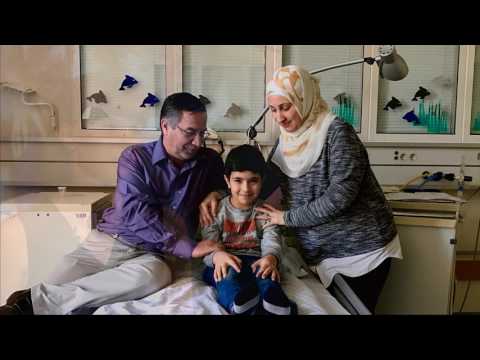
just last month here he’s sitting in his
hospital bed with his mother and father
he is my patient and I’m his doctor and
our life stories couldn’t be more
different but there’s one thing that we
have in common we both live with type 1
diabetes every day in both of our lives
there was a day when our parents got
extremely worried we were always thirsty
despite drinking enough we were we
rapidly lost weight despite eating
enough we were irritable and short of
breath and something was definitely
wrong so both of our parents decided to
take us to the doctor and the doctor
told our parents your child has diabetes
the good news is your child is going to
live but there is no cure and your child
will have to inject insulin every day
without insulin a small child with type
1 diabetes can only survive for up to
two days in my case this was the 14th of
June in 2001 and for Muhammad it was the
14th of November in 2015 which was also
the day when their home town Aleppo was
hit by severe air strike and ironically
was also were Diabetes Day after their
home was bombed Muhammad’s family had no
choice but to leave and find a new
insulin supply at first they were able
to find it on the black market they
could only find it there
because the only insulin producing
facility in Syria was borned in 2015 so
insulin had to be brought in from
neighbor
countries such as turkey or the Lebanon
and it was of course heavily overpriced
but diabetes management requires more
than just access to insulin even in a
hospital setting with diabetes
specialists on hand it usually takes a
few weeks to get the dosage right
Muhammad’s family knew nearly nothing
about how to use insulin but his father
suffers from type 2 diabetes which may
have saved Mohammed’s life although type
2 is quite different from type one
diabetes and does not require insulin in
every case
Mohammed’s father at least knew how to
perform a blood sugar test on his son’s
finger and at least what the numbers
meant after some time they were unable
to find insulin anywhere in Syria’s so
they tried to feed to Europe and took
the risk to travel overseas which was
the next big challenge for Mohammed’s
family the decision to leave is already
a challenge but their journey itself is
risky and without support along the way
when refugees fleeing towards Europe
need medical aid there’s no guarantee
that a doctor or hospital will take them
in without being integrated into the
local hospital systems they might be
unable to afford or request medical
attention
Mohammed’s family fled to Turkey over
the border and then paid smugglers for
passage to Greece and into Europe most
Mugler’s who take people over the
Mediterranean Sea forced them to leave
everything behind so they don’t sink
Muhammad’s father secretly kept one
thing the insulin and saved his son’s
life Mohammed’s parents like all parents
in and outside this room were willing to
do absolutely everything to save their
child’s life
what would you do if there was no way to
survive a few more days in this country
unfortunately not every family wins this
fight and in some cases weiter
medication gets thrown overboard
so this story is also for them when
Muhammad’s family left Syria they had no
idea what would be waiting for them
they were hoping to find a safe place
where Muhammad could survive but they
didn’t know the camps in Greece would be
just as overcrowded as those in Syria
and the neighboring countries with
terrible hygienic conditions and that a
long episode of hardship and monotony
was waiting for them even after arriving
a Europe the time it took for
integration and acceptance became a
burden the family split up in Greece
Muhammad’s mother went ahead to Germany
with their two younger siblings
immediately applied for asylum and the
application process for the family to be
reunited and safety but it would take
another one and a half years from 2015
to this year for Muhammad to brought in
to his mother and that was also the
first chance to see a pediatric diabetes
specialist he had arrived in Europe and
survived without any real support from
any European medical system the patients
we treated have all suffered hardship
first the situation in their home
country that forced them to leave then
the long journey and finally even
logistical and administrative challenges
upon arrival the health check-up on
arrival in Europe is sometimes the first
opportunity to see a doctor in weeks
months and sometimes even years in
Greece all Muhammad’s family hype was
only one type of insulin in the form of
a drug we mostly don’t use in Europe
anymore and no specialist to support
them under these conditions Mohammad
only survived by luck and thanks to the
support of his family
can we really claim to be taking proper
care of those in need even after they
have arrived mm that’s what type one
international
diabetes activist group estimates as the
number of Syrians in dire need of
insulin before the war diabetes like
most chronic health conditions was a
manageable disease in Syria yet suddenly
it has become a death sentence not only
in Syria but around the globe today
people with type 1 diabetes and
humanitarian crises are dying for those
who stay the economic situation is often
so bad that they cannot afford to eat or
drink
so how would anyone be able to buy
medication for those who leave finding
access to medication and doctors is even
more complicated when they get stuck at
refugee camps or at closed borders today
there are over 50 million people
violently uprooted from their homes that
is about 250,000 people with type 1
diabetes without structure and safety
without access to insulin and diabetes
education that is as many as the
population of this city living in a dire
life-threatening reality this is a
terrifying number but numbers and
statistics don’t always tell us enough
about who these people actually are
Mohammed is a story about the individual
person behind those numbers it is a
story about that everybody has a name
that everybody is somebody that
everybody has a story and a medical
history during war bombs and guns are
not the only things that kill people for
many it is the lack of infrastructure
that is their death sentence a skilled
person or a helping hand and their daily
challenges can save lives and access to
the systems of care that we are so proud
of can be the difference between
survival and death for the 247 missing
children we can support organizations
like type 1 international or Doctors
Without Borders
that are going beyond our national
borders to help for those who arrive and
live in the refugee camps next door each
one of you can contribute by making our
own neighborhoods a safe place for them
so they can live a life in safety in
peace and in dignity thank you
[Applause]
[Music]
[Applause]
hi there my name is Katrina I’m a
pediatrician specialized in
endocrinology and diabetes and for one
year I worked with Berlin’s refugee
Health Unit I’m a doctor and a patient
when I was a kid my immune system had
one of my vital organs down and I was
diagnosed with type 1 diabetes type 1
diabetes means multiple blood sugar
tests and insulin injections everyday
and regular visits at a specialist
doctor and the pharmacy in daily life it
is quite difficult to keep your blood
sugar levels in range
whatever you do impacts it what you eat
when you’re sick
physical activity whether you’re nervous
or excited
everything can potentially make your
blood sugar go up or down too little
insulin will result in a high blood
sugar and too much insulin will result
on a low blood sugar both can be
life-threatening acute events in this
room 100 people at least 20 more of us
have a chronic condition I’m sure there
are people sitting here amongst us who
are affected or have a friend or a
family member if you want to show
yourself feel free to do so
I’m here today to talk about a neglected
group of refugees those with chronic
conditions there are missing people
while some arrived most don’t amongst
the people migrating across borders
there is the same occurrence of chronic
disease as in any population refugees
face many challenges every day even if
they do not need medical service but for
those who do finding access to medical
care becomes a major challenge without
health insurance many of them have to
rely on volunteer doctors like my
colleagues and myself in conflict areas
like war-torn Syria there are only a
small number of operational hospitals
left many of them are working
underground usually civilians and places
like hospitals are protected by
international humanitarian law and
violation of these laws is considered as
a war crime but in Syria they have
become main targets of airstrikes and
the hospitals we see on the news today
likely won’t be there tomorrow in our
refugee health unit we have helped more
than 60,000 people since the war in
Syria started that is more than two
hundred people per day half of them are
children amongst these children we have
seen many infections one nutrition
psychological trauma but only a few with
chronic conditions those that we see in
the hospitals of our country every day
diabetes or cancer doesn’t care how old
you are or if your country is at war
it just happens also when it will happen
to a child is totally unpredictable
working with the refugee health unit we
have received three children with type 1
diabetes among the 60,000 people we
treated
there should have been 250 children with
diabetes
we’re wondering where are those 247
children that should have arrived today
I’ll tell you about one of the three
that did Muhammad who was with us in
burden now where his chronic condition
can be cared for Muhammad was a
ten-year-old boy who arrived in Europe
just last month here he’s sitting in his
hospital bed with his mother and father
he is my patient and I’m his doctor and
our life stories couldn’t be more
different but there’s one thing that we
have in common we both live with type 1
diabetes every day in both of our lives
there was a day when our parents got
extremely worried we were always thirsty
despite drinking enough we were we
rapidly lost weight despite eating
enough we were irritable and short of
breath and something was definitely
wrong so both of our parents decided to
take us to the doctor and the doctor
told our parents your child has diabetes
the good news is your child is going to
live but there is no cure and your child
will have to inject insulin every day
without insulin a small child with type
1 diabetes can only survive for up to
two days in my case this was the 14th of
June in 2001 and for Muhammad it was the
14th of November in 2015 which was also
the day when their home town Aleppo was
hit by severe air strike and ironically
was also were Diabetes Day after their
home was bombed Muhammad’s family had no
choice but to leave and find a new
insulin supply at first they were able
to find it on the black market they
could only find it there
because the only insulin producing
facility in Syria was borned in 2015 so
insulin had to be brought in from
neighbor
countries such as turkey or the Lebanon
and it was of course heavily overpriced
but diabetes management requires more
than just access to insulin even in a
hospital setting with diabetes
specialists on hand it usually takes a
few weeks to get the dosage right
Muhammad’s family knew nearly nothing
about how to use insulin but his father
suffers from type 2 diabetes which may
have saved Mohammed’s life although type
2 is quite different from type one
diabetes and does not require insulin in
every case
Mohammed’s father at least knew how to
perform a blood sugar test on his son’s
finger and at least what the numbers
meant after some time they were unable
to find insulin anywhere in Syria’s so
they tried to feed to Europe and took
the risk to travel overseas which was
the next big challenge for Mohammed’s
family the decision to leave is already
a challenge but their journey itself is
risky and without support along the way
when refugees fleeing towards Europe
need medical aid there’s no guarantee
that a doctor or hospital will take them
in without being integrated into the
local hospital systems they might be
unable to afford or request medical
attention
Mohammed’s family fled to Turkey over
the border and then paid smugglers for
passage to Greece and into Europe most
Mugler’s who take people over the
Mediterranean Sea forced them to leave
everything behind so they don’t sink
Muhammad’s father secretly kept one
thing the insulin and saved his son’s
life Mohammed’s parents like all parents
in and outside this room were willing to
do absolutely everything to save their
child’s life
what would you do if there was no way to
survive a few more days in this country
unfortunately not every family wins this
fight and in some cases weiter
medication gets thrown overboard
so this story is also for them when
Muhammad’s family left Syria they had no
idea what would be waiting for them
they were hoping to find a safe place
where Muhammad could survive but they
didn’t know the camps in Greece would be
just as overcrowded as those in Syria
and the neighboring countries with
terrible hygienic conditions and that a
long episode of hardship and monotony
was waiting for them even after arriving
a Europe the time it took for
integration and acceptance became a
burden the family split up in Greece
Muhammad’s mother went ahead to Germany
with their two younger siblings
immediately applied for asylum and the
application process for the family to be
reunited and safety but it would take
another one and a half years from 2015
to this year for Muhammad to brought in
to his mother and that was also the
first chance to see a pediatric diabetes
specialist he had arrived in Europe and
survived without any real support from
any European medical system the patients
we treated have all suffered hardship
first the situation in their home
country that forced them to leave then
the long journey and finally even
logistical and administrative challenges
upon arrival the health check-up on
arrival in Europe is sometimes the first
opportunity to see a doctor in weeks
months and sometimes even years in
Greece all Muhammad’s family hype was
only one type of insulin in the form of
a drug we mostly don’t use in Europe
anymore and no specialist to support
them under these conditions Mohammad
only survived by luck and thanks to the
support of his family
can we really claim to be taking proper
care of those in need even after they
have arrived mm that’s what type one
international
diabetes activist group estimates as the
number of Syrians in dire need of
insulin before the war diabetes like
most chronic health conditions was a
manageable disease in Syria yet suddenly
it has become a death sentence not only
in Syria but around the globe today
people with type 1 diabetes and
humanitarian crises are dying for those
who stay the economic situation is often
so bad that they cannot afford to eat or
drink
so how would anyone be able to buy
medication for those who leave finding
access to medication and doctors is even
more complicated when they get stuck at
refugee camps or at closed borders today
there are over 50 million people
violently uprooted from their homes that
is about 250,000 people with type 1
diabetes without structure and safety
without access to insulin and diabetes
education that is as many as the
population of this city living in a dire
life-threatening reality this is a
terrifying number but numbers and
statistics don’t always tell us enough
about who these people actually are
Mohammed is a story about the individual
person behind those numbers it is a
story about that everybody has a name
that everybody is somebody that
everybody has a story and a medical
history during war bombs and guns are
not the only things that kill people for
many it is the lack of infrastructure
that is their death sentence a skilled
person or a helping hand and their daily
challenges can save lives and access to
the systems of care that we are so proud
of can be the difference between
survival and death for the 247 missing
children we can support organizations
like type 1 international or Doctors
Without Borders
that are going beyond our national
borders to help for those who arrive and
live in the refugee camps next door each
one of you can contribute by making our
own neighborhoods a safe place for them
so they can live a life in safety in
peace and in dignity thank you
[Applause]
[Music]
Please follow and like us: