
visualize an image of greenhouse gases
some chuckling got a picture in your
head okay open your eyes how many of you
visualized something like this pretty
ugly right well you probably already
know that greenhouse gases like co2 are
widely acknowledged to be the primary
cause of climate change but what you may
not be aware of is that methane which is
also a greenhouse gas is 25 times more
potent than co2 and now accounts for 25
to 30 percent of global warming this is
an image from space at night in United
States you can see the eastern seaboard
is all lit up Chicago Minneapolis up
there in North Dakota we don’t have any
major cities but you see an awful lot of
lights well guess what
those aren’t lights those are methane
gas flares from the Bakken oil and gas
fields with enough power for two major
cities but what if I told you that the
greenhouse gas methane could actually be
a solution to climate change and that
the secret to solving that problem is
right here in my pocket this is a new
carbon-based material called Marylyn it
was invented right here in New Hampshire
by a bunch of really bright scientists
and engineers over the past 14 years we
make it in a bunch of different formats
this is a video of the output of one of
our Maryland furnaces this furnace
transforms gases including methane into
Maryland I was describing Maryland to a
senior executive in the materials
industry and he interrupted me and he
said John that’s not how we think about
it at all
I said well these are smart guys I
better shut up and listen to what they
have to say so I said okay how do you
think about it and he said fundamentally
we believe your team has invented a new
form of carbon on the planet pretty
compelling statement right so what makes
this stuff so special this is a
microscopic image of Maryland at its
most basic level it is interconnected
bundles of very long format carbon
nanotubes that long format and that
interconnectedness make for some really
cool properties at the macro scale first
of all it’s really light so we think of
carbon fiber as being a really light
material right mirror lawn is 1/3
lighter in fact in the early days of
production if our operators weren’t
careful these sheets could actually
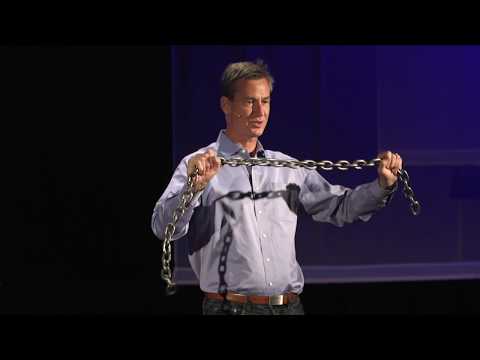
second Marilyn is strong this chain as a
strength of about 5,000 pounds this
Marilyn rope is the same length and the
same strength as this chain but the
chain weighs 37 times more than the rope
so it’s light and it’s strong unlike
most carbon materials Merlin can also
conduct electricity and heat let’s talk
this is basically a ruler with a thread
of Merlin in it connected to a battery
when I apply power to the mirror law and
electricity it will go through that
thread and you can hear it as sound all
right now what’s interesting is if I
strain the ruler you can hear a shift in
the frequency of the sound right so
imagine a smart material like this
embedded in an airplane wing not only
can I make that airplane lighter and
stronger but I can monitor its health
and status in real time in addition to
conducting electricity
Merline can conduct heat so if I apply
power to a sheet a mirror lon it becomes
an instant effective and safe heater it
turns out by pure luck that the
wavelength of energy emitted by
marijuana is ideally tuned to the human
body creating a gentle therapeutic heat
in this video you can see just how
quickly the sheet of Merlin heats up and
then cools off as we see the heat with
an infrared imager
now that instant on instant off heat
means we can heat the person not the
space so what do I mean by that each of
you has your own internal thermostat
some of you might be cold right now
while other view might be hot imagine if
we install Merlin heaters in chairs
overhead fixtures cubicles conference
room tables each of you could control
your own comfort level while reducing
the temperature of the building and for
each degree that we reduce the
temperature in a building that can be up
one of the earliest applications for
Marilyn was on the Juno spacecraft
mission to Jupiter Marilyn can withstand
some of the harshest environments known
to man it was the only material
qualified to protect the spacecraft from
the severe radiation of space while also
holding up to the extreme temperatures
and the potential Micro meteor strikes
they would encounter on its five-year
mission to Jupiter in another space
related application we supplied the yarn
to NASA and they turned it into a
composite high-pressure gas tank this
tank flew successfully on a Brant rocket
last May and why was this important wait
is a really big deal in space according
to NASA Marilyn could reduce the weight
of launch vehicles by up to 25 percent
so if you’re thinking about deep space
missions a faster trip is a big deal
when you’re going to Mars and a one-way
trip can take three to nine months so
that’s Marilyn the really cool material
it’s got lots of really cool
about a year ago the folks from arpa-e
came to us with a challenge arpa-e is
part of the Department of Energy they’re
modeled after DARPA you know the guys
who really invented the internet and
things like GPS navigation and their
mission is to fund disruptive energy
technologies that can change the energy
equation in the United States their team
was looking for an effective way to
convert methane into clean hydrogen and
some useful carbon product so we took
them out back showed them our furnaces
and we said here you go
we take methane in as our primary
feedstock we create this carbon-based
valuable material called Marilyn and oh
by the way during the process we create
excess hydrogen so up until ARPA came to
visit we were just focused on how do we
make Marilyn but now we had a new
challenge could we make this process
work at a level that could impact the
planet we had to start thinking on a
whole new scale we had to start thinking
in quads what is a quad a quad is a
quadrillion BTUs of energy to put that
in perspective you know this is a tanker
we’ve seen all seen tankers on the ocean
or in the port there they’re massive a
single tanker can hold about 84 million
gallons of crude oil a quad is 95
tankers that’s about 1% of the annual
energy consumption in the United States
so now we’re calibrated I want to take
you back to that image from space of
those methane flares this is what those
flares look like at ground level flare
gas is
generally considered a waste product by
the old and gas industry it’s too toxic
and logistically challenging to be
profitable but what if we could scale up
our black cotton candy machine our
Marilyn furnace and place it right at
the flare site instead of that methane
going up in smoke we could convert it to
clean hydrogen energy and Marilyn could
this be a concept that could be a
game-changer for the planet we decided
to model it and see if it could be so
globally there are about 5.2 quads of
energy and flare gas emissions annually
so that’s that’s a pretty big number
right so remember those tankers well if
we take about two-thirds of that gas and
put it in to our furnaces we can create
about 49 million tons of marijuana in
two quads of clean hydrogen will use
that’s two quads of clean hydrogen
energy that didn’t exist before and in
that 49 million tons
we’re sequestering the equivalent of a
hundred and eighty seven million tons of
co2 so that’s a win right it’s looking
pretty good but what do you do with 49
million tons of Marylyn good question
right well if we’re going to make
millions of tons of this stuff it has to
be competitively priced and it has to be
sustainable so let’s look at that
without going into all the details of
this graph basically what we’re looking
at is a comparison of Marylyn stainless
steel carbon fiber aluminum and concrete
as a function of price and performance
and you see Marilyn in the upper left
hand corner which reflects that is
relatively high performing and
relatively inexpensive
so it’s competitive at scale check will
it be recyclable
I think of Merlin as essentially carbon
so carbon to carbon dust to dust
yes it’s recyclable or it can be
repurposed for example it could be
repurposed into tires or asphalt or if
you remember that gas can the the tank
for NASA well their plan is when they
get to Mars they’re going to convert
that into habitats for the astronauts so
it can be recyclable and it’s
competitive but again what do you do
with 49 million tons
well what if we take 19 million tons and
we use it to lightweight vehicles we
replace the steel and aluminum with
marylin by light weighting the vehicle
we increase gas mileage and we decrease
fuel consumption and co2 emissions and
what if we take another 20 million tons
and we replace structural steel
structural steel is really energy
intensive to make and it’s heavy to
transport and what if we use another 10
million tons as an additive to concrete
we become the strengthener the rebar to
the concrete while reducing its weight
by half and what if with a relatively
small amount of marijuana we renovate
commercial buildings heat the person not
the space an increased building energy
efficiency so if you remember originally
we were talking about the impact of the
flare gas and what it could do in terms
of energy and efficiencies and
sequestering co2 well now if we look at
the applications for that 49 million
tons of Marylyn we can save 45 quads of
energy and reduce co2 emissions by 3
forty-five quads of energy is almost
half the energy consumption in the
United States annually three billion
tons of co2 is about two-thirds of the
u.s. as co2 emissions annually it’s
starting to get pretty interesting right
so this isn’t gonna be easy there is
tremendous technical risk execution risk
market adoption risk to achieve this
vision this is a picture of our VP of
product development about a year ago and
this is hard stuff by the way we’re
hiring but there is reason to be
optimistic
it’s an audacious challenge sure but
we’ve talked to a really large group of
smart people over the last year and
fortunately they haven’t thrown us out
of the room the oil and gas majors have
been surprisingly receptive as opposed
to seeing us as a threat they actually
see as a concept like ours as strategic
to their future and we’ve been chatting
with some really forward-thinking
automotive manufacturers and they see
sustainability and efficiency as core to
their business so can a greenhouse gas
save the planet this is what rich Ward
director of the global methane program
for the carbon war room has to say
scientists tell us that climate change
will be solved by many simultaneous
actions like buckshot
however the profound possibilities of
carbon to materials in Maryland at
Megaton scale looks very much like a
silver bullet he goes on to say that
Marilyn produces clean hydrogen it’s
sequester’s carbon in the materials of
life it realizes
remarkable efficiencies it totally
disrupts numerous co2 intensive
industries and it turns the petroleum
industry from black to green so if we
execute well we bring partners along
with us and we have some good fortune we
do have a shot at a greenhouse gas
saving the planet thank you
[Applause]
[Music] [Applause]
Please follow and like us: