
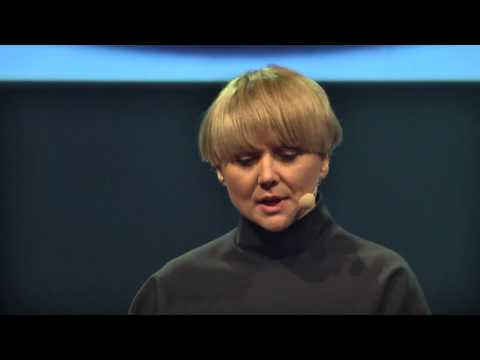
hello everyone
five years ago I studied something with
a community of really brilliant people
that would help us understand better how
the world works it started me on a
journey that has been incredibly
rewarding but also really surprising
some things that happen I would have
never have imagined what you see behind
me is the edition of Wired magazine that
was curated by President Barack Obama
and our community in the champion of our
community featured and the future
technology frontiers and I never
imagined that joi Ito of MIT Media Lab
would send a team over to work with us
and make a documentary about it
and I most certainly wouldn’t imagine
they’ll be standing here at the moment
representing women innovators as the
current European woman innovator of the
year because I just think of myself as
an enabler
I just enable a community of around
5,000 or so innovators to push the
boundaries of what innovation can be and
what we have discovered is that we can
radically change the way that innovation
is managed we have managed to bolt on
disruptive innovation safely on top of
current industry capabilities now
innovation is a funny thing in 1950 the
Sainsbury family opened the first
self-service supermarket in Croydon in
London and this idea was such a novel
thing for the people of Croydon that the
company had to issue a statement that
said something on the lines of no really
it’s okay you can take the goods from
the shelves yourselves and nobody will
think you are stealing of course if you
had asked any group of consumers at that
time should we turn a warehouse into a
store they would have said no we won’t
service if in 2005 we had asked anyone
should we remove all of the buttons of a
mobile phone they would have said no
that’d be awful
of course what these businesses are
really good at and the reason why they
have survived is not because you could
take things off the shelves yourself or
because you can stab at the screen with
your finger it’s because they have
allowed a huge amount of other products
and services to be part of their idea
they became an ableist none of you would
ever turn off your electricity supply in
your home even though it’s a product a
product that you pay for that’s because
it’s just too useful it just enables too
many useful things and of course when it
was first harvested by the likes of
Tesla and Edison’s for new kinds of
products he was so radically
transformative that I now I now call it
a meta technology an enabler at the
grand scale just harnessing
electromagnetism for instance has
engendered all sorts of new industries
like broadcasting and recording and
communications and this little dinky
format that you are all probably
familiar with
which still dictates the length of all
of your pop tracks today now he also of
course enabled the internet and an
Internet is another hugely enabling
platform and of course it allows you to
develop all sorts of ideas mainly on
screen these days but that’s just the
transitional phase and we’ll come back
to that later
but the thing is that the more your
technology is an enabler for other
people’s innovations the less likely is
to become obsolete
so for instance electricity today in
today’s sermon ology could be considered
a platform and has never been a better
time to allow other people to build on
top of your ideas we’ve gone from being
consumers to users to adopters testers
of new technologies to being content
creators every single person in this
space is a content creator you all
upload content on a daily basis and this
is only likely to increase in the last
hundred years we have automatized
all of our daily chores and we’re doing
more of this kind of thing with robotics
and AI and we’re freeing up more time to
generate meaningful content generate new
knowledge and build new ideas people who
build their ideas on top of yours have
it in their interest that your product
survives
for this reason all these enabling
technologies that just talked about they
were hugely disruptive at their time and
that now they’re simply how the world
works so what I have been encouraging
our community is to experiment with the
way that the world works so that we can
generate more of these enabling
technologies and enable more ideas to
happen and what we ended up with is a
toolkit is an entire toolkit of enabling
technologies but I’ll tell you more
about that later first we had to solve a
problem because what we had to do is
bring all these people from different
disciplines into a space of common
understanding and that’s really hard
it’s hard because we have developed our
language really beautifully to describe
even more complex concepts and this is
kind of generated something that we took
refer to as jargon so you have this kind
of cliques of people who can talk to
each other beautifully about these
complex concepts and you haven’t got a
clue about what they’re saying and in
fact you don’t understand what’s so
clever about it now what we need to do
is bring these guys in the room together
with these other guys in our in our
community for instance we have people
who are specialists in artificial
intelligence and neuroscience and
blockchain technologies and data
analytics and designers and critical
thinkers all of these guys have to come
into a space where they can exchange
knowledge because at the intersection of
these various areas of knowledge some
new knowledge can happen and the first
thing we have to do is change our
starting point change the way that we
communicate so not rely on the screen
anymore which is an old paradigm bring
the whole thing into the physical space
I now call it the physical internet
because of this and not in terms of
nodes and synapses if anybody’s familiar
with the Internet of Things it’s been
modeled on this kind of mental model
more about the fuzzy spaces in between
where culture and behavior and all these
different areas of knowledge intersect
in the physical space we start using
completely different ways to communicate
in addition to speech and this you will
be familiar with if you’ve ever had to
do a business deal because you want it
to be
in person because when you’re there in
person there are so many other things
that you infer from the communication
that by writing and looking at the
screen you just simply won’t be able to
and this area is not only useful for us
in terms of talking through the
ubiquitous hack lots of you may be
familiar with a hackathon concept which
is basically a translation of thought
into practice a way of thinking out loud
the way that allows us to discuss with
others through prototyping so it
eliminates the jargon not only that
there’s more to it there’s gesture there
signalling then there’s the area of the
limbic brain which actually is
responsible for decision making and for
build up of trust for instance and it’s
influenced by things like music on the
Left it’s Ronnie da from Israel on the
right its Ahmed Buckley from the
Palestine these are our labs last year
in Berlin and these were the two people
who are communicating via music music is
our social glue we put music at the
centre of this community in the physical
space right from the beginning and
suddenly we witness small miracles of
knowledge transfer where there hadn’t
been before and what was extraordinary
about it is that it opened up new kinds
of channels of communication that we
really hadn’t experienced before and
that hadn’t been accessible before what
we realized was that through these new
ways of communicating we could really
help people not just through enabling
them through technology but through
becoming something that’s really
extraordinary through allowing them to
be people that everybody could aspire to
to be truly great this is Victoria
modesta she’s a Bionic artist she’s a
champion of accessibility and champion
of new technologies our community during
a labs in Berlin equipped to it also
of different bodily functions that would
make her extraordinary would make her
someone we could aspire to for instance
there was a team led by a fantastic
designer fashion tech designer unequip
Rex who enabled her prosthetic leg to
generate special effects for the stage
so for instance in this case it was
creating smoke for the stage and he
created an image that kind of reminds
you of that famous picture of Marilyn
Monroe but with a completely new spin on
it and other teams work with Victoria to
enable her in other ways so they built a
dress that was fitted with LED lights
that changed color in response to
neurofeedback but what was really cool
about it is that then Victoria could
actually start to control the color of
her dress by using her mind and most of
these ideas were built using the tool
kit that we developed of enabling
technologies so this is the riot board
that was developed together with the Air
Canada Centre Pompidou in Paris it’s one
of our tangible user interfaces that
creates a connection between data from
air come and is embeddable in new types
of products and this was this is this is
this version here on the screen is one
that was very first one in January 2015
but when it was launched it was a whole
set of them were developed for the first
creative testbed that we launched and
combined with other interfaces that
allowed our crowd to generate a whole
host of new products and new ideas what
happened was that these teams were able
to communicate with engineers that
offered this enabling interface and they
were able to feed knowledge back into
the core IP and the engineers were in
turn able to add to their IP and further
enhanced the product so it was a very
much a two-way communication but we
created layers of intellectual property
that allowed everybody to know exactly
where someone else’s intellectual
property stopped and they started this
is
Rajyam Gorakhpur being interviewed for
the Ben Heck show he had built on top of
the riot board with a set of ways in
which he could physically interact with
systems at first with music systems than
the gaming then we realized that you
could completely replace the Kinect with
his system and he would have more
players but I was really curious to find
out what would happen if we took that
system and ported it over into an area
of industry that used heavy machinery
and so we created a prototype for the
forestry agriculture sector which is
completely separated from music and from
gaming and mainly that with a one and a
half hour brain song session with a head
of product of one of the biggest plants
in the world of heavy machinery and at
the end of this brainstorming session we
realized that what we had developed was
something that wasn’t just making that
product by interaction faster or better
but was actually adding safety it was
adding more modes of communication it
was making it cheaper it was creating
more ROI so then we went to the biggest
investors in the region and they
immediately saw the potential building
something for a sector as big as that
and the distributor of componentry that
wanted to scale the riot board
immediately saw the potential of
launching a new product with so many
early adopters so what happened was that
industry came to us as a result of
witnessing some of these things and
decided to donate IP to our tool kit
which i think is probably unheard of but
it was so valuable to them for instance
we ended up with being able to use
philips hue lighting api and combine it
with sound to generate applications for
health for communications for instance
generative light in response to data
this may meant that we were now creating
a pool of IP that came from all sorts of
sectors of industry and this is
something that we now refer to as the
industry Commons and we’re building this
further because it’s really valuable
it’s not just plain research and
development that creates assets you can
then add to your core IP
but it’s actually something that enables
new markets and new market niches to
develop for instance it takes your IP
into some of the local communities that
can then develop ideas that are
meaningful to them and that solve
problems that they know they have and we
really want to go there we want to go
there even though it’s risky there are
some unknowns we’re going to have to
tackle issues of security and privacy
very early but we want to go there
because one of these days we want to be
able to say well those enabling
technologies that we’ve developed where
they’re just how the world works thank
you very much
[Applause]
Please follow and like us: