
[Laughter]
hello so I was told I should be careful
because there’s bird poop on the stage
so some of you might know I am the only
non Malaysian speaker today so I’ve come
from Mexico
therefore apologies with my accent at
some point is not so clear and the last
time I was in a public speaking event a
friend of mine sent me a message saying
if everything goes wrong or if anything
goes wrong just add speaking Spanish
that would mail the ladies down today a
friend of mine is sitting in the
audience and she texts me if all goes
wrong just take off your shirt so I hope
I can finish my presentation with all my
clothes on right um so today we’re
talking about the future for me we
cannot talk about the future without
talking about sustainability and if you
ask me where do I see the future I see
it right here right now in front of me
how many of you are younger than 30
years old that’s exactly my point
the big majority of you are really young
and you have all this energy and you
have so many things ahead of you and
very important you have ideas great
ideas and these ideas are going to shape
the future not just of Malaysia but the
future of humanity there’s things that
we need to consider when we talk about
the future so all the things just like
in nature are interrelated so when we
talk about the future we need to
consider the world population how many
of us are living in this planet the
human needs what do each of us need to
stay alive we need to consider how are
we supply in these things to all of us
and finally the impact that this has on
that beautiful planet that keeps us
alive everything is interrelated
so let’s start with war population we
know that we are more than 7.3 billion
people in the world and still
reproducing more and more we expect to
have more than 10 billion people living
in this planet by the year 2100 even
though the birth rates are decreasing we
know that the total population is
increasing because when development
happens also death rates decrease the
perfect example we have it in countries
like Germany Sweden where people are
reproducing less correct but with more
development the total rate still
increases they are reproducing less but
they are still reproducing so we know
we’re going to be a lot more people in
the planet and all of us have certain
basic needs
we all need food water shelter housing
we need sanitation and very important
like some of the other speakers have
already mentioned we’re all going to
need energy to keep us alive to keep our
industry is going so let’s talk about
these separate things food we know that
as countries develop the diets changes
well so we’re talking about more people
with changing diets
this means countries that used to
consume more starch base things like
rice now they’re moving into more dairy
and meat and don’t forget that to
produce 1 kg of rice takes about 3000
liters of water to produce 1 kg of beef
takes more than 15,000 liters of water
this is what we call beer total water
so some of you only keep in mind yeah
but I only consume 2 to 4 liters of
water a day correct for the beautiful
water everything that you consume all
the meat all the cotton in your shirts
there was a lot of water that was
required to produce those goods and
services so we know that the food demand
is going to increase considerably in the
future food is related to water like
we just explained and water cannot be
taken separately without talking about
sanitation we know that we have issues
with sanitation 80% of the developed
developing countries put the sewage back
into rivers and oceans without treating
it properly we know that this is killing
the species there and we’re basically
polluting the same water that we need to
survive in this planet we are destroying
the things that keep us alive we know
that an increasing amount of population
also means sorry also means that there’s
going to be a lot of housing required
the way we supply the housing today is
based on a very inefficient model that
number one is unaffordable to many and
number two does not take care of the
people and the planet so people have to
inquire that that goes on for even three
generations and you have places like
here in Kuala Lumpur with occupant C
rates of 23% while you have people
living on the streets this system is
just not delivering results the other
thing that we have to consider talking
about the housing model is that
architecture develops pretty but pretty
useless boxes so when you buy a house
you have to plug in the energy you have
to plug in the water and you have to
plug your house to the sewage system
otherwise your house is useless and the
problem of this is that every time we
turn on the lights we turn on the air
conditioning we flush our toilet we are
trashing the planet polluting polluting
polluting and this is the kind of houses
we are still looking at in the future
obviously more houses more people more
food more water means more energy we’re
expecting the energy demand to increase
by more than 50 percent in the next 30
years and the big issue of this is that
80% of this
energy is going to be produced with
non-renewable sources like some of the
speakers already mentioned sources that
produce or put carbon out there we are
trashing our planet and the system that
we have designed to provide us with all
those needs is what we call the economy
today and for many years we have focus
entirely on the economic system what’s
the problem with this economy is based
on one main core idea growth if the
economy is not growing we talk about
crisis nobody wants to have crisis
crisis is bad if there’s a crisis
there’s no economic growth how do you
get economic growth consumption if you
look at the formula of the GDP is
consumption plus investment plus
government spending plus net experts in
a summary consume so they have convinces
that consuming is the answer to
everything you’re not happy
no worries go shopping there’s poverty
in your country you need growth there’s
inequality in your country you need
growth democracy is not working you need
growth growth is the peel that solves
every single problem now what is the
problem the biggest problem with this
this is based on a linear system so the
economic system that we have created is
based on two very wrong assumptions
number one that the natural resources
are infinite and number two that they
are out there for us humans to do
whatever we want with them they are all
there for us to take and waste as much
as we want and there’s a strong impact
on the environment the part of the
equation that we have forgotten there’s
a way to measure the impact that our
economic system has on the sorry on the
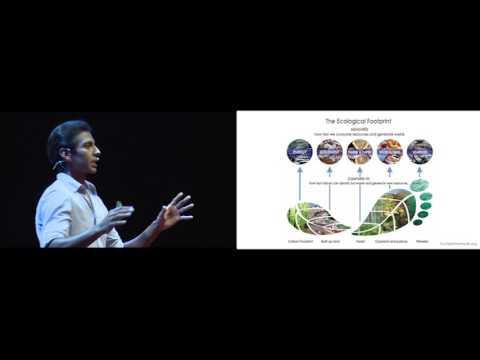
environment we call it the ecological
footprint every one of us has an
ecological footprint what this means is
everything that takes from the
environment to keep us alive the amount
of water the amount of land to produce
the cotton that we are wearing the
amount of forage that we need to filter
all that carbon the amount of oceans
that we need to take all that carbon
that we’re putting out in the air and we
can quantify that very accurately and of
course depending on what country you
live in
your ecological footprint could be
higher or lower this is this one this is
what it looks in terms of the planet
with people living in it an analogy to
explain it very simple is if you look at
the green part that’s the biological
capital all the forests all the oceans
all the water that we have to keep us
alive the red line is the consumption
that we have so we know that we have
already crossed the line if we explain
this in financial terms this the green
part is your the money the capital that
you have in your account if you are
inside the green area you are paying
your consumption with the interest
generated by the capital in your account
in the moment you cross the green path
you’re spending more money than your
capital is producing in terms of the
planet we are consuming more than what
our planet can provide and we have
crossed that line and we are consuming
more and more and more and we’re going
to be more people in countries that are
growing and growing and growing this is
just not sustainable to keep us alive
with the way we’re consuming today it
would take one-and-a-half planet Earth
what’s the problem with this we only
have one planet earth looking at a list
of countries with a Rica logical
footprint we see two things here
obviously it’s hard to read all the
names of the countries
but something that you can see is that
the big majority have crossed the line
another thing that we can analyze here
is that the more developed the country
the larger the ecological footprint of
the rabbit ins is but we all have been
told that we have to go that way
we have to consume more the other thing
we can see is that the largest part of
those columns is the carbon the carbon
that we’re putting out there and as we
have analyzed this is gonna continue
increasing so it’s just gonna get worse
and worse and worse let’s look at
Malaysia this is what has been happening
with Malaysia if you see Malaysia is
already consuming more than what the
country can provide so what how can that
work you import things you start
consuming things that have been produced
in another country so you don’t see the
impact you are just enjoying your
consumption if the whole world would
consume add Malaysian levels we will
need 3.5 planet earth and we are so
happy going shopping right why not
the impact that this has on the planet
in terms of animals is exactly this we
have killed 52% of the other animals
sharing the planet with us and this has
only been tracked from the 70s onwards
so we don’t even know if the impact is
even higher than this talking about
freshwater species is even worse 76% of
freshwater species are not coming back
we have killed them other generations
will never see them so we have to
understand how nature works and stop
following a model that is not working a
model that has threatened other species
and today is threatening our own
existence we have to understand how
nature works in a cycle
or in a linear system the best example
is analyzing how a tree works this
beautiful illustration by the local
artist Elena Moran explains how a tree
takes energy from the Sun without moving
without polluting and the tree takes
that energy and builds it into sugars
and things that are good for other
species like us and like other animals
and if no animal eats these fruits it
falls down to the ground gets covered by
leaves some water falls on it and it
becomes compost compost is good for the
tree itself and is good for all other
species of plants around it the tree
takes the carbon which is poison to us
and that’s how it grows it stores it in
a solid mass and that’s how a tree grows
the tree uses the energy filters the
water puts it back in the air in a very
pure form by doing transpiration and
evaporation and gives us as well
oxygen together with the water it’s a
perfect system amazingly adapted to this
planet that produces no waste and
produces only good things to other
species think about it humans are the
only species in the planet that produce
garbage something that no other species
can use and that now we are having
problems with it what you’re looking at
is an Earthship Michael Reynolds the
creator of Earthship biotech Terr was
tire of what the architects were doing
these useless boxes so he said we need
instead of building so many spaceships
let’s build health ships a house that
can provide people with water food
energy stable comfortable temperature
with zero carbon footprint
and the house that is built mainly with
natural materials and garbage these are
the kind of materials we use energy
biotech tur tires we take a whole bunch
of tires recycled tires garbage that
otherwise would be burned or thrown to
the oceans or whatever but you know
tires are so strong is rubber and steel
is the best building material you can
time its earthquake proof so we take
them we fill them up with dirt we pile
them up as words we plaster them and we
blasted them again
and make them look pretty we make them
look like this and that’s very
temperature efficient earthquake proof
and dirt cheap affordable this is what a
finish wall looks like then we take
bottles we take cans we pile them up we
these are bottles very temperature
efficient you get the natural light
passing through but not the heat good
insulation it looks beautiful and this
kind of concept is what I’ve been
promoting in Malaysia the first aid ship
in Malaysia is being built as we are
sitting here I just got some pictures of
the update I should be building but I
had to take a break to be here we’ve
been building for the last three months
the first ad ship in Malaysia this house
when it’s completed is going to capture
water from the rain is going to filter
it while producing food for its
habitants two houses in one community
center built with garbage and natural
materials and we are building it with an
orang asli community and I said with not
four we are not a charity where we give
people things for free we empower them
we teach them how to replicate these
systems we think that they can afford
with metals that they can replicate so
they don’t need to wait for us to go
back once we finish they know how to
replicate this with things they can
afford so the project is open to
volunteers we don’t charge anything and
people have asked me are you scared that
people will start replicating these and
then you lose your business and like
well if people start replicating this I
will be the happiest man in the world
this is what we want we want people to
start spreading this so we take
volunteers we don’t charge them anything
they come they learn how we do these
things and they help us build it I’m not
saying that building airships is the
solution the solution to all problems
but it’s a simple example of things that
we could all be doing we have to think
how are we going to live in this planet
in the future today we’re talking about
the future one thing we need to keep in
mind is that the economy was created by
us but we were created by nature nature
the planet does not belong to us we
belong to the planet we cannot talk
about the future if we trash that planet
which is what we have been doing we need
to wake up we need to grow up stop
behaving like a child in its early
development stages where it’s all about
me and mine and we have to think about
us ours all the species sharing this
planet with us we have to take care of
them because we depend on them as well
what are we going to do with all the
money in the world if there’s no fish in
the sea if there’s no oxygen in the air
and there’s no clean water to drink we
can have a whole bunch of rich countries
we die in population some scientists say
it’s too late already
we have doomed ourselves our system has
reached a position where even if we stop
all industry today there’s so much
carbon out there that we’re going to
start seeing climate change to a level
that
is going to go out of control life in
the planet is going to continue only
without humans so it’s our decision
I believe there’s hope I believe we you
sitting here have the power to change
this we just have to focus less on
finance and economics and more on the
real things nature the things that keep
us alive we have to study how the
systems work we have to understand them
and we have to spread the message I
believe there’s hope I believe you are
the hope
let’s build today for tomorrow thank you
very much [Applause]