
[Music]
yeah thank you very much and indeed it
is a different topic that I want to talk
about then the topic that I usually talk
about which is the narrative of
biodiversity science that we’ve created
over the past several decades but in
recent we’re not quite working okay
in recent times we’ve started thinking
about what role we as scientists should
play in advocating the information that
we gather from the world around us and
what role should we play maybe as more
honest brokers as as people who are
unbiased in our presentation of the data
and of the information that we have and
as you can imagine this is quite
difficult to sit to separate these kinds
of things this kid does not seem to want
to work ok so this is how we usually
view scientists we think about them in
the lab we think about them in the field
they’re out collecting data they’re
testing hypotheses and then they’re
presenting the information that they
gathered to the world of course science
isn’t so clean we’re humans and as
humans we have to start thinking about
the role that we play in the world
around us so what are we to do as
scientists and about a month ago this is
why it’s very timely and fascinating a
little bit more than a month ago and on
Earth Day there was the first-ever March
for science now this started in the
United States but it traveled all across
the world tens and hundreds of thousands
of people participated in march for
science many of them in their very first
ever protest because scientists are
often thought of as introverted folks or
unbiased folks that are in the lab here
they are out in the in the world saying
hey let’s stand up for science let’s
talk about science and really give us a
role at the table it was supposed to be
a nonpartisan event clearly however it’s
very difficult especially on Earth Day
to think about nonpartisan dynamics
when we’re dealing with the current
environment all over the world but in
particular in the United States about
what role science and scientist should
play and so this got me thinking what
role do we play are we really honest
brokers and there’s actually a debate in
the blogosphere right now and over
Twitter about whether we have gone too
far doing with these kinds of marches
we’re losing our credibility as honest
brokers if we go out there and sort of
try to advocate for what we believe and
it’s a real challenge to think about how
to balance these kinds of things and
scientists are really struggling with
these kinds of ideas right now and so I
want to go back a little bit in history
and say okay well let’s think about
scientists from historical times and
think about what role they played as
brokers versus advocates and this was
Alexander von Humboldt at the time one
of the most famous scientists in the
world probably one of the most well
known people in the world right from
right here in Germany he did a number of
things some of them that are familiar to
my field our he started thinking about
plants and plant traits as you for
example went up mountains you’d see
different kinds of species up and down
mountains with different kinds of traits
and he sort of made some hypotheses
about that what that might do
importantly however humble was also very
interested and advocating for science in
fact when we went to the United States
and we saw slavery he realized what a
horrible travesty this was and he said
this to people like Thomas Jefferson and
said hey we need to start really
worrying about these kinds of things he
was also the first to explain the
fundamental functions of forests and
ecosystems and really some people
suggest invented naturalism or sort of
environmentalism
we also have classic well known
scientists like Charles Darwin who of
course realized the influence that his
science would have on society caused him
to think about and worry about this
thing for many many many years before he
actually published his work Alfred
Wallace another co-discoverer of the
theory of evolution was very fascinated
or very impressed by the
influence that humans were having on the
world around and then actually started
to become quite a strong
environmentalist realizing that we
needed to worry about the impact that
humans were having around the world
around us interestingly he also had some
kind of wacky ideas he got involved in
spiritualism later on his career and and
the British government almost tried to
take away his pension because they were
worried about the role he had made as a
famous scientist and now it was coming
up with some sort of kooky or wacky
ideas right here much closer to home
Ernst Hackl from yenna again a very
well-known invented the word ecology for
science the science of ecology also
phylogeny and another a number of other
things unfortunately he also had some
biases and those biases were quite
racist and so he actually thought humans
were made up of eight or nine species
some of which were just into extinction
and others of which would dominate and
so clearly it’s really hard to
disentangle brilliant scientists versus
our own personal biases all of these
guys are bring all of these guys up
because they were interested in this
thing that we call biodiversity and so
it might be in butterflies it might be
in plants or any other thing we’re
interested in how this diversity arises
how its distributed across the planet
and maybe how it’s changing through time
so if we for example look at the last
say 1/2 billion years we see a pattern
where biodiversity has been rising and
rising and rising through time but you
notice these triangles and these
triangles we call extinction events so
the big yellow ones we call mass
extinction events and we have some
parameters that define what a mass
extinction event might be the previous
mass extinction event was probably
caused by a large asteroid that hit
earth and caused an extinction of
dinosaurs and 75% of all other life on
Earth and we think that today we’re
involved in a possibly a new mass
extinction we’re not quite sure how far
it’s gone but we do know the extinction
rates are quite accelerated because of
human activities so this is different
than the other kinds of extinction
events we’ve seen in Earth’s history
because it’s a species on the planet
that seems to be causing the extinction
of many other species on the planet
and so of course we know this is our
narrative this is the narrative that we
as biodiversity scientists bring to the
world we think extinction is happening
we think is happening very rapidly and
of course we have lots of evidence for
these kinds of things for example dodo
birds a number of amphibians have been
going extinct very rapidly lately
because of a disease many plants are
also going extinct we also know many
species are quite at risk of extinction
and that if the if activities continue
as they’re going we’re going to see a
lot more extinctions
for example the pandas and various
plants and reptiles numbers and numbers
of species are threatened with
extinction so yes species are
disappearing from the planet and we can
show that a lot of it has to do with
human activities and this is where the
the narrative comes from so these are
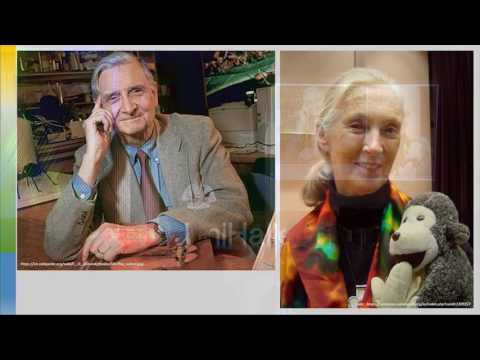
two very well-known scientists giving
the narrative helping play a huge role
in advocacy this is eel Wilson who early
in the early part of his career studying
ants became a quite a strong advocate
even helped invent the term biodiversity
quite a strong advocate for biodiversity
conservation Jane Goodall on the right
who made her career studying chimpanzee
colonies again quite a strong advocate
for biodiversity and animal welfare and
other events these these are brilliant
scientists who are playing a strong role
in policy and how people perceive
biodiversity creating this narrative
that we have and so this is the context
that I work in and that I live in we’ve
created a narrative biodiversity is
declining and this narrative the German
government has recently funded and taken
a leadership role at the integrative
biodiversity Center based in Leipzig but
also at Halle Indiana taking a
leadership role in the science of this
biodiversity and so here is our
narrative the narrative is that humans
are increasing in their population on
the planet and we’re using the resources
of those planet by doing so we are
affecting biodiversity
we’re driving species extinct we’re
changing the structure of biodiversity
in many different ways and as a result
we know now that biodiversity also has a
relatively strong influence on the
global ecosystem or at least on local
dynamics within that global ecosystem
and so we have this narrative humans
affect biodiversity usually negatively
biodiversity affects ecosystem functions
and functions go and affect our personal
everyday lives and so we need to worry
about biodiversity if we want to be
happy and healthy and so forth this is a
nice narrative it’s it’s not untrue but
there’s a lot underneath this that I
think we’re just starting to realize
this narrative is quite biased by sort
of our personal aesthetic and our
personal feelings towards the world
here’s a map and this map comes from a
study by Tim newbould and and dozens of
colleagues with Aidid a global analysis
of mat global biodiversity but local
biodiversity and local biodiversity
change and so the red spots have up to
32 percent of local biodiversity
declining you look at this map and you
say oh no this is a huge problem local
biodiversity is declining over much of
the planet humans are the cause of this
this is due to land use effects and then
we know this cascades down to affect the
ecosystem functioning in our own
well-being unfortunately it’s not such a
clear-cut story there are some biases
that go in its brilliant science but
there are biases that go into how we
develop these kinds of narratives for
example let’s take where we are right
here in Halle colleagues of mine at M Lu
and that idea have taken advantage of an
amazing data set and this amazing data
set goes back to this late 1600s of the
numbers of plants in this city hallo and
what you can see through time is that
there are more plants in the city of
Halle today more plant species in the
city of Halle today than there were
several hundred years ago so even within
this map of biodiversity declining by
2030 percent we come out to a place like
this and we’re like there are more
species of course it’s not that simple
there’s a lot of complexity going on
on in these data some species have gone
extinct others have replaced them some
of those others are from North America
or Asia or elsewhere it’s different but
we’ve quantified biodiversity as the
numbers of things we actually see more
things in Halle than we did several
hundred years ago and so these are two
of the least bias scientists that I know
this is Jackie and Christina these are
my children they love science my my wife
their mother is also a biologist so we
go all over the world and we collect
insects and they have an insect
collection here they’re on Hawaii and
the mountaintops of Hawaii pristine
environment collecting insects with
well-known entomologist but here they
are in Leipzig at the alt Meza and in
number got a beer garden finding just as
many species with world-renowned
pollinator biologists and a
world-renowned and biologist finding
lots and lots of species they love
collecting at the beer garden or in the
place just outside the old Meza they
don’t see this biodiversity klein in the
same way that we do because we’ve biased
ourselves a fair bit
so let’s look back into that narrative
and we have to ask ourselves actually of
course we know biodiversity is declining
globally but we have a lot of questions
about what’s going on locally some
people suggest it’s actually quite
dramatic others say hey wait a minute
it’s not such a big deal also we don’t
know exactly how this biodiversity is
going to affect the global ecosystem we
certainly know it has a big effect on
local ecosystems but we don’t know very
well what is the fact that the global
ecosystem is and so this is where the
Sociology part of my talk comes in
because I was involved in a working
group at the idea it’s a synthesis group
where we brought people in from around
the world who were sort of having these
fights in the literature is local
biodiversity declining like we want the
narrative to it say or actually are
these other people more correct or how
do we find reconciliation between these
two views you can see this is not day
one of the workshop and everybody is
quite happy
what was amazing to me is that through
time it got uglier and uglier and uglier
the personalities of these people really
started to separate and so much so now
that people are not talking to each
other anymore they’re not willing to
work with one another anymore the
dialogue has become so biased both sides
each side thinks that they’ll have the
moral high ground one side thinks that
we have this narrative and that of
course parking lots and crop fields and
other things have low biodiversity the
other side says hey we look at a silly
like holo we look at a lot of these long
time series and we’re not seeing that
decline they both think they have the
moral high ground but they’re becoming
more and more partisan right the same
way that we might see it in global
politics and elsewhere and it’s been
really fascinating to me to witness the
debate of brilliant smart people who all
have the same information but they view
it in very different ways even as
scientists and so I want to just wrap up
the talk by having a slight analogy to
the context of global change climate
change now notice we call it climate
change nowadays 10 20 years ago we call
it a global warming right and so there
clearly there’s a reason for changing
the terminology and I think the same
thing has to be thought about for
biodiversity science so oftentimes we
see this number 97 percent 97 percent of
all climate scientists believe that the
climate is changing and it’s due to
humans ok that’s a pretty strong effect
pretty strong sort of consensus what
about biodiversity right now we’re still
in this battle is biodiversity declining
locally or not what is the rate of these
kinds of extinctions so let’s think
about this polar bear here the polar
bear is probably going to go extinct
sadly ok we have good evidence from
climate change modeling and other
elsewhere that the habitat is going to
disappear for the polar bear and when it
does disappear this thing is going to
have to swim farther to get its food and
it’s in really bad shape because it’s
already very rare
this is terrible for the polar bear it’s
terrible for us we love many of us like
polar bears we like to know that they
exist in the world
biodiversity globally will decline if
this thing goes extinct but what about
local biodiversity in fact there are
many species that are going to be quite
happy with the polar bear going extinct
right it’s not simply biodiversity is
declining because the seal for example
is eaten by the polar bear and it’s
going to increase in this abundance it
might be quite happy we might see more
diversity of some of these things but of
course we don’t know the seal also eats
all the fish and there’s a very complex
food web but the bottom line is that
simply because some species go extinct
doesn’t tell us anything about what
biodiversity is going to be just like
when you think about climate change
climate change some places get wetter
some places get drier some places get
warmer some places get cooler it’s not
just all one thing and we have to change
the narrative and biodiversity science
as well I think sometimes it declines
locally regionally globally sometimes it
doesn’t and by creating this narrative
we’ve created this sort of bias so
strongly that we can’t see the data so
clearly to think about wind biodiversity
is declining and when it’s not and that
there are good reasons for this so
that’s all I wanted to say to you about
just to give you a little bit of idea of
the underbelly of science and how our
biases can manifest in the narratives
that we tell thank
[Applause]
[Music]
[Applause]
[Music]
Please follow and like us: