
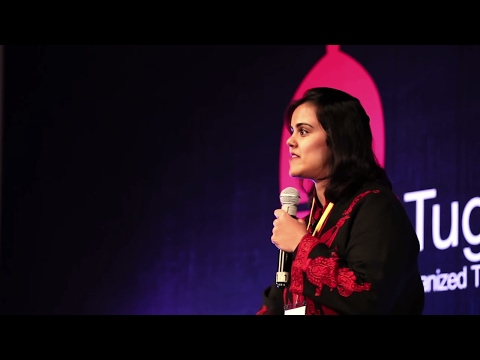
good in life pretty much I’m hoping
everyone and how many of you like to see
yourselves when you’re not feeling so
good in life how do you sort of deal
with that does that never happen it
happens right so the question really is
how many of us at some point of the
other in our lives have dealt with some
kind of emotional or mental problem or
know somebody our neighbor a friend a
relative our child our mother anyone
that goes acknowledged in your life
anyone you care about
I often wonder why people don’t talk
about this and part of the Young Global
Leaders program at the World Economic
Forum and every Leadership Summit I’ve
been to in the last few years I try and
ask this question this question to
people who are business leaders leaders
in society political leaders around the
world and maybe there are more people
talking about it in the US maybe then in
Japan maybe more people talking about it
in Chennai than in Delhi but that’s why
this conversation has got to be had
frankly it was a lot easier for me to
come here and talk about
entrepreneurship or culture or the
successes of the art world but it’s a
lot harder to talk about your scars so
here I am today when I was 10 years old
I woke up one morning and went to the
loo to brush my teeth and my mum asked
me if I thought that her toothpaste was
poisoned and I wasn’t really sure what
to say I didn’t understand the question
I didn’t know what the answer was and I
had several such baffling questions for
years and months after that that I
didn’t understand only because I was 10
several traumatic moments came and went
and I had no idea how to deal with them
nobody had any idea we didn’t have a
name we didn’t have a face we didn’t
know what it was and the disease of
schizophrenia took my mother away from
me and from herself for no fault of hers
for 10 years I didn’t see her for 10
years
while I didn’t talk about it I went to
school everyday I went to college after
that I met with my friends I led a
normal life based in sports eights and
studies had went to every party but I
didn’t talk about the thing that
mattered the most to me because how can
a child talk about not knowing where
their mother is how can a child talk
about the traumas and the stigma and the
denial that society imposes on you how
do you live every day and where do you
find that courage so for me I had to go
through my own journey my journey from
complete ignorance to some sort of
understanding my journey from complete
denial to some acceptance of what life
had just given me and from deep shame to
some sort of self-respect 25 years ago
you couldn’t google the word
schizophrenia or bipolar or manic
depressive or any of this no one even
knew what these words meant no one had
the tools or the ability to even
understand what it takes to live with
mental illness and so there was nowhere
to go I had to deal with my shame I had
to deal with the stigma that society
imposed on me and as hard as it was
every day it made me ask the question
Who am I where am I what is my sense of
identity and how do I break free and a
few years later as I saw with both my
parents I walked into the rashtrapati
bhavan
to get an award from the president in
the same room that India got its
independence and I asked myself that
question I’m here today because I was
able to break free I’m not here today
because of any business achievements I’m
not here today because I’m a woman of
substance I’m here today because I was
able to make that very small journey
that most people find very hard but I
don’t know what society and what the
ecosystem and what this country can do
to us as little young people when we’re
growing up and we have nowhere else to
turn to today I’m able to see the world
for what it is and thankfully I learned
from my mother every day and she holds
her own and comes back and integrates
into mainstream society she is the most
active grandparent in my four-year-olds
life and I’m grateful for that but I
know that not all
stories have a happy ending it’s hard
for a bulk of society think about people
across the country we’re talking in
urban centers I’m not even talking about
rural India where 60% of the people live
in Delhi in Bombay in Chennai in these
cities the level of acceptance and
understanding is so low that for most
families suffering for any kind of
mental problems the results are there
abandoned they’re hidden they locked
away their outcasts it’s very very
difficult for families to come back and
deal with their friends their peers
because they are judged it’s very hard
to then find your own place in life and
that is the problem that this country is
facing today we don’t have the
facilities we don’t have the care we
don’t have the Diagnostics but most of
all we don’t have the mind space the
humanness that it takes to actually
acknowledge that this problem exists and
that’s why it’s so important to talk
about it the statistics around mental
health are even more scary India
accounts for 15% of the mental health
problems in this country about 6 to 7
percent of our population has some sort
of mental health problems or the other
and yet 90% never have access to any
kind of treatment because India has one
psychiatrist for every 4 lakh patients
so these are the statistics were
equipped with 2% of the professionals
that this country needs 4,000
psychiatrists 3,000 social workers 1000
psychologists for this country this is
the crisis in India but please ask
yourself when you hear these statistics
are the statistics the problem are the
facilities the problem is the lack of
care or the lack of awareness the
problem or is it our own abilities to
actually wake up and seek help how many
of us actually get up every day and say
I will pay attention to my neighbor to
that kid in school to my college friend
how many of us actually are able to get
up and break the shackles of shame and
get help
so please ask yourselves not to put
money on this not to put effort on this
but just to think a little bit
differently please ask yourselves how
are you going to deal with
anybody you know how how would you help
them think about the little children
growing up in our country I owe it to my
four-year-old daughter here and to my
mother but I most of all to my country
and to myself because I feel it’s my
responsibility not to stand here and
talk about any successes in life it’s my
responsibility to talk about the scars
because maybe that’ll make a difference
and please ask yourselves the next time
it comes up will you talk about it [Applause]