
[Applause]
it’s an honor to be here today I want to
talk to you about so first what’s
another bug arthropods are animals with
an exoskeleton so my question for you is
how do you feel about arthropods I love
them I want to learn more about them or
I’d rather throw my hands in the air and
run for the exits right now many people
do not feel like you do in fact our own
language is a bit biased against both
just take a look at the nouns out there
it’s not so good and if you move on to
the burbs it doesn’t get any better so I
get where that comes from
there are arthropods out there that are
bad news mosquitoes ticks that bugs
there are many more but actually it’s
only about 1% of all market parts that
are detrimental to humanity in fact the
vast majority of arthropods are hugely
beneficial to us and in fact they make
up 95% of all animals how many is that
you ask scientists so far have
identified about a million arthropods on
the planet but most scientists agree
there’s probably another 29 million more
to go so it matters this matters to me
because I spend a lot of time thinking
about markup Oz and looking at
arthropods I’m a pro photographer Here I
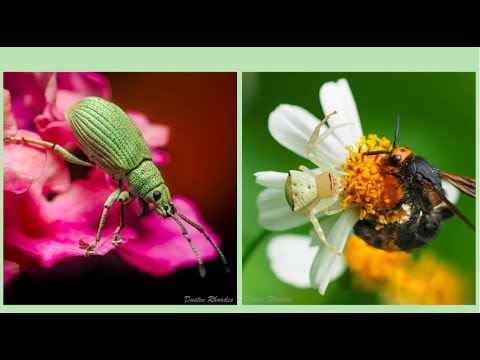
am photographing a weevil looks like
this I also like to go out at night
because arthropods are ectotherms right
so they need the Sun to warm them often
at night there
here I mean if you look at my left arm
you can see a flower crab spider
so I’m not alone no plants also love
bugs you might be surprised to hear that
80% of all plants on the planet
or angiosperms that means they require
from outside pollination in order to
reproduce what does that mean well here
are just some of the foods that we have
everyday
courtesy of arthropods roughly 35
percent of all the foods that we eat
come to us free of charge now if that’s
not enough for you don’t UN Food Program
just released this statistic this is the
economic benefit alone that we’ve just
received from our coupons every single
year around the world free of charge so
when I hear those things when I see
those statistics and I see the food we
get it always surprises me when I walk
into the average hardware store and I
find shelves and shelves filled with
chemicals designed to wipe out
arthropods and it makes me wonder in the
spirit of the TED talk you know maybe
it’s time for us to take a step back a
bit and reboot the way we think about
market pots instead of some of these
terms
and they want to know why you think that
just tell us what they know most people
know some pollinators they know that
bees pollinate our crops that you can
ask that did you know that butterflies
are also great pollinators
maybe beetle species are great
pollinators as are bumblebees maybe we
both species are great pollinators now
here’s one most people run from this is
a wasp it’s actually trying to gather a
bit of nectar from this flower and it’s
risking its life to do it because you
look closely you can see the crab spider
hiding against the white flower
beautiful they do it while you sleep as
well are supposed to come out at night
like these hummingbird moms and they
pollinate flowers and gather nectar
there are many other species to do it as
well this is a tiger mom you can see the
pollen now here’s one more I want to
pause a little bit because this is the
insect that many people grab this water
for this is a fly it’s actually
mimicking with beating but if you look
closely at it at its forelegs and its
underbelly in his face can see those
little grains of pollen these flying 90
flies are pollinators they’re extremely
important and it’s not just there are
many many species that do this bee flies
or pollinators or supplies many of them
are pollinators this is an important one
these are hover flies here if you look
at its body it’s covered in pollen we
actually get a double benefit from other
flies because not only do they pollinate
our crops but they lay their eggs on the
same plants plants are often covered
with something the commerce hate with
your athens and the larvae of the hover
flies actually eat the aphids so they
bring those those consumers down and
then they help with the pollination as
well now here’s something kind of
interesting most part the pods wear more
than one hat and blowflies are no except
so this is a blowfly hearing while it
pollinates it also helps break down
nutrients for the soil returning back to
plant because it purifies our
decomposers some other decomposers you
might know our dung beetles they help
break down ways to return it to the soil
another one some of you’ve made me study
their stag beetles if you look at this
exoskeleton you can see all that that’s
because it’s spent a lot of time hauling
around through the ground those passages
it leaves leads a pathway for water to
flow and nutrients to flow flies again
this is one of my favorite this is a
gold and dump fly we get double benefit
from these guys because they lay their
eggs on dung so the larvae Kingstown the
dung and while that happens they hang
off to the side and pick off the insects
that come to try and stop fly if you
look closely you can see the compound
eyes on the end of the stalk of course
millipedes some of you see these around
Taiwan to get big now I feel like it’s
time to address the elephant in the room
they are in your house they are there
because you have left things out for
them pose this one is out in the forest
you can see he’s breaking down an old
tree you got their elephants and right
we get upset about them they’re in our
house they’re in our house because we’ve
left things up so about now many of you
are probably thinking pollinators
decomposers I know
plant milkweed beetles there and stick
bugs eat plants grasshoppers eat plants
plant hoppers EPLAN shield bugs some of
you prefer diseases stink bugs this
visual shield they implants to here’s
what we need to remember arthropods are
the foundation of the food chain they
are preyed upon by AB Murray from fish
and birds reptiles and they’re even a
part of the food chain that we never get
from including other larger pods as well
like these are called secondary
consumers lady beetles we get a double
benefit from lady beetles as well
because not only did adults eat aphids
their larvae this is enough lady beetle
larvae if you look closely you can see
me painted they’re not the only ones
damselflies are great secondary
consumers balancing out the population
these are relatives of dragonflies one
of my favorites the robber fly show you
this in action play course this is a
robber flying a little mean sand storm
the summer it was it’s eating a fly they
paralyze it was one of my absolute
favorites of course pregnant does a Hera
doula I love how curious they are
they’ll sometimes when I’m out in the
field and photographing things
that’s a male the females get a lot
bigger I think we should all just pause
for a moment and enjoy this one this is
the Taiwan specialty this is a Formosa
viewing it’s a damselfly and then we
have special here they hang out around
rivers and lakes the damselflies are
also related of course to dragonflies we
get a double benefit from dragonflies
because when their larval state most
dragonfly spend the majority of their
life underwater they spend most of their
time attacking the steel larvae here’s
one secondary consumer that we probably
never seen or thought about this is
actually a velvet ant which is not an
ant it’s actually a wingless plus well
the females wingless the males have
wings they prey on the ground dwelling
insects they’re not only just incredibly
beautiful they’re beautifully designed
they have a really thick exoskeleton
because we make tunneling underground
other insects will stain them and they
can’t get through their exoskeleton they
also have a really powerful stinger
themselves so much so that other insects
try to mimic them this is a Johnson’s
jumping spider that’s actually mimicking
the velvet ants you see it’s red and
happening in there it’s actually a
farmer’s favorite this is an assassin
bug related to the same
my favorite one is this one this is
actually a tiger beetle tiger penis runs
so fast that they actually suffer from
motion blindness for a long time we have
suffered from motion blindness but
including some arthropods and looking at
they’re important to us as pollinators
as decomposers they are the foundation
of the food chain that supports all of
us and on top of that they are insanely
beautiful
[Applause]
Please follow and like us: